
Drift vs Intercom Fin: Which AI Chatbot Wins for Business?
Overview
Drift and Intercom Fin are two leading AI-powered chatbot platforms, but they serve different primary functions. Drift focuses on conversational marketing and sales, helping businesses qualify leads and book meetings. Intercom Fin, on the other hand, is an AI customer service bot designed to resolve support tickets autonomously. This comparison examines their features, pricing, strengths, and weaknesses to help you choose based on your needs.
Key Features Comparison
- Lead Qualification: Drift excels with advanced lead scoring and routing, while Intercom Fin offers basic lead capture via its chatbot.
- Support Automation: Intercom Fin shines with autonomous ticket resolution using GPT-4, whereas Drift has limited support capabilities.
- Integration Ecosystem: Both integrate widely (Salesforce, HubSpot, Slack), but Intercom has a richer app marketplace.
- Customization: Drift provides more advanced bot workflows for marketing; Intercom Fin focuses on response templates and knowledge base linking.
- Analytics: Drift offers detailed conversation analytics and revenue attribution; Intercom Fin provides support metrics like resolution rate.
Pros & Cons
Drift
- Pros: Strong B2B focus with advanced lead qualification and routing; robust integration with CRM and marketing automation; excellent for capturing and converting high-intent leads.
- Cons: Pricing can be steep for small businesses; setup and customization may require technical expertise; some users report a learning curve for complex workflows.
Intercom Fin
- Pros: AI-powered resolution with natural language understanding; seamless integration with Intercom’s suite; good for customer support automation and deflection; user-friendly interface.
- Cons: Limited to Intercom ecosystem; may not be ideal for complex sales processes; pricing can be high for full feature set; occasional inaccuracies in AI responses.
Drift
- Pros: Strong B2B lead qualification with native Salesforce integration; robust playbooks for routing and meeting scheduling; excellent for account-based marketing.
- Cons: Pricing is on the higher end; setup can be complex for non-technical users; chatbot responses can feel scripted without heavy customization.
Intercom Fin
- Pros: AI-powered resolution across email, chat, and help center; easy to set up with pre-built content from help articles; strong customer support and analytics.
- Cons: Can be expensive for high volumes; AI may require fine-tuning to avoid generic answers; limited advanced lead routing compared to Drift.
Drift
- Pros: Strong sales-focused playbooks and routing; integrates deeply with CRM and sales tools; excellent for B2B lead qualification.
- Cons: Pricing is higher for full features; setup and customization can be complex; less intuitive for non-technical users.
Intercom Fin
- Pros: AI-powered resolution with seamless handoff to human agents; excellent for customer support and self-service; user-friendly interface and quick setup.
- Cons: Limited sales-specific features; can get expensive at scale; AI responses may require fine-tuning for complex queries.
Drift
Pros: Excellent for B2B lead generation, strong CRM integrations, robust meeting scheduling.
Cons: Expensive, less effective for complex support, limited AI autonomy.
Intercom Fin
Pros: High-resolution rate for support, good knowledge base integration, easy setup.
Cons: Weaker for sales/marketing, can be costly at scale, less customizable for non-support use cases.
Pricing Comparison
Drift: Starts at $2,500/month for Premium with basic bots, goes up to custom enterprise plans. No free tier.
Intercom Fin: Starts at $39/month for a single seat, but Fin requires an Inbox seat ($74/month) plus resolution fees ($0.99/resolution). Free trial available.
For small businesses, Intercom Fin is more affordable initially, but Drift may offer better ROI for sales-heavy teams.
Best Use Cases
- Drift: B2B companies needing lead qualification, meeting bookings, and pipeline acceleration.
- Intercom Fin: Customer support teams handling high volumes of repetitive tickets, especially in SaaS or e-commerce.
Verdict
Choose Drift if your primary goal is sales and marketing automation. Choose Intercom Fin if you need AI-powered customer support. For companies requiring both, consider using both platforms separately, though costs may add up.
Visual Comparison
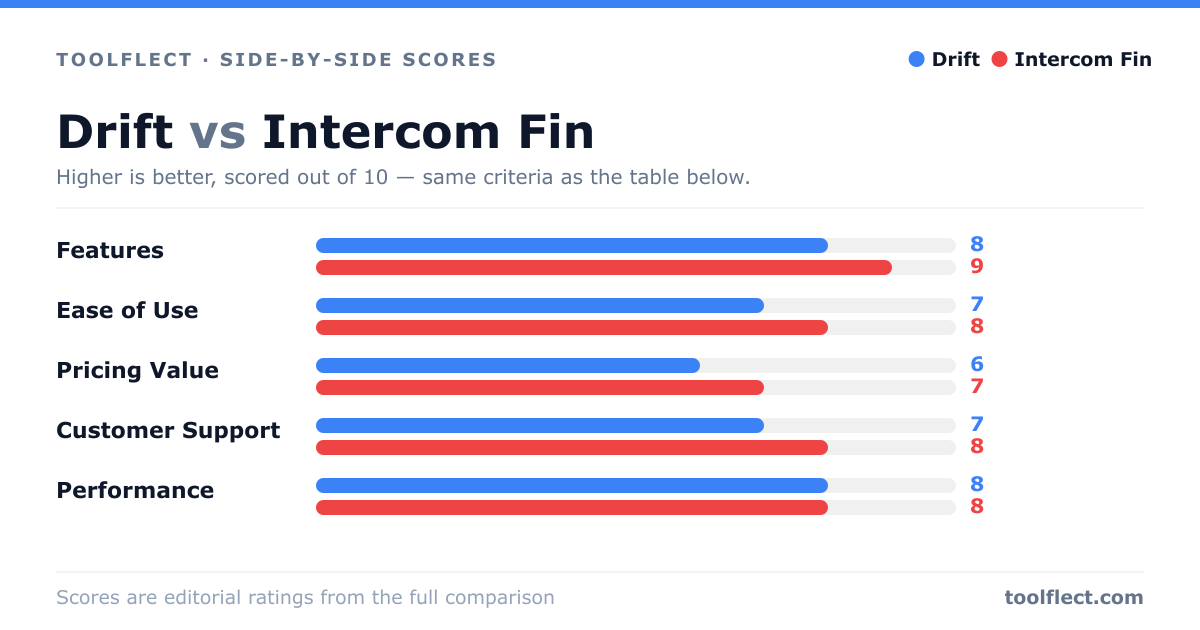
| Criterion | Drift | Intercom Fin |
|---|---|---|
| Features | 8/10 – Lead gen, routing, chat, email, and integrations | 9/10 – AI chatbot, help desk, and proactive support |
| Ease of Use | 7/10 – Powerful but requires setup and training | 8/10 – Intuitive interface, quick to deploy |
| Pricing Value | 6/10 – Premium pricing, may be costly for SMBs | 7/10 – Good value for support teams, but can add up |
| Customer Support | 7/10 – Responsive but varies by plan | 8/10 – Strong support with extensive resources |
| Performance | 8/10 – Reliable, fast, and scalable | 8/10 – Accurate AI, minimal downtime |