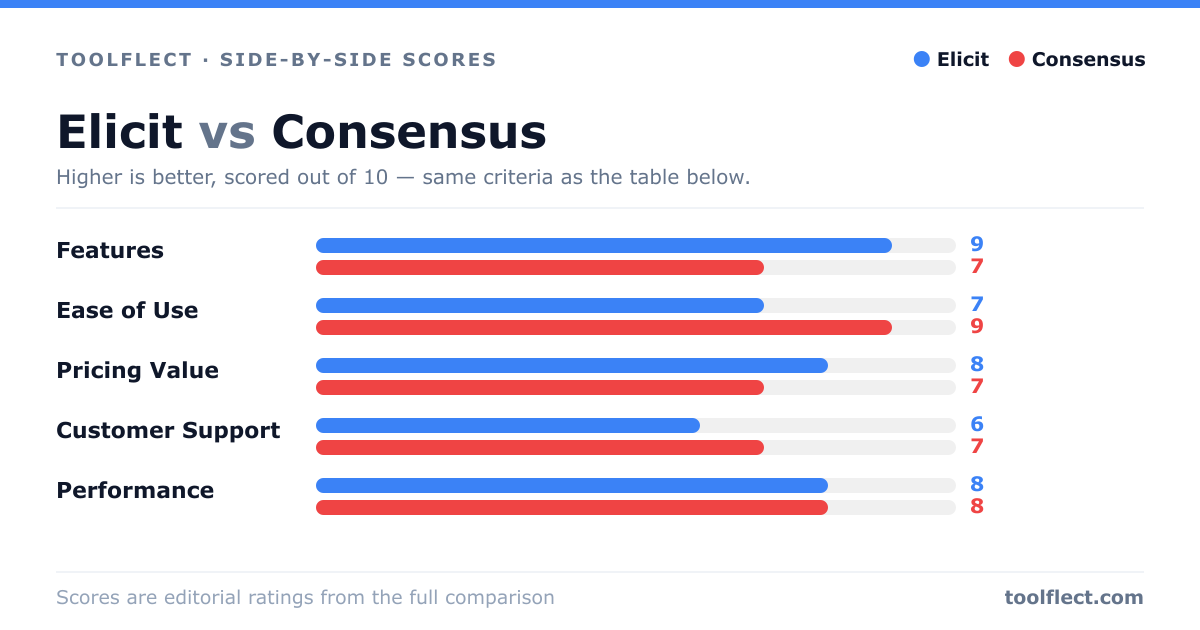
Elicit vs Consensus: Which AI Research Tool Wins?
Overview
Elicit and Consensus are AI-powered tools designed to accelerate academic research. Elicit, developed by Ought, focuses on automating literature reviews, extracting data from papers, and answering research questions. Consensus, on the other hand, is a search engine that synthesizes findings from millions of scientific papers to provide evidence-based answers. Both aim to save researchers time, but they approach the task differently.
Key Features Comparison
Elicit:
- Automated literature review with ranked paper lists
- Data extraction into tables (e.g., study details, outcomes)
- Question answering based on selected papers
- Integration with Zotero and other reference managers
- Batch processing of papers for systematic reviews
Consensus:
- AI-powered search across 200M+ research papers
- Consensus Meter showing agreement among studies
- Snapshot summaries of key findings
- Citation extraction and export
- Browser extension for quick access
Pros & Cons
Elicit Pros:
- Excellent for extracting structured data
- Reduces time for systematic reviews
- Good at ranking relevant papers
Elicit Cons:
- Limited free tier (50 credits/month)
- Steeper learning curve for complex tasks
- Occasional inaccuracies in data extraction
Consensus Pros:
- Intuitive interface with quick answers
- Consensus Meter provides at-a-glance insights
- Large database of papers
Consensus Cons:
- Less depth than Elicit for detailed analysis
- Cannot extract data into custom tables
- Answers may oversimplify nuanced topics
Pricing Comparison
Elicit offers a free plan with 50 credits per month (1 credit per 5 papers processed). Paid plans start at $10/month for 1,000 credits, up to $50/month for 5,000 credits. Custom enterprise pricing is available.
Consensus has a free tier with 20 AI searches per month. Paid plans start at $9.99/month for 100 searches, $19.99/month for 300 searches, and $49.99/month for unlimited searches. Both offer annual discounts.
Best Use Cases
Elicit is ideal for:
- Conducting systematic reviews or meta-analyses
- Extracting specific data points from many papers
- Researchers who need detailed, customizable workflows
Consensus is best for:
- Quick fact-checking or gaining overview of a topic
- Students or professionals seeking rapid answers from literature
- Users who prefer a simple, search-engine-like interface
Verdict
Both tools are excellent but serve different purposes. Choose Elicit if your work involves deep dives into literature with structured data extraction. Choose Consensus for fast, high-level insights across many studies. For most researchers, using both in tandem may be the most effective approach: Consensus for initial exploration, Elicit for detailed analysis.
Visual Comparison