
Iris.ai vs SciSpace: Which AI Tool Wins for Research & Learning?
Overview
Iris.ai and SciSpace are both AI-powered platforms designed to streamline the research process, but they approach it from different angles. Iris.ai specializes in scientific literature discovery using AI to map concepts and find relevant papers, while SciSpace (formerly Typeset) offers a comprehensive environment for reading, writing, and collaborating on research papers. This comparison examines their strengths and weaknesses to help you choose the right tool for your workflow.
Key Features Comparison
- Iris.ai: Concept-based search, automatic literature mapping, AI-powered summarization, citation analysis, and research workspace.
- SciSpace: AI reading assistant (explain, summarize, compare), paper search, smart citation tool, collaborative writing, and LaTeX integration.
Pros & Cons
Iris.ai
- Pros: AI-powered literature review and summarization; intuitive interface for researchers; supports multiple languages; offers a free plan with limited features.
- Cons: Limited integration with reference managers; can be slow with large documents; pricing may be high for individual researchers; lacks collaborative features.
SciSpace
- Pros: Comprehensive research platform with AI-powered explanations; includes citation and reference management; offers a free plan with generous limits; good for collaborative research.
- Cons: Steeper learning curve for new users; some advanced features require a paid plan; occasional inaccuracies in AI-generated summaries; limited customization options.
Iris.ai
- Pros: AI-powered literature discovery and summarization; intuitive visual maps of research topics; time-saving for systematic reviews.
- Cons: Limited database coverage compared to major publishers; no full-text search for some documents; pricing can be high for individual researchers.
SciSpace
- Pros: Extensive database of over 200 million papers; AI-powered explanations and Q&A for papers; collaborative features for teams.
- Cons: User interface can be overwhelming for new users; some advanced features require a paid plan; occasional inaccuracies in AI-generated summaries.
Iris.ai
- Pros:
- Advanced AI-powered literature review and summarization
- Semantic search across millions of research papers
- Time-saving automation for research workflows
- User-friendly interface for non-technical users
- Cons:
- Limited database compared to SciSpace
- No direct PDF annotation or collaboration features
- Pricing can be high for individual researchers
- Steeper learning curve for advanced features
SciSpace
- Pros:
- Large database of over 270 million papers
- Integrated AI explanations and chat with PDFs
- Collaborative features for teams
- Affordable pricing with free tier
- Cons:
- AI explanations can be inaccurate at times
- Interface can be overwhelming for new users
- Limited customization of search filters
- Export options are limited in free version
Iris.ai
- Pros: Excellent for discovering novel papers via concept mapping; strong visualization of research landscape; free tier available.
- Cons: Steeper learning curve; limited writing collaboration features; smaller database compared to broader tools.
SciSpace
- Pros: Intuitive reading interface with AI explanations; robust collaborative writing; seamless LaTeX support; extensive paper database.
- Cons: Some advanced features require subscription; occasional accuracy issues in AI summaries; less focused on literature mapping.
Pricing Comparison
Iris.ai offers a free tier with limited features, while premium plans start at around $15/month for individuals. SciSpace also has a free plan with basic AI features; its Pro plan costs $10/month, and the Lab plan (for teams) is $20/month. Both provide discounts for annual billing.
Best Use Cases
- Iris.ai: Ideal for researchers exploring new fields, conducting systematic literature reviews, or needing visual concept maps to understand research trends.
- SciSpace: Best for students and academics who need an all-in-one tool for reading, annotating, citing, and writing papers collaboratively.
Verdict
Choose Iris.ai if your primary need is discovering and mapping scientific literature in a visual way. Choose SciSpace if you want a comprehensive platform for reading, understanding, and writing research papers. Both are powerful, but your choice depends on whether you prioritize exploration or production.
Visual Comparison
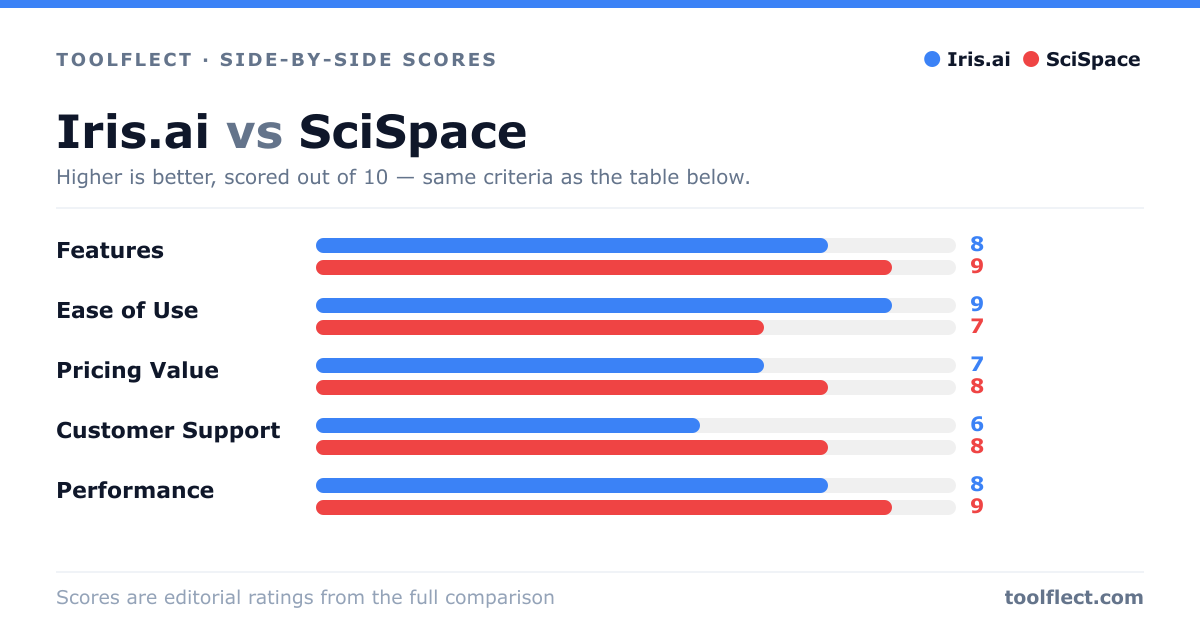
| Criterion | Iris.ai | SciSpace |
|---|---|---|
| Features | 8/10 – AI literature review, summarization, and search | 9/10 – AI explanations, citation management, and collaborative tools |
| Ease of Use | 9/10 – Simple and intuitive interface | 7/10 – More complex due to extensive features |
| Pricing Value | 7/10 – Free plan available, but paid plans can be pricey | 8/10 – Free plan with generous limits, affordable paid options |
| Customer Support | 6/10 – Limited support channels, slow response times | 8/10 – Responsive support via email and chat |
| Performance | 8/10 – Fast processing for most tasks, occasional delays with large files | 9/10 – Reliable and fast, even with large datasets |