
CrewAI vs Relevance AI: Which AI Agent Platform Wins?
Overview
CrewAI and Relevance AI are both powerful platforms for building and orchestrating AI agents, but they cater to slightly different audiences and use cases. CrewAI focuses on agent orchestration for complex, multi-step workflows, while Relevance AI provides a no-code environment for creating AI teams and automations. This comparison examines their key features, strengths, weaknesses, pricing, and ideal scenarios to help you choose the right tool.
Key Features Comparison
- Agent Collaboration: CrewAI excels at orchestrating multiple agents with role-based collaboration, allowing them to work on tasks sequentially or in parallel. Relevance AI offers similar multi-agent workflows but emphasizes simplicity and pre-built templates.
- Ease of Use: Relevance AI is designed for non-technical users with a drag-and-drop interface, while CrewAI requires some coding for setup and customization, offering more flexibility for developers.
- Customization: CrewAI provides deep control over agent behavior, tools, and memory, making it suitable for complex needs. Relevance AI offers customization through a visual builder but is more limited in advanced configurations.
- Integrations: Both platforms integrate with popular LLMs (GPT-4, Claude, etc.) and external tools, but CrewAI has a broader set of community integrations and supports custom tool creation.
- Scalability: CrewAI can handle large-scale agent systems with efficient task delegation, while Relevance AI is better suited for smaller to medium-scale automations.
Pros & Cons
CrewAI
- Pros:
- Open-source and free to use, with a strong community and extensive documentation.
- Flexible role-based agent design allows for complex, customizable workflows.
- Seamless integration with LangChain and other popular AI tools.
- Lightweight and easy to deploy in existing Python projects.
- Cons:
- Requires coding knowledge; no visual builder or low-code options.
- Limited built-in integrations compared to commercial platforms.
- No managed hosting or support; you handle infrastructure and maintenance.
- Steeper learning curve for non-developers.
Relevance AI
- Pros:
- No-code platform with a drag-and-drop interface, accessible to non-technical users.
- Pre-built templates and a library of tools for rapid deployment.
- Managed infrastructure with built-in scalability and reliability.
- Strong customer support and onboarding resources.
- Cons:
- Pricing can become expensive as usage scales.
- Limited customization for complex, unique workflows.
- Vendor lock-in; less flexibility to modify underlying code.
- Some advanced features are only available on higher-tier plans.
CrewAI
- Pros:
- Open-source and free to use, with a strong community and active development.
- Flexible role-based agent design allows for complex, customizable workflows.
- Integrates well with popular LLMs and tools, and supports both Python and JavaScript.
- Lightweight and can be self-hosted, giving full control over data and deployment.
- Cons:
- Requires technical expertise to set up and manage; not for non-coders.
- Limited built-in integrations compared to commercial platforms.
- No official GUI or low-code interface; everything is code-based.
- Support is community-driven, which may be slower for enterprise needs.
Relevance AI
- Pros:
- User-friendly no-code platform with a visual builder for creating AI agents.
- Extensive library of pre-built templates and integrations (e.g., Slack, Zapier).
- Scalable cloud infrastructure with built-in monitoring and analytics.
- Excellent customer support and onboarding resources.
- Cons:
- Proprietary platform with subscription costs; can become expensive at scale.
- Less flexibility for custom coding compared to open-source alternatives.
- Data is hosted on their cloud, which may raise privacy concerns for some enterprises.
- Limited advanced customization for complex, niche workflows.
CrewAI
- Pros: Open-source and free to use, allowing full customization and integration with existing codebases.
- Pros: Lightweight and flexible, enabling developers to define agents and tasks programmatically.
- Pros: Strong community support and active development, with frequent updates and improvements.
- Cons: Requires programming knowledge to set up and use effectively, making it less accessible to non-technical users.
- Cons: Lacks built-in UI for monitoring or managing agents, requiring third-party tools or custom solutions.
Relevance AI
- Pros: No-code platform with a user-friendly drag-and-drop interface, ideal for non-technical users.
- Pros: Includes a library of pre-built tools and templates for common use cases, speeding up deployment.
- Pros: Offers built-in monitoring and analytics dashboards for tracking agent performance.
- Cons: Pricing can be expensive for larger teams or high-volume usage, with limited free tier.
- Cons: Less customizable than open-source alternatives, with constraints on advanced modifications.
CrewAI
- Pros: Highly flexible, strong agent coordination, supports complex workflows, open-source core, active community.
- Cons: Steeper learning curve, requires coding skills, less intuitive UI, documentation can be sparse for advanced use cases.
Relevance AI
- Pros: User-friendly no-code interface, quick setup, pre-built templates, good for rapid prototyping, excellent customer support.
- Cons: Limited customization, fewer advanced features, higher cost for large-scale operations, less control over agent internals.
Pricing Comparison
CrewAI offers a free open-source version (self-hosted) with optional cloud hosting starting at $19/month for the CrewAI Cloud (Starter). Paid plans include advanced features and support. Relevance AI has a free tier with limited usage, then paid plans from $19/month (Starter) to $299/month (Business) and custom Enterprise pricing. For heavy usage, Relevance AI can become more expensive.
Best Use Cases
- CrewAI: Ideal for developers building complex, multi-agent systems for research, code generation, data analysis, or any scenario requiring fine-grained control and scalability.
- Relevance AI: Best for non-technical users, marketers, and small teams needing to quickly automate repetitive tasks like content generation, social media management, or simple data processing.
Verdict
Choose CrewAI if you need maximum flexibility and are comfortable with coding; choose Relevance AI if you prioritize ease of use and rapid deployment without technical overhead. Both are excellent but serve different primary audiences.
Visual Comparison
| Criterion | CrewAI | Relevance AI |
|---|---|---|
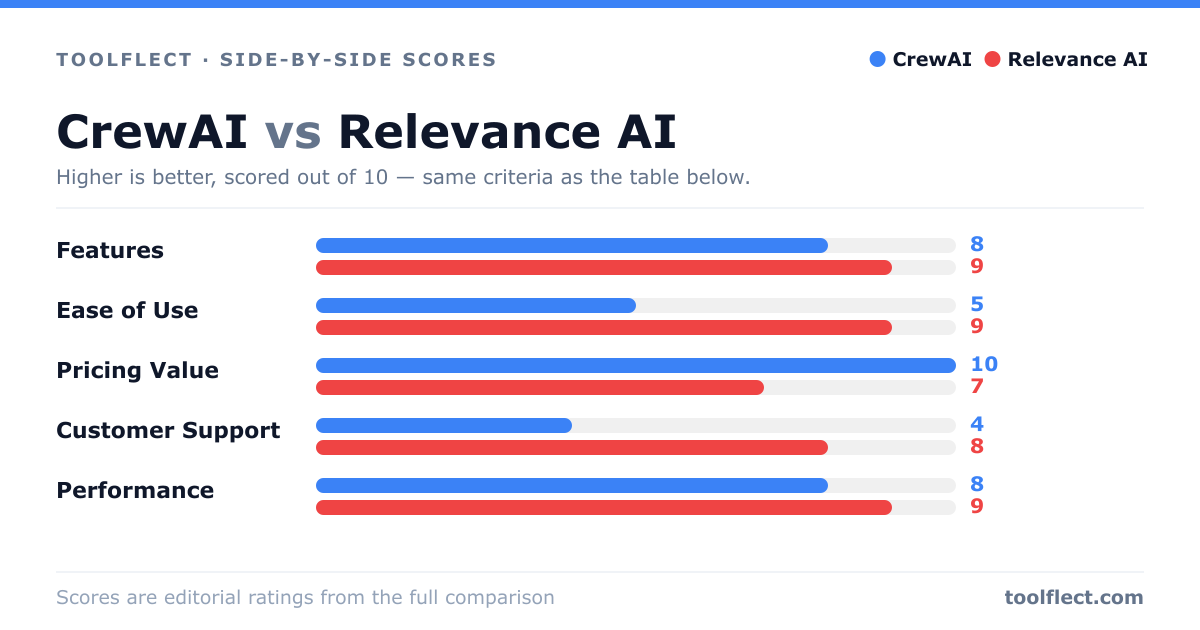
| Features | 8/10 – Extensive role-based agent design, but requires coding. | 9/10 – Rich no-code toolset with pre-built integrations. |
| Ease of Use | 5/10 – Developer-focused, steep learning curve. | 9/10 – Intuitive visual builder, minimal technical skill needed. |
| Pricing Value | 10/10 – Free and open-source, but you pay with time and effort. | 7/10 – Subscription costs can add up, but includes support and hosting. |
| Customer Support | 4/10 – Community support only, no official SLA. | 8/10 – Responsive support with dedicated resources. |
| Performance | 8/10 – Lightweight and fast, but depends on your infrastructure. | 9/10 – Optimized and scalable, with reliable uptime. |