
CrewAI vs Skillscript: Which AI Agent Framework is Right for You?
Overview
CrewAI and Skillscript are both platforms for building AI agents, but they cater to different needs. CrewAI is an open-source framework designed for orchestrating multiple AI agents in a collaborative workflow, emphasizing role-based delegation and task management. Skillscript, on the other hand, is a commercial platform that focuses on enabling developers to quickly create single or multi-agent systems using reusable ‘skills’ (API integrations) and a visual builder. While CrewAI appeals to developers who want fine-grained control and Python flexibility, Skillscript targets users seeking rapid prototyping and ease of use.
Key Features Comparison
- Agent Architecture: CrewAI uses role-based agents with specific goals and tasks; Skillscript uses skill-based agents that can be composed from pre-built modules.
- Orchestration: CrewAI excels at sequential and hierarchical task delegation among agents; Skillscript supports parallel and sequential execution via a flow-based editor.
- Customization: CrewAI offers deep customization through Python code; Skillscript provides a visual interface and configuration files.
- Integration: CrewAI integrates with any Python library; Skillscript has a marketplace of skills (APIs, tools) and supports custom skills.
- Learning Curve: CrewAI requires Python knowledge; Skillscript is more accessible to non-coders.
Pros & Cons
CrewAI
- Pros:
- Role-based agent design with clear delegation and collaboration
- Flexible task orchestration with sequential and hierarchical processes
- Active community and frequent updates
- Integrates well with LangChain and other LLM tools
- Cons:
- Steeper learning curve for complex workflows
- Limited built-in observability and debugging tools
- Documentation can be sparse for advanced use cases
Skillscript
- Pros:
- Lightweight and easy to learn with a simple YAML-based syntax
- Designed for rapid prototyping and automation of repetitive tasks
- Built-in support for versioning and reusability of skills
- Good for small to medium-sized projects
- Cons:
- Less flexible for complex multi-agent interactions
- Smaller community and fewer third-party integrations
- Limited support for advanced AI features like memory and reasoning
CrewAI
- Pros:
- Role-based agent design with autonomous inter-agent delegation.
- Built-in memory and tool integration for complex workflows.
- Active community and frequent updates.
- Cons:
- Steeper learning curve for non-developers.
- Requires Python knowledge for customization.
- Limited visual debugging tools.
Skillscript
- Pros:
- Declarative YAML-based configuration simplifies agent definition.
- Lightweight and fast execution.
- Good for simple task automation.
- Cons:
- Less flexible for complex multi-agent interactions.
- Smaller community and fewer integrations.
- Documentation is sparse.
CrewAI
- Pros:
- Role-based agent design with autonomous collaboration
- Flexible task delegation and process flows
- Active community and frequent updates
- Integrates with LangChain and other tools
- Cons:
- Steeper learning curve for complex workflows
- Requires careful prompt engineering for reliability
- Limited built-in observability and debugging
- Documentation can be sparse for advanced features
Skillscript
- Pros:
- Simple, declarative syntax for defining skills
- Lightweight and easy to integrate
- Focus on reusability and composability
- Good for rapid prototyping
- Cons:
- Less mature ecosystem and community
- Limited advanced orchestration features
- Fewer integrations out-of-the-box
- May require custom code for complex scenarios
CrewAI
- Pros: Open-source, highly flexible, strong community, supports complex workflows.
- Cons: Steeper learning curve, requires coding, less built-in templates.
Skillscript
- Pros: Easy to use, visual builder, pre-built skills, fast prototyping.
- Cons: Proprietary, limited customization, pricing may scale with usage.
Pricing Comparison
CrewAI is free and open-source (MIT license), but you may incur costs for hosting and LLM API calls. Skillscript offers a free tier with limited agents and skills, with paid plans starting at $49/month for more agents, skills, and priority support. Enterprise pricing is available on request.
Best Use Cases
- CrewAI: Complex multi-agent research tasks, automated content pipelines, simulation of team dynamics, and projects where full control over agent behavior is required.
- Skillscript: Rapidly building customer support bots, personal assistants, simple workflow automations, and prototypes where time-to-market is critical.
Verdict
Choose CrewAI if you need a powerful, open-source multi-agent system and have Python expertise. Choose Skillscript if you want a user-friendly platform for quickly building agents without deep coding. Both are excellent tools, but serve different audiences.
Visual Comparison
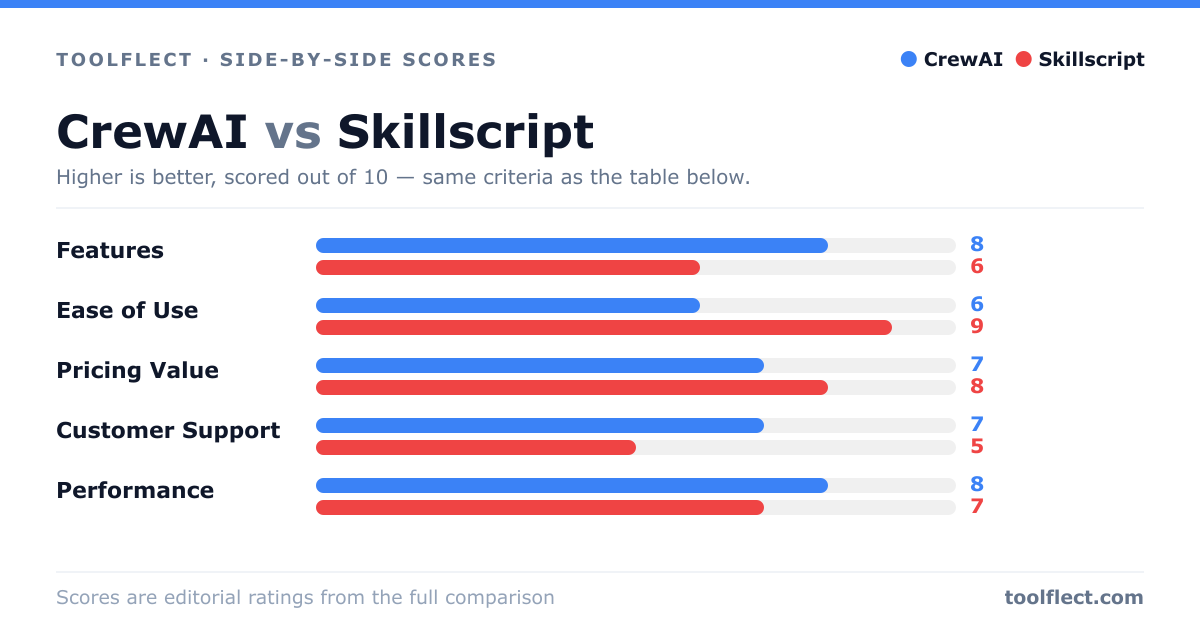
| Criterion | CrewAI | Skillscript |
|---|---|---|
| Features | 8/10 – Role-based agents, task delegation, process flows | 6/10 – Simple skill definitions, basic automation |
| Ease of Use | 6/10 – Moderate learning curve, requires understanding of agent concepts | 9/10 – Very easy to start with YAML syntax |
| Pricing Value | 7/10 – Open-source with optional cloud services | 8/10 – Free and open-source, low overhead |
| Customer Support | 7/10 – Active GitHub issues and Discord community | 5/10 – Smaller community, slower response times |
| Performance | 8/10 – Efficient for complex workflows, but can be resource-intensive | 7/10 – Lightweight and fast for simple tasks |