Pinecone vs Weaviate: Which Vector Database Wins?
Overview
Pinecone and Weaviate are both leading vector databases designed to handle similarity search and power AI applications. Pinecone is a fully managed, serverless vector database known for its simplicity and high performance. Weaviate is an open-source vector database that offers flexibility and self-hosting options, with a strong focus on hybrid search and modularity. This comparison will help you understand their differences and choose the right one for your needs.
Key Features Comparison
- Managed vs Open Source: Pinecone is fully managed, requiring no infrastructure setup. Weaviate is open-source and can be self-hosted or used via a cloud service.
- Vector Search: Both support high-dimensional vector similarity search with various distance metrics (cosine, dot product, Euclidean).
- Hybrid Search: Weaviate offers built-in hybrid search combining vector and keyword search. Pinecone focuses primarily on pure vector search, though it supports metadata filtering.
- Scalability: Pinecone scales automatically with usage, while Weaviate requires manual scaling or using their cloud offering.
- Integrations: Both integrate with popular ML frameworks and data processing tools, but Pinecone has a more streamlined API for production use.
- Extensibility: Weaviate allows custom modules and has a GraphQL API, while Pinecone uses a RESTful API.
Pros & Cons
Pinecone
- Pros:
- Fully managed serverless vector database with automatic scaling
- High performance and low latency for production workloads
- Simple API and SDKs for easy integration
- Built-in metadata filtering and hybrid search capabilities
- Cons:
- Proprietary and closed-source, leading to vendor lock-in
- Pricing can become expensive at scale
- Limited customization compared to open-source alternatives
Weaviate
- Pros:
- Open-source with a strong community and self-hosting options
- Flexible deployment: cloud, on-premises, or hybrid
- Supports multiple modules (e.g., vectorization, Q&A, generative search)
- GraphQL and RESTful APIs for easy access
- Cons:
- Requires more setup and maintenance if self-hosted
- Performance may vary depending on configuration
- Smaller ecosystem compared to Pinecone
Pinecone
- Pros:
- Fully managed, serverless vector database with automatic scaling and minimal operational overhead.
- High performance with low latency queries, even at billion-scale.
- Simple API and SDKs for Python, Node.js, and other languages, making integration easy.
- Built-in metadata filtering and namespaces for multi-tenancy.
- Cons:
- Pricing can be expensive for large-scale or high-throughput use cases.
- Limited customization and control over the underlying infrastructure.
- Vendor lock-in due to proprietary technology and lack of self-hosting options.
- Fewer advanced features like hybrid search or custom vector index types compared to open-source alternatives.
Weaviate
- Pros:
- Open-source with a flexible architecture, allowing self-hosting or cloud deployment.
- Supports hybrid search (combining vector and keyword) and multiple vector index types (HNSW, etc.).
- Built-in modules for vectorization, including OpenAI, Cohere, and Hugging Face integrations.
- Strong GraphQL API and RESTful endpoints for easy querying.
- Cons:
- Requires more setup and maintenance if self-hosted, which can be complex.
- Performance may not match Pinecone at extreme scale without tuning.
- Documentation and community support are less extensive compared to more mature solutions.
- Some advanced features (e.g., replication, backup) are only available in the enterprise edition.
Pinecone
- Pros:
- Fully managed, serverless vector database with automatic scaling and minimal operational overhead.
- Excellent performance with high recall and low latency, even at billion-scale.
- Simple API and SDKs for Python, Node.js, and other languages, making integration easy.
- Strong ecosystem integrations with LangChain, LlamaIndex, and major cloud providers.
- Cons:
- Proprietary and closed-source, leading to vendor lock-in.
- Pricing can become expensive at scale, especially for high write/read volumes.
- Limited customization and control over underlying infrastructure.
- No self-hosted option, requiring data to be sent to Pinecone’s cloud.
Weaviate
- Pros:
- Open-source with a flexible deployment model: self-hosted, on-premises, or cloud.
- Built-in modules for vectorization, hybrid search (BM25 + vector), and generative search.
- Supports multiple vector index types (HNSW, IVF) and allows fine-tuning for performance.
- Strong GraphQL and REST APIs, plus client libraries for major languages.
- Cons:
- Requires more setup and maintenance if self-hosting, including managing infrastructure.
- Performance tuning can be complex, requiring understanding of index parameters.
- Documentation and community support are growing but not as extensive as some competitors.
- Cloud offering is less mature compared to Pinecone’s fully managed service.
Pinecone Pros
- Fully managed, zero maintenance
- Excellent performance and low latency
- Simple and intuitive API
- Automatic scaling
Pinecone Cons
- Proprietary and closed-source
- Limited customization
- Cost can be high at scale
Weaviate Pros
- Open-source and self-hostable
- Hybrid search capabilities
- Flexible and extensible
- No vendor lock-in
Weaviate Cons
- Requires more setup and maintenance
- Performance may vary based on configuration
- Steeper learning curve
Pricing Comparison
Pinecone offers a free tier with limited capacity, then usage-based pricing starting at $0.10 per million vectors per month. Weaviate is free for self-hosted, but if you use their cloud service, pricing starts at $25 per month for a basic cluster. For large-scale production, Pinecone’s managed service can be more expensive, but it saves on operational costs.
Best Use Cases
- Pinecone: Ideal for startups and enterprises that want a fast, reliable, and fully managed vector database without worrying about infrastructure. Great for production AI applications like recommendation systems, semantic search, and anomaly detection.
- Weaviate: Best for teams that prefer open-source solutions, need hybrid search, or want to customize their vector database. Suitable for research projects, on-premises deployments, and applications requiring data privacy.
Verdict
Both Pinecone and Weaviate are excellent vector databases, but they cater to different needs. Choose Pinecone if you prioritize ease of use, performance, and managed services. Choose Weaviate if you value open-source flexibility, hybrid search, and control over your infrastructure. Assess your team’s technical expertise and long-term requirements to make the best decision.
Visual Comparison
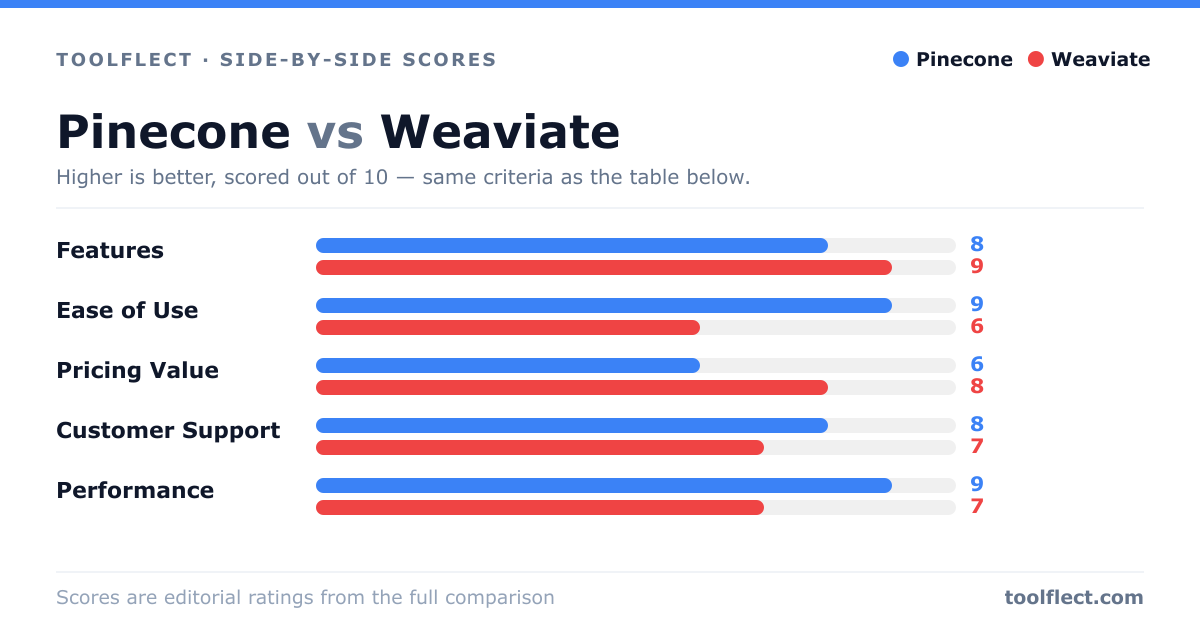
| Criterion | Pinecone | Weaviate |
|---|---|---|
| Features | 8/10 – Rich feature set including hybrid search, metadata filtering, and serverless scaling | 9/10 – Extensive modules and integrations, but some advanced features require configuration |
| Ease of Use | 9/10 – Very easy to get started with a fully managed service and clear documentation | 7/10 – More complex to set up and manage, especially for self-hosted deployments |
| Pricing Value | 7/10 – Competitive pricing for small scale, but can get expensive at high usage | 8/10 – Free tier and open-source options provide good value, but cloud costs can add up |
| Customer Support | 9/10 – Excellent support with dedicated team and extensive resources | 7/10 – Community support is active, but enterprise support may require paid plan |
| Performance | 9/10 – High performance with low latency, optimized for production | 8/10 – Good performance, but may require tuning for optimal results |