OpenAI Ultrafast vs DeepSeek: Which Wins?
Overview
OpenAI Ultrafast and DeepSeek are two prominent LLM APIs in the market, each offering unique capabilities. OpenAI Ultrafast is known for its speed and integration with the broader OpenAI ecosystem, while DeepSeek focuses on cost-effectiveness and open-source accessibility. This comparison provides an unbiased look at their features, pricing, and performance to help you decide which aligns best with your requirements.
Key Features Comparison
OpenAI Ultrafast
- Ultra-low latency responses, ideal for real-time applications.
- Seamless integration with OpenAI’s suite of tools and APIs.
- Advanced reasoning and language understanding.
- Supports multiple modalities including text and image inputs.
- Robust developer documentation and SDKs.
DeepSeek
- Open-source models with customizable weights.
- Highly cost-effective pricing, especially for high-volume usage.
- Strong performance in coding and mathematical tasks.
- Supports long context windows (up to 128k tokens).
- Active community and frequent model updates.
Pros & Cons
OpenAI Ultrafast
- Pros: Blazing fast response times, ideal for real-time applications; high accuracy on complex tasks; robust API and ecosystem; strong support for multiple modalities.
- Cons: Higher cost per token; less transparent about model details; rate limits on lower tiers; occasional downtime during peak usage.
DeepSeek
- Pros: Cost-effective pricing, especially for high-volume use; open-source model weights; strong performance on coding and math; good multilingual support.
- Cons: Slower inference compared to Ultrafast; less polished developer tools; smaller community and fewer integrations; limited documentation.
OpenAI Ultrafast
- Pros:
- Extremely fast response times, ideal for real-time applications.
- High accuracy on complex tasks due to advanced model architecture.
- Strong ecosystem and API integration options.
- Regular updates and improvements from OpenAI.
- Cons:
- Higher cost per API call compared to some alternatives.
- Limited customization for specific use cases.
- Dependent on OpenAI’s cloud infrastructure.
- May have usage limits under heavy load.
DeepSeek
- Pros:
- Cost-effective pricing, especially for high-volume usage.
- Open-source model allows for self-hosting and customization.
- Good performance on Chinese language tasks.
- Transparent development and community support.
- Cons:
- Response times can be slower under peak load.
- Less mature ecosystem and fewer integrations.
- May require technical expertise for self-hosting.
- Smaller community compared to OpenAI.
OpenAI Ultrafast
- Pros:
- Ultra-low latency responses, ideal for real-time applications.
- High accuracy and reasoning capabilities across diverse tasks.
- Robust API with extensive documentation and developer support.
- Strong ecosystem integration with OpenAI services.
- Cons:
- Pricing can be higher for high-volume usage.
- Limited customization options for specialized use cases.
- Dependent on OpenAI’s infrastructure and policies.
DeepSeek
- Pros:
- Cost-effective pricing, especially for large-scale deployments.
- Open-source model allows for fine-tuning and self-hosting.
- Good performance on coding and mathematical tasks.
- Transparent development and community-driven improvements.
- Cons:
- Higher latency compared to Ultrafast in some scenarios.
- Smaller ecosystem and fewer third-party integrations.
- May require more technical expertise to deploy and optimize.
OpenAI Ultrafast
Pros: Exceptional speed, reliable infrastructure, extensive ecosystem, excellent support.
Cons: Higher cost, closed-source, limited customization.
DeepSeek
Pros: Affordable, open-source, good performance on technical tasks, flexible deployment options.
Cons: Slightly higher latency, less polished documentation, smaller ecosystem.
Pricing Comparison
OpenAI Ultrafast follows a per-token pricing model, typically higher than DeepSeek. For example, OpenAI Ultrafast might charge $0.015 per 1k input tokens and $0.03 per 1k output tokens, while DeepSeek charges significantly less, often around $0.001 per 1k input and $0.002 per 1k output. For high-volume applications, DeepSeek offers substantial savings.
Best Use Cases
OpenAI Ultrafast: Real-time chatbots, customer support automation, applications requiring low latency and high reliability.
DeepSeek: Budget-conscious projects, coding assistants, data analysis, and scenarios where open-source customization is beneficial.
Verdict
Choose OpenAI Ultrafast if you prioritize speed and ecosystem integration and have the budget. Choose DeepSeek if cost efficiency and open-source flexibility are your primary concerns. Both are excellent, but your specific needs will determine the best fit.
FAQ
Which API is faster?
OpenAI Ultrafast is designed for ultra-low latency, making it faster than DeepSeek in most scenarios. However, actual speed can vary based on network and load.
Can I use DeepSeek for commercial projects?
Yes, DeepSeek’s open-source models are available for commercial use under permissive licenses, but you should review the specific license terms.
Does OpenAI Ultrafast support fine-tuning?
Yes, OpenAI Ultrafast supports fine-tuning on custom datasets, allowing you to adapt the model to your specific domain.
Which is more cost-effective for large-scale deployments?
DeepSeek is significantly more cost-effective for large-scale deployments due to its lower per-token pricing.
Visual Comparison
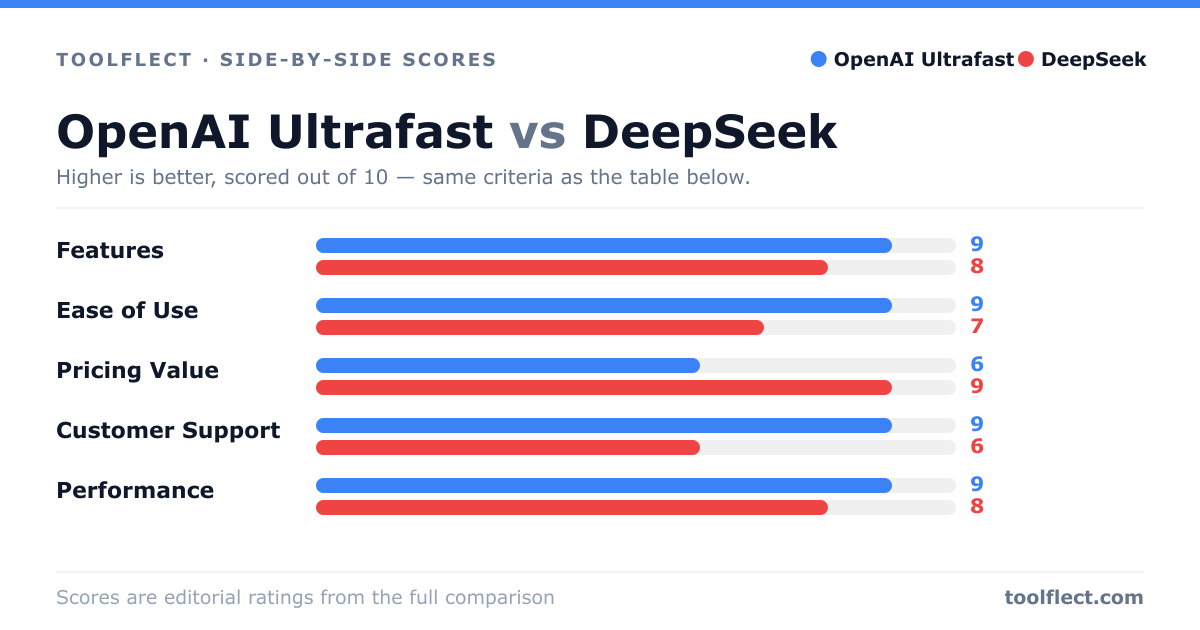
| Criterion | OpenAI Ultrafast | DeepSeek |
|---|---|---|
| Features | 9/10 – Extensive, including multimodal and function calling | 8/10 – Strong in code and math, but fewer extras |
| Ease of Use | 9/10 – Intuitive API and clear docs | 7/10 – Requires more setup and technical know-how |
| Pricing Value | 6/10 – Premium pricing, but worth it for speed | 9/10 – Very affordable, excellent for scaling |
| Customer Support | 8/10 – Responsive, but enterprise-focused | 6/10 – Community support mainly, slower responses |
| Performance | 10/10 – Ultra-low latency, high throughput | 8/10 – Good, but not as fast under load |