LangChain vs LlamaIndex: Which AI Framework Powers Your Next RAG Application?
Overview
LangChain and LlamaIndex are two leading open-source frameworks for building applications with large language models (LLMs), especially for retrieval-augmented generation (RAG). LangChain offers a broad ecosystem for chaining LLM calls, while LlamaIndex specializes in data indexing and retrieval. Both have vibrant communities and are widely used in production.
Key Features Comparison
- LangChain: Modular chain/agent architecture, 100+ integrations, memory management, prompt templates, streaming support, extensive tooling for agents.
- LlamaIndex: Advanced data ingestion (PDF, SQL, etc.), multiple indexing strategies (vector, keyword, hybrid), query engines, easy-to-use retrieval pipelines, built-in evaluation.
Pros & Cons
LangChain
- Pros:
- Extremely flexible and modular, allowing custom chains and integrations with many LLMs and tools.
- Large and active community with extensive documentation and examples.
- Supports advanced features like agents, memory, and tool use out of the box.
- Cons:
- Steep learning curve due to its abstract concepts and many components.
- Rapidly evolving API can lead to breaking changes and outdated tutorials.
- Overly complex for simple RAG tasks; may be overkill for small projects.
LlamaIndex
- Pros:
- Purpose-built for RAG and data indexing, with simple, high-level APIs.
- Excellent data connectors for various sources (databases, files, APIs).
- Strong focus on performance and scalability for large document sets.
- Cons:
- Less flexible for non-RAG workflows; primarily oriented towards data indexing and retrieval.
- Smaller community and fewer third-party integrations compared to LangChain.
- Documentation can be sparse for advanced use cases.
LangChain
- Pros:
- Extensive integrations with LLMs, vector stores, and tools
- Flexible and modular architecture for complex workflows
- Large community and active development
- Supports multiple languages (Python, JS)
- Cons:
- Steep learning curve due to abstraction layers
- Documentation can be overwhelming
- Frequent API changes may break existing code
- Overkill for simple RAG tasks
LlamaIndex
- Pros:
- Specialized for data indexing and retrieval
- Simpler API for RAG pipelines
- Excellent data connectors for various sources
- Strong focus on performance and efficiency
- Cons:
- Less flexible for non-RAG workflows
- Smaller ecosystem compared to LangChain
- Limited language support (mainly Python)
- Documentation less comprehensive
LangChain
- Pros: Extensive integrations with LLMs, vector stores, and tools; flexible chain and agent abstractions; large community and ecosystem.
- Cons: Steep learning curve due to complexity; frequent API changes; verbose code for simple tasks.
LlamaIndex
- Pros: Focused on data indexing and retrieval; simpler API for RAG; excellent for document Q&A.
- Cons: Fewer integrations for non-RAG use cases; smaller community; less flexible for complex agent workflows.
Pricing Comparison
Both frameworks are open-source (MIT / Apache 2.0) with free tiers. Paid cloud offerings: LangChain has LangSmith (observability, cost per event), LlamaIndex has LlamaCloud (managed indexing, usage-based). Both are cost-effective for small to medium projects.
Best Use Cases
- LangChain: Multi-step reasoning agents, complex tool-using chatbots, customer support automation, and applications requiring extensive chain orchestration.
- LlamaIndex: Document Q&A, knowledge base search, data analysis over structured/unstructured data, and any RAG-heavy application.
Verdict
Choose LangChain if you need maximum flexibility and agent capabilities. Choose LlamaIndex if your primary need is efficient retrieval from large document sets. Both are excellent; your choice depends on your specific use case.
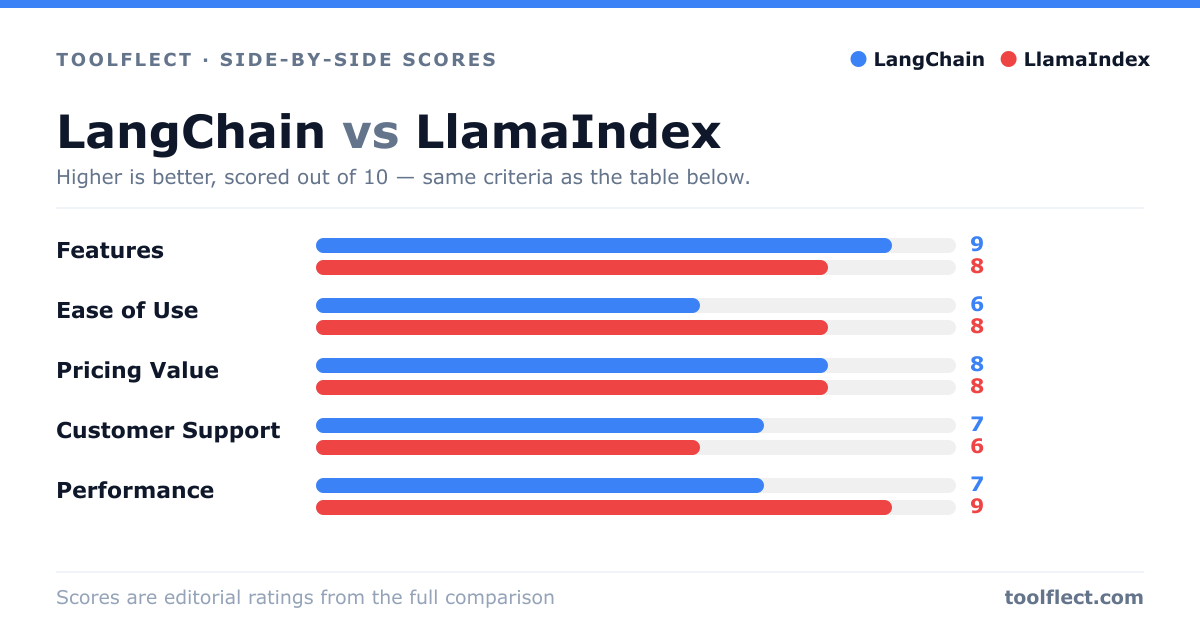
Visual Comparison
| Criterion | LangChain | LlamaIndex |
|---|---|---|
| Features | 9/10 – Extensive: agents, chains, memory, integrations | 8/10 – Focused on RAG: indexing, retrieval, data connectors |
| Ease of Use | 6/10 – Steep learning curve, complex abstractions | 8/10 – Simpler APIs, quicker to get started |
| Pricing Value | 8/10 – Free and open-source, but may require more dev time | 8/10 – Free and open-source, efficient for RAG |
| Customer Support | 7/10 – Active community, but no official support | 6/10 – Smaller community, but responsive maintainers |
| Performance | 7/10 – Flexible but can be slower due to overhead | 9/10 – Optimized for fast indexing and retrieval |