
NightCafe vs DeepDream Generator: Which AI Image Generator Wins?
Overview
NightCafe and DeepDream Generator are two popular AI image generation platforms that allow users to create stunning artwork from text prompts. NightCafe is known for its wide array of algorithms, including Stable Diffusion, DALL-E 2, and its own style transfer, making it versatile for various artistic styles. DeepDream Generator, originally famous for its psychedelic deep dream effects, has expanded to include other AI models like Stable Diffusion and offers a strong community aspect. Both platforms cater to beginners and experienced creators, but they differ in features, pricing, and user experience.
Key Features Comparison
- Algorithms: NightCafe offers multiple algorithms (Stable Diffusion, DALL-E 2, Artistic, etc.) while DeepDream Generator focuses on Deep Dream and also supports Stable Diffusion.
- Customization: NightCafe provides extensive control over settings like style, aspect ratio, and seed. DeepDream Generator offers sliders for dream intensity and style.
- Community: Both have active social platforms where users can share creations and join challenges.
- Output Resolution: NightCafe allows up to high resolutions on paid plans; DeepDream Generator offers up to 4K on Pro.
- Bulk Generation: NightCafe supports bulk creation; DeepDream Generator has batch options.
Pros & Cons
NightCafe
- Pros: Extensive algorithm selection (DALL-E 2, Stable Diffusion, etc.)
- Pros: Generous free daily credits
- Pros: Active community and challenges
- Cons: Advanced features require paid credits
- Cons: Interface can be overwhelming for beginners
DeepDream Generator
- Pros: Simple and intuitive interface
- Pros: Unique deep dream styles
- Pros: Free tier with basic features
- Cons: Limited algorithm options
- Cons: Slower processing on free plan
NightCafe
- Pros: Wide variety of styles and algorithms (Stable Diffusion, DALL-E 2, etc.)
- Pros: Generous free credits daily, allowing extensive experimentation
- Pros: Active community and challenges that foster creativity
- Cons: Free tier limits resolution and advanced features
- Cons: Interface can be overwhelming for beginners
DeepDream Generator
- Pros: Unique deep dream aesthetic, perfect for surreal art
- Pros: Simple and intuitive interface, easy for novices
- Pros: Offers both deep dream and style transfer options
- Cons: Limited styles compared to NightCafe
- Cons: Free tier has watermarks and lower resolution
NightCafe
- Pros: Wide variety of algorithms (e.g., Stable Diffusion, DALL-E 2, VQGAN+CLIP) for diverse styles; generous free daily credits; active community and challenges.
- Cons: Free tier limits resolution and commercial use; interface can be overwhelming for beginners; some advanced features require subscription.
DeepDream Generator
- Pros: Simple and intuitive interface; unique deep dream aesthetic; free tier with decent features; supports upscaling and style transfer.
- Cons: Fewer algorithm choices; slower processing on free tier; limited customization compared to NightCafe.
NightCafe
- Pros: Wide variety of algorithms, easy to use, generous free tier (5 credits/day), excellent community, multiple export options.
- Cons: Credit system can be limiting for heavy users, some advanced features require learning.
DeepDream Generator
- Pros: Unique deep dream effects, strong social features, good for experimental art, affordable paid plans.
- Cons: Fewer algorithm choices, free tier adds watermarks, interface slightly less intuitive.
Pricing Comparison
- NightCafe: Free tier: 5 credits/day. Paid: AI Beginner ($10/month for 100 credits), AI Enthusiast ($30/month for 300 credits), AI Artist ($100/month for 1000 credits).
- DeepDream Generator: Free tier: 5 credits/day with watermark. Paid: Basic ($10/month for 100 credits, no watermark), Pro ($20/month for 300 credits), Ultra ($30/month for 600 credits).
Both offer additional credits for purchase. NightCafe’s pricing is similar but provides more algorithms per credit.
Best Use Cases
- NightCafe: Ideal for users who want versatility and control over many artistic styles, from photorealistic to abstract. Great for generating diverse images for projects, social media, or personal art.
- DeepDream Generator: Best suited for those who enjoy the distinctive deep dream aesthetic or want to create dreamlike, surreal imagery. Also good for building a following in a niche community.
Verdict
Choose NightCafe if you value a wide range of algorithms, a beginner-friendly interface, and a generous free tier. It’s the better all-rounder for most users. Opt for DeepDream Generator if you are particularly drawn to the deep dream style or want a more focused community experience. Both tools are excellent, but NightCafe edges ahead in versatility and value.
Visual Comparison
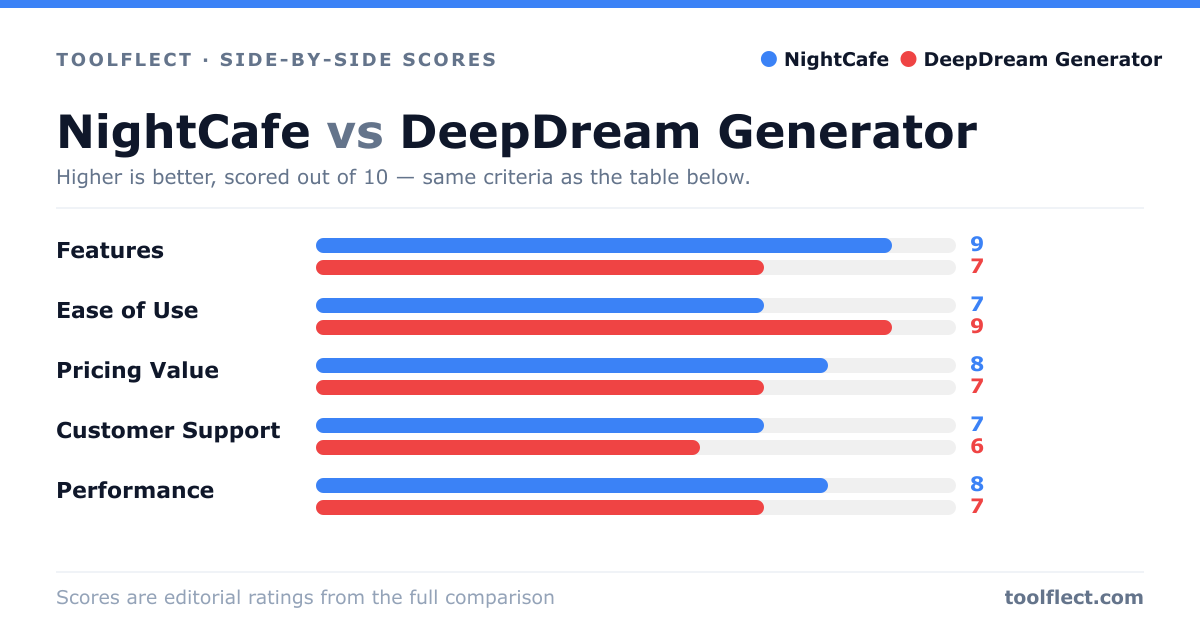
| Criterion | NightCafe | DeepDream Generator |
|---|---|---|
| Features | 9/10 – Wide range of algorithms and customization | 7/10 – Fewer algorithms but unique styles |
| Ease of Use | 7/10 – Feature-rich but steeper learning curve | 9/10 – Very user-friendly |
| Pricing Value | 8/10 – Free credits daily, reasonable paid plans | 7/10 – Limited free tier, paid plans are decent |
| Customer Support | 7/10 – Email support, community forum | 6/10 – Email support only |
| Performance | 8/10 – Fast generation on paid plans | 7/10 – Slower on free, acceptable on paid |