
Labelbox vs Scale AI: Which Data Annotation Platform Wins?
Overview
Labelbox and Scale AI are two leading data annotation platforms that help businesses build high-quality training data for machine learning models. Labelbox focuses on providing a flexible, collaborative workspace with a strong emphasis on human-in-the-loop workflows. Scale AI, on the other hand, offers a full-stack solution combining automated annotation with a managed workforce, aiming for scalability and speed. Both platforms serve similar purposes but differ in approach, pricing, and target audience. This article provides an unbiased comparison to help you choose the right one for your needs.
Key Features Comparison
- Annotation Tools: Labelbox offers a wide range of tools including image, video, and text annotation with custom interfaces. Scale AI provides similar tools but also includes advanced features like LiDAR and sensor fusion for autonomous vehicles.
- Automation & AI Assistance: Scale AI heavily integrates AI-assisted labeling and pre-annotation to speed up the process. Labelbox also has automation features but relies more on human input.
- Workflow Management: Labelbox excels in workflow design with customizable review queues and quality control. Scale AI offers a more managed service with dedicated project managers.
- Integration & API: Both offer robust APIs and integrations with popular ML frameworks. Labelbox has a more open platform, while Scale AI provides tighter integration with its own data engine.
- Collaboration: Labelbox provides real-time collaboration and role-based access. Scale AI offers similar but with less flexibility.
Pros & Cons
Labelbox
- Pros: Intuitive UI with collaborative features; strong automation and model-assisted labeling; flexible ontology for various data types.
- Cons: Pricing can be high for small teams; advanced features require enterprise plan; occasional performance issues with large datasets.
Scale AI
- Pros: High-quality human labeling with rigorous QA; scalable for large projects; strong API and integrations.
- Cons: Higher cost per annotation; less user-friendly for non-technical users; limited customization in some workflows.
Labelbox
- Pros: Intuitive UI with collaborative labeling workflows; strong automation and model-assisted labeling; flexible integration with ML pipelines.
- Cons: Pricing can be high for small teams; advanced features require enterprise plan; occasional performance lag with large datasets.
Scale AI
- Pros: High-quality managed labeling services; robust API and SDK; supports diverse data types (image, video, text, 3D).
- Cons: More expensive for custom projects; less control over labeling process; onboarding can be complex.
Labelbox
- Pros:
- Intuitive UI and easy setup for teams of all sizes.
- Strong collaboration features with real-time commenting and review workflows.
- Flexible labeling interfaces for various data types (image, video, text).
- Robust API and integrations with popular ML frameworks.
- Cons:
- Pricing can be higher for small teams or startups.
- Advanced features like model-assisted labeling require higher-tier plans.
- Limited built-in quality control compared to Scale AI.
Scale AI
- Pros:
- High-quality annotations with rigorous QA processes.
- Scalable workforce for large-scale projects.
- Advanced features like autonomous vehicle data labeling and sensor fusion.
- Strong focus on enterprise-grade security and compliance.
- Cons:
- Less intuitive for self-serve users; more geared toward managed services.
- Pricing can be opaque and often custom quotes.
- Longer turnaround times for complex projects.
Labelbox
- Pros: Highly customizable, transparent pricing, strong community support, excellent for teams that want full control.
- Cons: Steeper learning curve, requires more manual setup, less automated than Scale AI.
Scale AI
- Pros: Fast deployment, managed workforce, advanced automation, good for large-scale projects.
- Cons: Higher cost, less transparency in pricing, less control over the labeling process.
Pricing Comparison
Labelbox offers a free tier with limited features and then subscription-based pricing starting at $299 per month for the Pro plan, with custom enterprise pricing. Scale AI does not publicly disclose pricing; it is quote-based and typically higher due to the managed service component. For small to medium projects, Labelbox is more cost-effective. For large-scale, time-sensitive projects, Scale AI may justify its cost with speed and convenience.
Best Use Cases
- Labelbox: Ideal for startups and mid-sized companies that need flexibility, have in-house labeling teams, and want to keep costs down.
- Scale AI: Best for enterprises with massive data volumes, tight deadlines, and limited in-house labeling resources, especially in autonomous driving and robotics.
Verdict
Both Labelbox and Scale AI are powerful tools, but they cater to different needs. Choose Labelbox if you value control, customization, and cost-effectiveness. Choose Scale AI if you need speed, scalability, and a fully managed solution. Evaluate your project size, budget, and team capabilities to make the right decision.
Visual Comparison
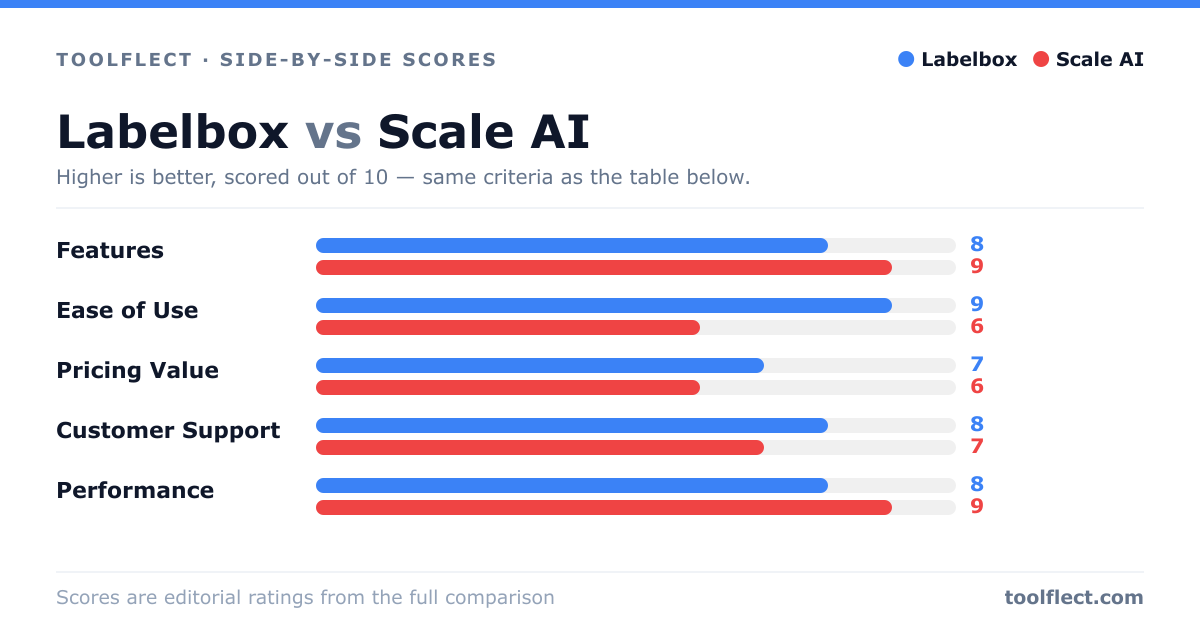
| Criterion | Labelbox | Scale AI |
|---|---|---|
| Features | 8/10 – Comprehensive toolset including automation and collaboration. | 9/10 – Advanced ML-assisted labeling and robust API. |
| Ease of Use | 9/10 – Intuitive interface, quick onboarding. | 6/10 – Steeper learning curve, more complex setup. |
| Pricing Value | 7/10 – Transparent but can be pricey for small teams. | 6/10 – Premium pricing, but justified for high accuracy. |
| Customer Support | 8/10 – Responsive support and helpful documentation. | 7/10 – Good support, but slower for enterprise requests. |
| Performance | 8/10 – Handles large datasets well, occasional lag. | 9/10 – High throughput and reliable performance. |