
Kustomer vs Forethought: Which CRM Wins?
Overview
Kustomer and Forethought are two customer service platforms that leverage AI to enhance support operations. Kustomer, acquired by Meta in 2020, is a full-featured CRM focused on delivering a unified customer view and omnichannel support. Forethought is an AI-native platform that automates ticket triage, routing, and resolution using generative AI. While both aim to improve efficiency, they differ in scope: Kustomer provides a comprehensive CRM suite, whereas Forethought specializes in AI-powered automation layered on top of existing helpdesks.
Key Features Comparison
Kustomer
- Omnichannel Support: Email, chat, phone, SMS, social media, and messaging apps in one timeline.
- Customer Timeline: Unified view of all interactions, orders, and customer data.
- AI-Powered Assistants: Chatbots and agent assist for suggested replies.
- Workflow Automation: Customizable workflows for routing, escalation, and follow-ups.
- Analytics & Reporting: Real-time dashboards and custom reports.
- Integrations: Native integrations with Shopify, Slack, Salesforce, and more.
Forethought
- AI Triage: Automatically categorizes and routes tickets based on intent.
- Generative AI Responses: Drafts replies and suggests knowledge articles.
- Self-Service Automation: AI-powered chatbots for instant resolutions.
- Agent Assist: Real-time guidance and next-best-action recommendations.
- Analytics: Insights into automation performance and deflection rates.
- Integrations: Works with Zendesk, Salesforce, Intercom, and other helpdesks.
Pros & Cons
Kustomer
- Pros:
- Comprehensive CRM with unified customer timeline.
- Strong omnichannel support across many channels.
- Highly customizable workflows and automation.
- Robust analytics and reporting capabilities.
- Cons:
- Can be expensive for small teams.
- Steeper learning curve due to extensive features.
- Requires dedicated setup and configuration.
- Limited AI capabilities compared to AI-native platforms.
Forethought
- Pros:
- Advanced AI for ticket triage and resolution.
- Quick to deploy and integrate with existing helpdesks.
- Reduces response times and improves efficiency.
- Scalable for high-volume support teams.
- Cons:
- Not a full CRM; relies on other platforms for core ticketing.
- Pricing may be high for small businesses.
- Limited customization of the underlying helpdesk.
- AI accuracy can vary without proper training.
Pricing Comparison
Kustomer offers custom pricing based on seats and features, typically starting around $89 per user per month for the Enterprise plan. They also have a Starter plan for smaller teams. Forethought uses a usage-based pricing model, with costs depending on the number of tickets or resolutions automated. Both require contacting sales for a quote, making direct comparison challenging. Generally, Kustomer’s pricing is predictable per seat, while Forethought’s scales with automation volume.
Best Use Cases
Kustomer
Best for businesses seeking an all-in-one CRM to manage customer interactions across multiple channels, especially those with complex workflows and a need for a unified customer view. Ideal for mid-sized to large e-commerce and service companies.
Forethought
Best for support teams already using a helpdesk (like Zendesk or Salesforce) that want to add AI automation to reduce manual triage and improve response times. Suited for high-volume support environments.
Verdict
Kustomer and Forethought serve different needs. Kustomer is a comprehensive CRM that excels in providing a unified customer experience, while Forethought is a powerful AI layer that enhances existing helpdesks. If you need a full CRM with omnichannel support, Kustomer is the better choice. If you want to supercharge your current helpdesk with AI automation, Forethought is the winner. Consider your existing stack and goals before deciding.
FAQ
Can Kustomer and Forethought be used together?
Yes, Forethought can integrate with Kustomer to add AI-powered triage and automation, enhancing Kustomer’s native capabilities.
Which platform is more affordable for small businesses?
Kustomer may be more affordable for small teams due to per-seat pricing, while Forethought’s usage-based model can become costly with high ticket volumes.
Does Forethought replace a helpdesk?
No, Forethought is an AI layer that works on top of existing helpdesks like Zendesk or Salesforce; it does not provide core ticketing functionality.
Which tool offers better AI capabilities?
Forethought is more advanced in AI-driven automation, while Kustomer offers basic AI features as part of its CRM suite.
Visual Comparison
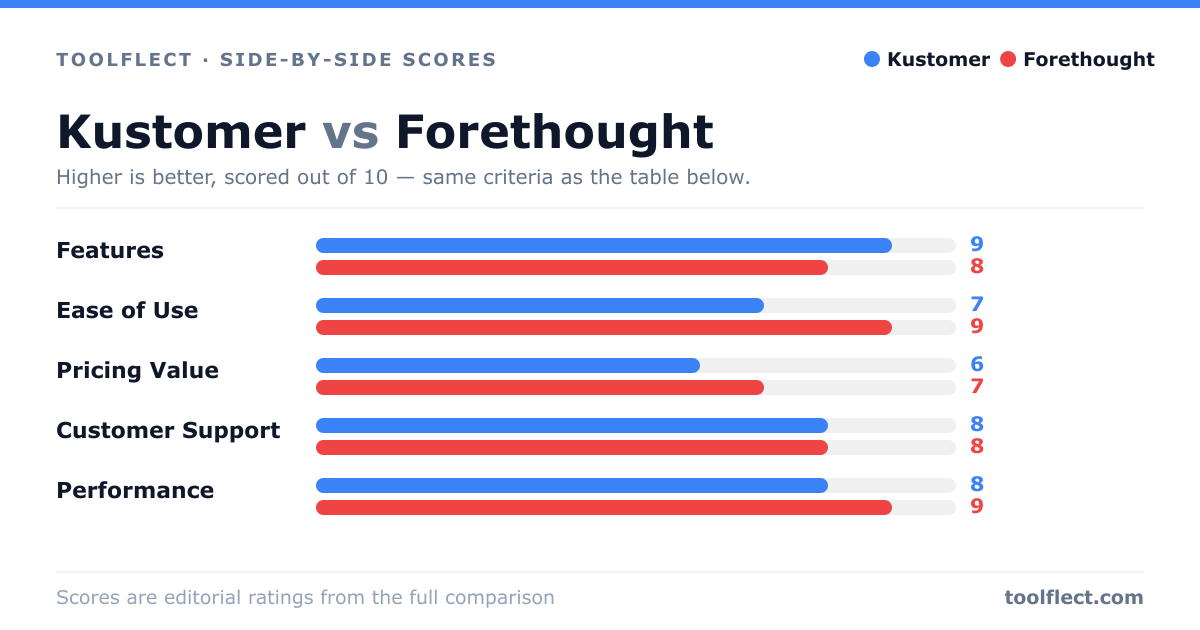
| Criterion | Kustomer | Forethought |
|---|---|---|
| Features | 9/10 | 8/10 |
| Ease of Use | 7/10 | 9/10 |
| Pricing Value | 6/10 | 7/10 |
| Customer Support | 8/10 | 8/10 |
| Performance | 8/10 | 9/10 |