
Elicit vs Consensus: Which AI Research Tool Reigns Supreme?
Overview
Elicit and Consensus are both AI-powered research tools designed to help academics, scientists, and students find and synthesize scientific literature. While they share the common goal of streamlining research, they approach the problem differently. Elicit excels at extracting structured data from papers and assisting with literature reviews, whereas Consensus focuses on providing quick, consensus-based answers from scientific literature. This comparison will help you decide which tool fits your workflow best.
Key Features Comparison
- Literature Search: Both tools enable searching across millions of scientific papers. Elicit uses a semantic search that understands intent, while Consensus uses a combination of semantic search and citation-based ranking.
- Data Extraction: Elicit offers powerful extraction of specific data points (e.g., sample size, outcomes) from papers into a table format. Consensus does not have direct data extraction capabilities.
- Answer Generation: Consensus generates concise, evidence-based answers to research questions with citations. Elicit provides summaries but focuses more on interactive exploration.
- Integrations: Elicit integrates with Zotero and supports export to CSV and BIB. Consensus offers browser extensions and API access.
- Collaboration: Elicit allows collaboration via shared projects. Consensus lacks native collaboration features.
Pros & Cons
Elicit
- Pros: Automates systematic literature reviews with AI-powered extraction.
- Pros: Intuitive interface for searching and filtering academic papers.
- Pros: Provides structured data extraction from papers (e.g., interventions, outcomes).
- Cons: Limited to research papers; not suitable for general web search.
- Cons: Free tier has limited features; advanced features require subscription.
Consensus
- Pros: Uses AI to summarize findings from millions of research papers.
- Pros: Clean, user-friendly interface with quick answers to research questions.
- Pros: Provides confidence scores and links to sources for verification.
- Cons: Focuses on consensus answers, may oversimplify complex debates.
- Cons: Free version has limited queries; premium required for full access.
Elicit
- Pros:
- Automates literature review with AI-powered search.
- Extracts key data into tables for easy comparison.
- Integrates with Zotero and other reference managers.
- Free tier available for basic use.
- Cons:
- Limited to research papers, not broader web content.
- Accuracy of extraction can vary.
- Steep learning curve for advanced features.
- Paid plans can be costly for heavy users.
Consensus
- Pros:
- Provides direct answers with cited sources.
- User-friendly interface with simple search.
- Includes consensus meter showing agreement among studies.
- Free for basic searches.
- Cons:
- Limited to scientific research papers.
- Less customizable than Elicit.
- No integration with reference managers.
- Advanced features require subscription.
Elicit
- Pros: Automates literature review and extracts key data from papers.
- Pros: Intuitive interface with a simple search and filter system.
- Pros: Provides a clear summary of findings, saving time.
- Cons: Limited to academic papers; not suitable for broader web research.
- Cons: Data extraction accuracy can vary depending on paper format.
Consensus
- Pros: Aggregates insights from millions of research papers.
- Pros: Offers a consensus meter showing agreement among studies.
- Pros: Clean, user-friendly design with quick answers.
- Cons: Focuses on yes/no questions; less flexible for complex queries.
- Cons: Free tier has limited features; premium required for full access.
Elicit
Pros: Excellent for systematic reviews; intuitive data extraction; strong project management; good for in-depth analysis.
Cons: Steeper learning curve; limited to 5,000 papers/month on free plan; answer generation less direct than Consensus.
Consensus
Pros: Fast, direct answers to research questions; easy to use; good for quick fact-checking; free tier generous.
Cons: Limited data extraction; no project organization; answers may oversimplify nuanced topics.
Pricing Comparison
Elicit offers a free tier (limited to 5,000 searches/paper extractions per month) and paid plans starting at $10/month for more capacity and advanced features. Consensus has a free tier with unlimited searches, and a Consensus Pro plan at $11.99/month that adds priority support and advanced filters. Both have academic discounts.
Best Use Cases
Elicit is best for researchers conducting systematic reviews, meta-analyses, or needing to extract detailed data from many papers. It excels in long-term projects where organization and repeatability matter.
Consensus is ideal for quick literature checks, getting straightforward answers to clinical or scientific questions, and for students who need a fast overview of a topic.
Verdict
If you need deep literature analysis and data extraction, choose Elicit. If you want fast, reliable answers to research questions with minimal effort, Consensus is the better choice. Both tools complement each other and can be used together for a comprehensive research workflow.
Visual Comparison
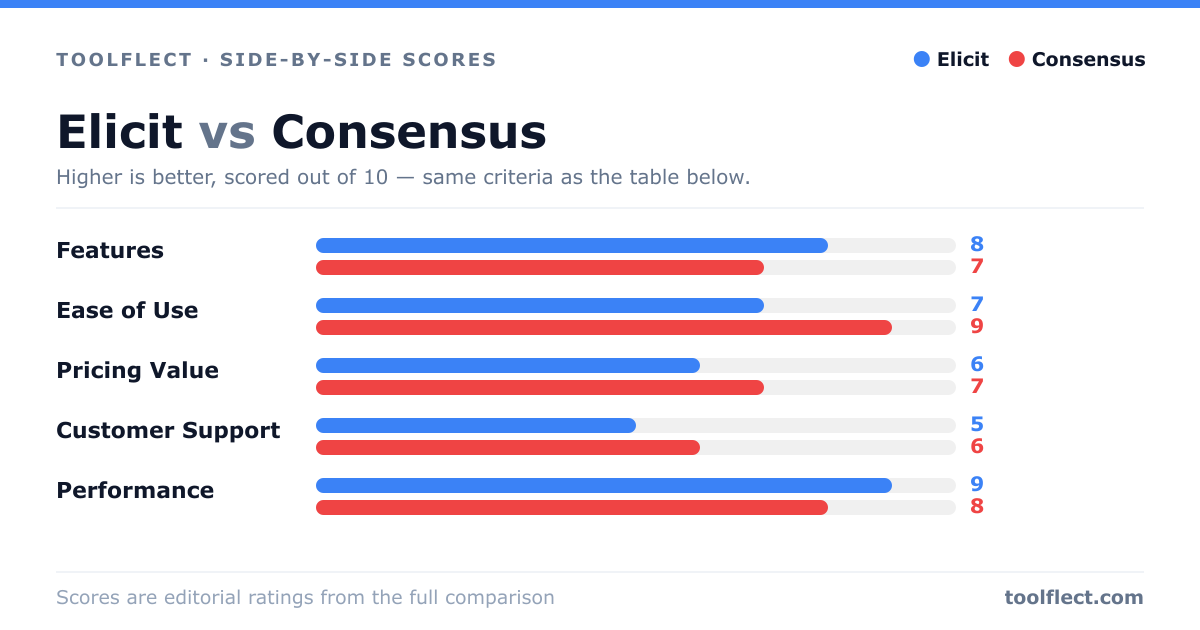
| Criterion | Elicit | Consensus |
|---|---|---|
| Features | 8/10 – Advanced extraction and systematic review tools | 7/10 – AI summarization and confidence scores |
| Ease of Use | 7/10 – Steeper learning curve for complex queries | 9/10 – Very intuitive and quick to learn |
| Pricing Value | 6/10 – Free tier limited, paid plans for full features | 7/10 – Free tier available, premium for more queries |
| Customer Support | 5/10 – Limited support options (email, help center) | 6/10 – Responsive support via email and chat |
| Performance | 9/10 – High accuracy in data extraction | 8/10 – Fast and reliable summaries |