
Research Rabbit vs Iris.ai: Which AI Research Tool Helps You Work Smarter?
Overview
Research Rabbit and Iris.ai are both AI-powered research assistants, but they serve different primary functions. Research Rabbit is a literature mapping tool that helps researchers discover and organize academic papers, visualizing citation networks. Iris.ai is a research reading tool that uses AI to extract key information, summarize papers, and assist with literature reviews. Both aim to reduce the time spent on manual research tasks, but their approaches and strengths differ.
Key Features Comparison
- Research Rabbit: Interactive citation maps, personalized paper recommendations, collaborative collections, Chrome extension, integration with Zotero, and a focus on discovery and exploration.
- Iris.ai: AI-powered reading and analysis, automatic summarization, concept extraction, data extraction for systematic reviews, and a “ScienceFunnel” that pre-filters and structures content.
Pros & Cons
Research Rabbit
- Pros:
- Visual citation network helps discover related papers intuitively.
- Free to use for researchers and academics.
- Collaborative features allow sharing collections with colleagues.
- Continuous updates and improvements based on user feedback.
- Cons:
- Limited to academic literature; not suitable for broader web research.
- No full-text search; only metadata and abstracts.
- Requires a stable internet connection; offline access not available.
- Learning curve for users unfamiliar with citation graph navigation.
Iris.ai
- Pros:
- AI-powered reading list generation from a single seed paper.
- Advanced natural language processing for concept extraction.
- Supports multiple document formats including PDFs and web pages.
- Offers a free plan with limited features.
- Cons:
- Pricing can be high for full access to all features.
- Accuracy of AI summaries may vary for complex documents.
- Limited integration with reference managers like Zotero or EndNote.
- User interface can be overwhelming for new users.
Research Rabbit
- Pros:
- Visual citation network helps discover related papers intuitively.
- Free to use with unlimited collections.
- Collaborative features allow sharing and co-editing collections.
- Integrates with Zotero for easy reference management.
- Cons:
- Limited to PubMed and arXiv sources; lacks broader coverage.
- No full-text search or PDF analysis.
- No mobile app; web interface only.
- Steep learning curve for advanced features.
Iris.ai
- Pros:
- AI-powered reading list generation from a single paper.
- Full-text search across millions of open-access papers.
- Smart filtering and concept maps for literature exploration.
- Supports multiple languages and formats.
- Cons:
- Free tier limited to 3 papers per month; paid plans required for more.
- Occasional inaccuracies in extracted data.
- Interface can be overwhelming for new users.
- No offline access or desktop app.
Research Rabbit
- Pros: Visual citation network exploration, collaborative features, free to use, integrates with Zotero.
- Cons: Limited to academic papers, no full-text search, occasional UI lag, no mobile app.
Iris.ai
- Pros: AI-powered literature review, natural language search, smart filtering, supports multiple document types.
- Cons: Steep learning curve, pricing can be high for full features, limited integration with reference managers.
Research Rabbit
- Pros: Intuitive visual mapping, excellent for discovering related papers, free to use, easy to organize papers into projects, good community support.
- Cons: Limited to literature discovery; no in-depth paper analysis or summarization, requires some learning curve for effective use, no PDF editing features.
Iris.ai
- Pros: Powerful AI reading assistant, detailed summarization and extraction, useful for systematic reviews, can handle large volumes of text, supports complex queries.
- Cons: Higher learning curve, pricing can be prohibitive for individual researchers, less emphasis on visual discovery, interface is less intuitive for casual use.
Pricing Comparison
Research Rabbit is currently free to use, with no premium tiers announced. It is funded by grants and partnerships. Iris.ai offers a freemium model: a free tier with limited usage, and paid plans starting from around $10-20 per month for individuals, with institutional pricing available. For serious research projects, Iris.ai’s paid plans provide more extensive features.
Best Use Cases
- Research Rabbit: Ideal for researchers exploring a new field, building literature reviews, tracking citation networks, and organizing papers visually. Best used in the early stages of research to find relevant literature.
- Iris.ai: Best for researchers who need deep analysis of papers, extracting specific data, summarizing large sets of documents, or conducting systematic reviews. Suitable for later stages of research where understanding content is key.
Verdict
Both tools complement each other rather than directly compete. Research Rabbit excels at discovery and organization, while Iris.ai excels at analysis and extraction. If you need to map a research field and find papers, choose Research Rabbit. If you need to read and understand papers more efficiently, choose Iris.ai. For a comprehensive research workflow, using both together provides the best results.
Visual Comparison
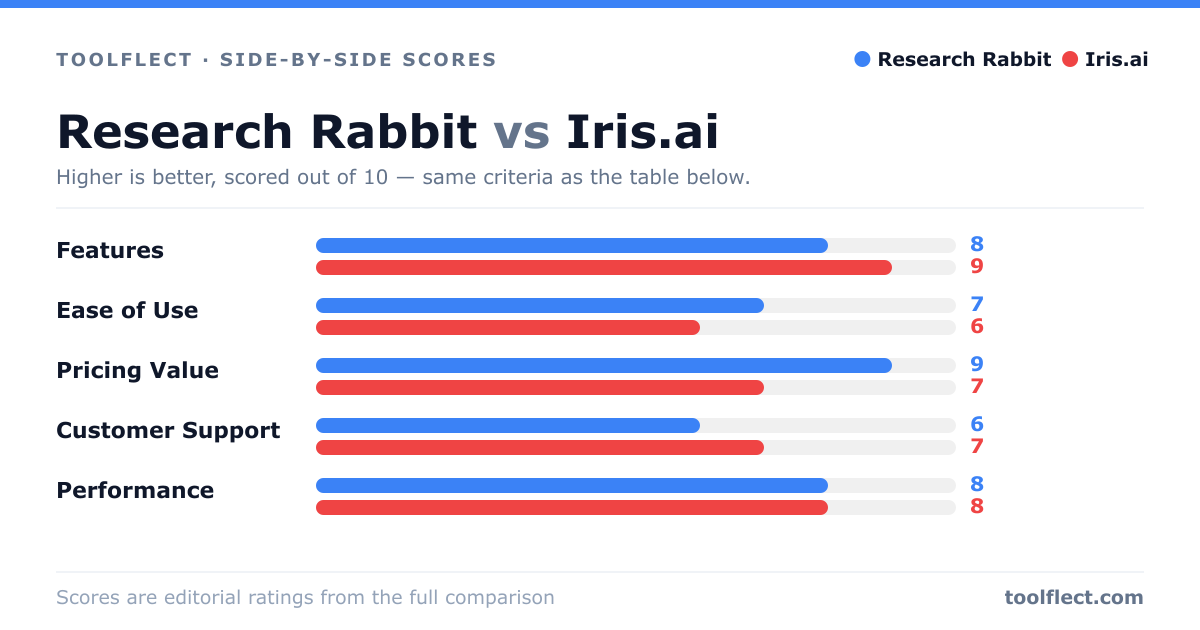
| Criterion | Research Rabbit | Iris.ai |
|---|---|---|
| Features | 8/10 – Visual citation mapping, collections, sharing | 9/10 – AI reading list, concept extraction, multi-format support |
| Ease of Use | 7/10 – Intuitive but requires learning graph navigation | 6/10 – Powerful but interface can be complex |
| Pricing Value | 9/10 – Free for academics | 7/10 – Free tier available, but premium plans are costly |
| Customer Support | 6/10 – Email support, community forum | 7/10 – Email support, knowledge base, responsive |
| Performance | 8/10 – Fast and reliable for literature discovery | 8/10 – AI processing can be slow for large documents |