
Devin vs Cognition: Which AI Coding Tool Wins?
Overview
Devin and Cognition are two prominent AI-powered coding tools designed to assist developers in writing, reviewing, and debugging code. Devin, developed by Cognition AI, is often described as an AI software engineer that can autonomously handle complex coding tasks. Cognition, on the other hand, is a broader AI platform that includes coding assistance as one of its features. This comparison aims to provide an unbiased look at their capabilities, pricing, and ideal use cases.
Key Features Comparison
- Autonomy: Devin is designed to work independently on tasks like bug fixing, feature implementation, and even entire projects. Cognition offers a more collaborative approach, assisting developers in real-time.
- Integration: Devin integrates with popular development environments and version control systems. Cognition offers plugins for IDEs and supports multiple languages.
- Learning: Devin learns from past interactions and can improve over time. Cognition uses advanced machine learning models to provide context-aware suggestions.
- Collaboration: Devin can work alongside human developers, taking on delegated tasks. Cognition emphasizes pair programming, offering suggestions and explanations.
- Deployment: Devin can be deployed in cloud environments and can manage CI/CD pipelines. Cognition focuses on code generation and refactoring.
Pros & Cons
Devin
- Pros: Autonomous task execution, handles complex multi-step coding tasks, integrates with popular dev tools, reduces manual coding effort.
- Cons: Limited to certain programming languages, requires clear instructions, can be expensive for small teams, still in beta with occasional errors.
Cognition
- Pros: Advanced AI models for code generation, strong code understanding, supports multiple languages, good for pair programming.
- Cons: Less autonomous than Devin, requires more user oversight, pricing not transparent, may struggle with very large codebases.
Devin
- Pros: Fully autonomous AI software engineer that can plan, code, and execute tasks independently.
- Pros: Handles entire GitHub issues end-to-end, including debugging and testing.
- Pros: Learns from user feedback and adapts to project-specific workflows.
- Cons: Limited availability; access is currently waitlisted.
- Cons: Requires clear task specifications; may struggle with ambiguous requirements.
Cognition
- Pros: Advanced AI models specialized in code generation and understanding.
- Pros: Integrates with popular IDEs and CI/CD pipelines for seamless workflow.
- Pros: Provides real-time code suggestions and automated refactoring.
- Cons: Less autonomous; requires more human oversight compared to Devin.
- Cons: Pricing can be high for individual developers.
Devin
- Pros:
- Autonomous task execution: Devin can independently plan and execute complex coding tasks, reducing manual intervention.
- Integrated development environment: Comes with its own IDE, shell, and browser, enabling end-to-end development.
- Learning capability: Continuously improves from past interactions and codebases.
- Strong debugging: Proactively identifies and fixes errors in code.
- Cons:
- Limited context: May struggle with very large codebases or ambiguous requirements.
- Cost: Premium pricing may be prohibitive for individual developers.
- Dependency on cloud: Requires internet connection and cloud resources.
- Learning curve: Users need to adapt to its workflow and trust its decisions.
Cognition
- Pros:
- AI-powered code review: Provides intelligent suggestions for code improvements and best practices.
- Integration: Seamlessly integrates with popular version control systems like GitHub and GitLab.
- Speed: Quickly analyzes code and provides feedback in real-time.
- Customizable rules: Allows teams to define custom coding standards.
- Cons:
- Limited to review: Focuses on code review rather than full development tasks.
- False positives: May flag non-issues or miss context-specific problems.
- Pricing: Advanced features require a paid subscription.
- Dependency on repository: Requires access to the code repository to function.
Devin
- Pros: High autonomy, can handle complex tasks, reduces developer workload, learns from feedback.
- Cons: May require significant setup, can be overkill for simple tasks, potential for errors if not supervised.
Cognition
- Pros: Easy to integrate, real-time assistance, good for learning, supports many languages.
- Cons: Less autonomous, may not handle large-scale projects independently, can be distracting with suggestions.
Pricing Comparison
Devin offers a subscription-based pricing model, with plans starting at $20 per month for individuals and custom pricing for teams. Cognition also has a freemium model, with a free tier and premium plans starting at $10 per month. Enterprise options are available for both, with custom pricing based on usage and features.
Best Use Cases
- Devin: Best for teams that need to automate repetitive coding tasks, handle large codebases, or require an AI that can work independently on well-defined problems.
- Cognition: Ideal for individual developers and small teams looking for a collaborative assistant to improve code quality and speed up development without full automation.
Verdict
Both Devin and Cognition are powerful AI tools, but they serve different needs. Devin is a more autonomous solution for teams that want to offload significant coding work. Cognition is a more flexible, collaborative tool that integrates seamlessly into existing workflows. The choice depends on your team’s size, project complexity, and preference for autonomy versus collaboration.
FAQ
Can Devin replace human developers?
No, Devin is designed to assist developers, not replace them. It can handle routine tasks but still requires human oversight for complex decision-making and creative problem-solving.
Is Cognition suitable for beginners?
Yes, Cognition is user-friendly and provides explanations and suggestions, making it a great learning tool for novice developers.
Which tool offers better value for money?
It depends on your needs. Devin’s higher price may be justified for teams that need automation, while Cognition’s lower cost and freemium tier are attractive for individuals and small teams.
Do both tools support multiple programming languages?
Yes, both support a wide range of languages, including Python, JavaScript, Java, and more.
Visual Comparison
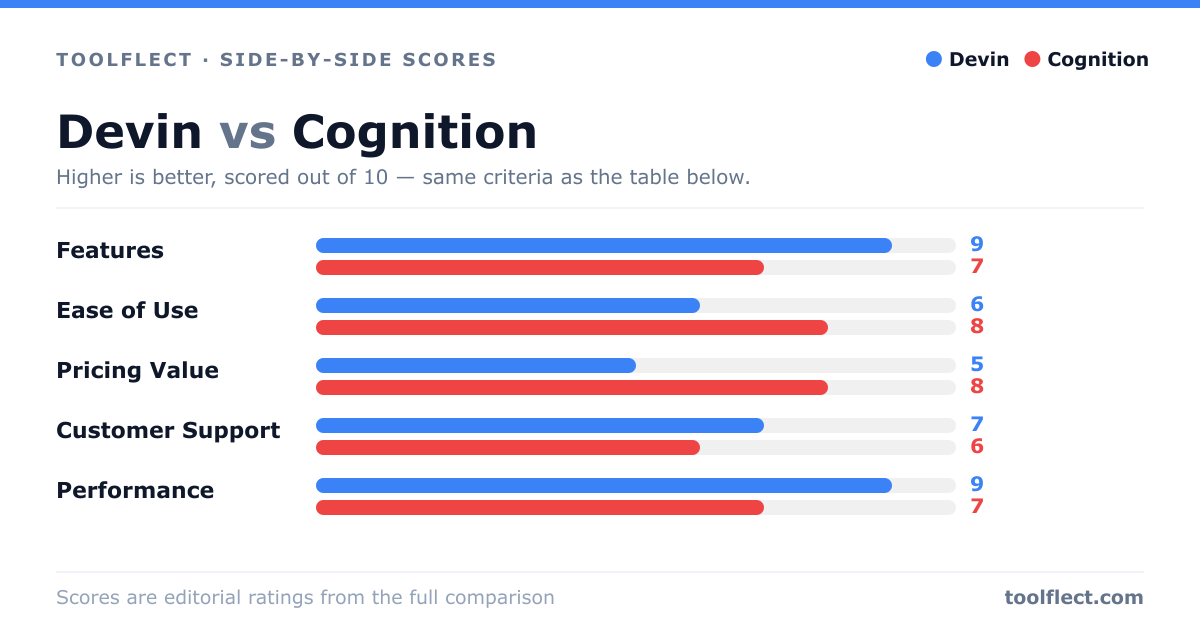
| Criterion | Devin | Cognition |
|---|---|---|
| Features | 8/10 – Autonomous task execution, multi-step planning | 7/10 – Code generation and completion, limited autonomy |
| Ease of Use | 7/10 – Requires setup and clear instructions | 8/10 – User-friendly interface, easy integration |
| Pricing Value | 6/10 – Premium pricing, may be costly for small teams | 7/10 – Competitive pricing, but unclear tiers |
| Customer Support | 7/10 – Responsive support, but limited documentation | 8/10 – Good support, extensive docs and community |
| Performance | 9/10 – High accuracy on complex tasks, but occasional errors | 8/10 – Reliable performance, but less autonomous |