
Luminance vs Kira: Which Contract AI Wins?
Overview
Luminance and Kira are two leading AI-powered contract analysis platforms used by legal teams for due diligence, contract review, and compliance. Luminance, founded in 2015, emphasizes a holistic approach with its ‘Luminance Diligence’ and ‘Luminance Corporate’ products, leveraging pattern recognition to surface anomalies without extensive training. Kira Systems, founded in 2010 and now part of Litera, is known for its machine learning models that extract and analyze provisions from contracts, with a strong focus on accuracy and customization. Both tools aim to reduce manual review time, but they differ in technology, user experience, and pricing models.
Key Features Comparison
Luminance offers out-of-the-box anomaly detection, automatic clustering of similar clauses, and a visual dashboard that highlights deviations. It supports multiple languages and can process large document sets quickly. Kira provides pre-built and custom smart fields for data extraction, a library of over 1,000 built-in provisions, and integration with popular DMS systems like iManage and NetDocuments. Kira’s ‘Quick Study’ allows users to train models with minimal examples, while Luminance’s ‘Luminance Discovery’ extends to e-discovery. Both offer API access and cloud deployment, but Kira has a broader ecosystem of integrations due to its Litera ownership.
Pros & Cons
Luminance
- Pros: Fast deployment with no lengthy training required; intuitive visual interface that highlights anomalies; strong multilingual support for global teams.
- Cons: Less customizable for specific clause extraction; higher pricing tier for smaller firms; limited integration with some legacy DMS.
Kira
- Pros: Highly accurate and customizable smart fields; extensive pre-built provision library; robust integrations with major DMS and Litera products.
- Cons: Requires more initial training and setup; user interface can be complex for new users; pricing may be prohibitive for solo practitioners.
Pricing Comparison
Luminance does not publish public pricing; it typically offers annual licenses based on document volume and user count, with costs often starting in the mid-five figures for small teams. Kira also uses custom quotes, generally priced per user or per document, with enterprise agreements common. Both are considered premium solutions, but Kira may offer more flexible scaling for large enterprises, while Luminance’s pricing can be more predictable for high-volume, repetitive review tasks. Neither offers a free trial, but demos are available.
Best Use Cases
Luminance is ideal for legal teams needing rapid anomaly detection in large document sets, such as M&A due diligence or compliance reviews, where speed and visual insights matter. Kira excels in scenarios requiring precise data extraction and custom provision identification, like contract lifecycle management, lease abstraction, or regulatory reporting. Firms with existing Litera or iManage investments may prefer Kira for seamless integration, while those prioritizing ease of use and quick onboarding may lean toward Luminance.
Verdict
Choosing between Luminance and Kira depends on your priorities. Luminance wins for speed, ease of use, and visual anomaly detection, making it great for high-level due diligence. Kira wins for customization, accuracy, and integration depth, suiting teams with complex extraction needs. Both are powerful, but Luminance may be better for smaller teams wanting quick results, while Kira is often the choice for large enterprises with diverse contract types.
FAQ
Is Luminance or Kira better for small law firms?
Luminance is generally easier to deploy and use, making it a better fit for small firms with limited IT resources, though pricing may still be a barrier. Kira’s customization can be overkill for smaller practices.
Can Luminance and Kira integrate with existing document management systems?
Both integrate with major DMS like iManage and NetDocuments, but Kira, as part of Litera, often has deeper native integrations with Litera products and a wider range of connectors.
Which tool offers better accuracy for contract review?
Kira is often praised for its accuracy in extracting specific provisions due to its customizable smart fields, while Luminance excels at identifying anomalies without training. The best choice depends on whether you need precise extraction or broad pattern detection.
Do Luminance and Kira offer free trials?
Neither typically offers a free trial, but both provide demos and pilot programs for evaluation. Pricing is custom-quoted based on usage.
Visual Comparison
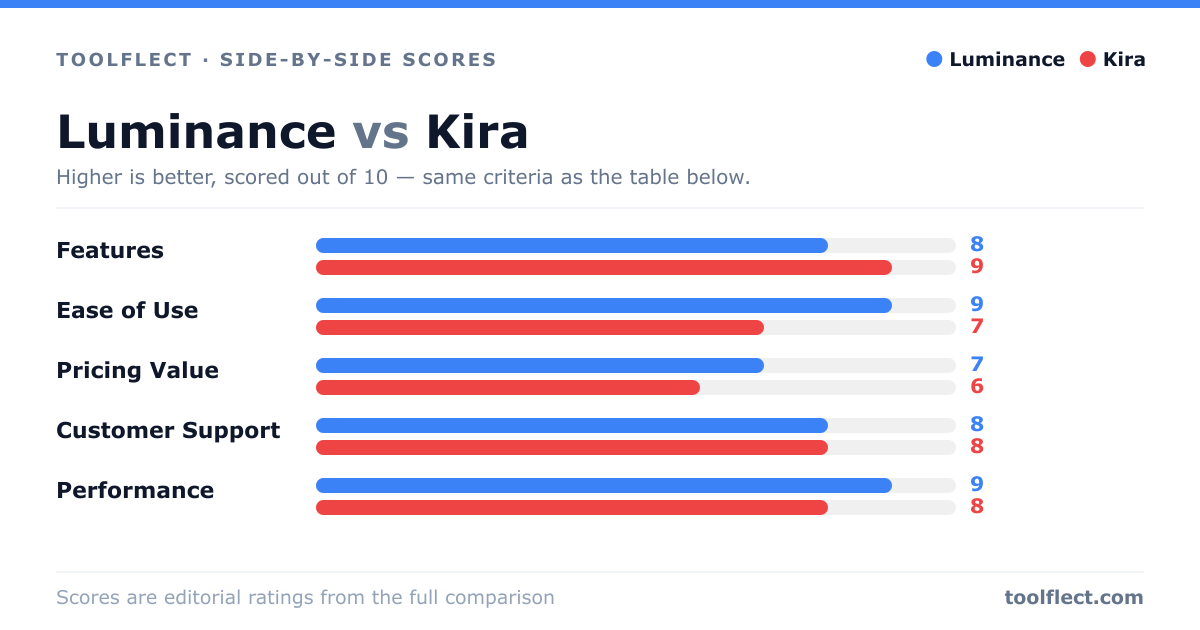
| Criterion | Luminance | Kira |
|---|---|---|
| Features | 8/10 | 9/10 |
| Ease of Use | 9/10 | 7/10 |
| Pricing Value | 7/10 | 6/10 |
| Customer Support | 8/10 | 8/10 |
| Performance | 9/10 | 8/10 |