DeepSeek vs OpenAI: Which AI Tool Wins?
Overview
DeepSeek and OpenAI are two prominent providers of large language models (LLMs) and APIs. OpenAI, with its GPT series, has been a pioneer in the field, offering powerful models like GPT-4 and GPT-3.5. DeepSeek, a relative newcomer, has gained attention for its open-source models and competitive pricing. This comparison aims to provide an unbiased look at their offerings, helping you decide which is better suited for your projects.
Key Features Comparison
- Model Variety: OpenAI offers a range of models including GPT-4, GPT-3.5, and specialized variants like Whisper for speech. DeepSeek provides models like DeepSeek-V2 and DeepSeek-Coder, with a focus on open-source availability.
- API Accessibility: Both offer RESTful APIs with SDKs in multiple languages. OpenAI has extensive documentation and a large community. DeepSeek’s API is straightforward but less documented.
- Context Window: OpenAI’s GPT-4 supports up to 128k tokens, while DeepSeek-V2 offers 128k as well, but some models have smaller windows.
- Multimodal Capabilities: OpenAI’s GPT-4 can process images and text, while DeepSeek primarily focuses on text, though some models support code.
- Fine-tuning: Both allow fine-tuning on custom datasets, but OpenAI’s fine-tuning is more mature with a dedicated API.
- Open Source: DeepSeek releases open-source weights for many models, allowing self-hosting. OpenAI does not release weights for its flagship models.
Pros & Cons
DeepSeek
- Pros:
- Open-source and free to use, with no API costs.
- Strong performance in coding and mathematical reasoning.
- Supports long context windows (up to 128k tokens).
- Transparent model architecture and training details.
- Cons:
- Limited ecosystem and third-party integrations compared to OpenAI.
- Smaller community and fewer tutorials/resources.
- Less polished user interface and developer tools.
- May require more technical expertise to deploy.
OpenAI
- Pros:
- Industry-leading models (GPT-4, GPT-4o) with broad capabilities.
- Extensive API and SDKs, plus integrations with many platforms.
- Robust developer support, documentation, and community.
- Advanced features like vision, DALL-E, and Whisper.
- Cons:
- Paid plans can be expensive for heavy usage.
- Closed-source and proprietary, limiting customization.
- Data privacy concerns and potential for bias.
- Occasional rate limits and downtime.
DeepSeek
- Pros:
- Open-source and free to use
- Strong performance in coding and math tasks
- Supports long context (up to 1M tokens)
- Transparent model architecture
- Cons:
- Limited ecosystem and integrations
- Less polished user interface
- Smaller community and fewer tutorials
- May require technical expertise for deployment
OpenAI
- Pros:
- Industry-leading models (GPT-4, GPT-4o)
- Extensive API and plugin ecosystem
- User-friendly interfaces (ChatGPT, API)
- Strong customer support and documentation
- Cons:
- Subscription costs can be high
- Closed-source and proprietary
- Usage limits on free tier
- Occasional performance variability
DeepSeek
- Pros:
- Open-source and free to use, with commercial licensing available.
- Strong performance in coding and mathematical reasoning tasks.
- Supports long context windows (up to 1M tokens) for handling large documents.
- Transparent model architecture and training details.
- Cons:
- Limited ecosystem and third-party integrations compared to OpenAI.
- Smaller community and fewer tutorials/resources.
- Customer support is primarily community-based, not dedicated.
- May require technical expertise for self-hosting or fine-tuning.
OpenAI
- Pros:
- Industry-leading models (GPT-4, GPT-4 Turbo) with broad capabilities.
- Extensive API and SDK support, plus integrations with many platforms.
- Robust documentation, developer resources, and active community.
- Enterprise-grade support and reliability with service-level agreements.
- Cons:
- Costly for high-volume usage; pricing can be prohibitive for some users.
- Closed-source, limiting customization and transparency.
- Data privacy concerns for sensitive information.
- Rate limits and potential downtime during peak usage.
DeepSeek
- Pros: Open-source models, competitive pricing, strong performance in coding tasks, transparency.
- Cons: Smaller ecosystem, less documentation, fewer third-party integrations, limited multimodal support.
OpenAI
- Pros: Industry-leading performance, extensive documentation, robust API, multimodal capabilities, strong support and community.
- Cons: Higher cost, closed-source, potential data privacy concerns, rate limits on lower tiers.
Pricing Comparison
Pricing models differ significantly. OpenAI charges per token for input and output, with GPT-4 costing $30 per 1M input tokens and $60 per 1M output tokens. GPT-3.5 is cheaper at $0.50/$1.50 per 1M tokens. DeepSeek offers more budget-friendly rates: DeepSeek-V2 costs $0.14 per 1M input tokens and $0.28 per 1M output tokens. However, OpenAI offers free credits for new users and a free tier for limited usage, while DeepSeek has a free trial but no permanent free tier. For high-volume usage, DeepSeek is significantly cheaper, but OpenAI’s performance may justify the cost for critical applications.
Best Use Cases
- DeepSeek: Ideal for startups and developers who need cost-effective AI, especially for coding assistance, data analysis, and projects where open-source is preferred.
- OpenAI: Best for enterprises requiring top-tier accuracy, multimodal capabilities, and reliable support. Suitable for customer service, content generation, and complex reasoning tasks.
Verdict
Both DeepSeek and OpenAI have their strengths. OpenAI remains the leader in performance and ecosystem, but at a premium price. DeepSeek offers a compelling alternative with open-source models and lower costs, making it attractive for budget-conscious developers. The choice ultimately depends on your specific needs: if you prioritize cost and openness, DeepSeek is a strong contender; if you need the best performance and support, OpenAI is the safer bet.
FAQ
Which API is more affordable?
DeepSeek is significantly cheaper than OpenAI for most usage levels. For example, DeepSeek-V2 costs $0.14 per 1M input tokens, while GPT-4 costs $30 per 1M input tokens. However, OpenAI offers a free tier and credits for new users, which can reduce initial costs.
Can I self-host DeepSeek models?
Yes, DeepSeek releases open-source weights for many of its models, allowing you to self-host them on your own infrastructure. OpenAI does not offer this option for its flagship models.
Which API has better performance?
OpenAI’s GPT-4 generally outperforms DeepSeek-V2 in many benchmarks, especially in complex reasoning and multimodal tasks. However, DeepSeek-V2 is competitive in coding and specific domains, and performance can vary based on the task.
Are there any limitations on API usage?
Both APIs have rate limits and usage policies. OpenAI has tiered rate limits based on your subscription, while DeepSeek has similar limits. Check the respective documentation for details.
Visual Comparison
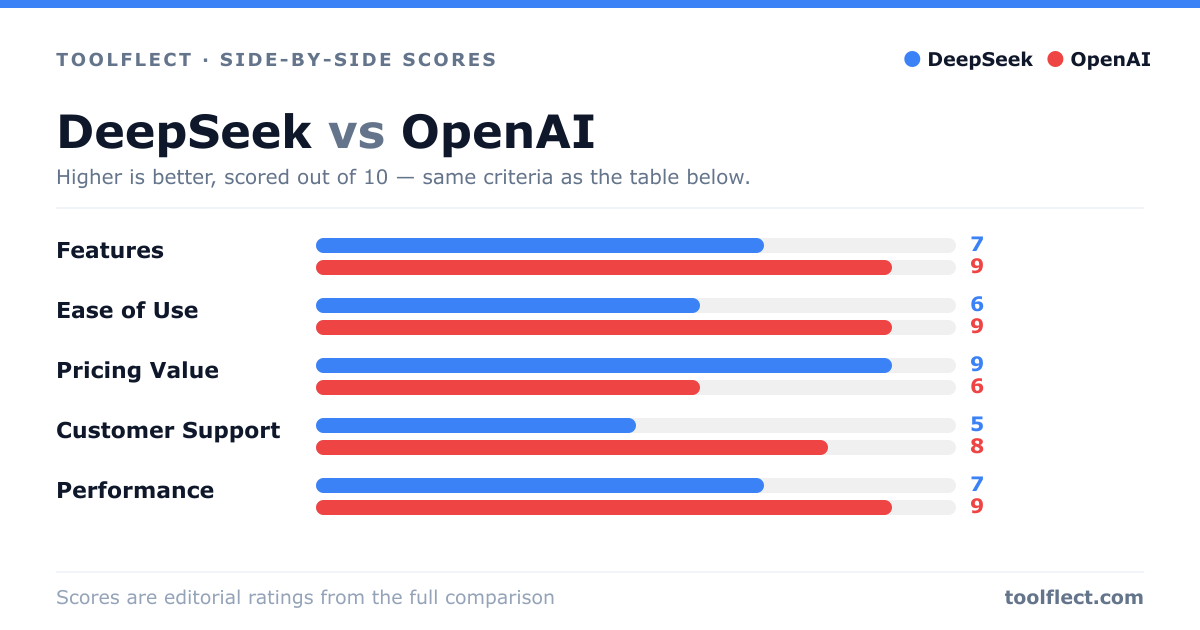
| Criterion | DeepSeek | OpenAI |
|---|---|---|
| Features | 8/10 – Strong in coding, math, long context | 9/10 – Broad multimodal, plugins, advanced tools |
| Ease of Use | 6/10 – Requires technical setup, less intuitive | 9/10 – User-friendly APIs, playground, clear docs |
| Pricing Value | 10/10 – Free and open-source | 6/10 – Pay-per-use, can be costly |
| Customer Support | 5/10 – Community support only | 8/10 – Dedicated support, extensive resources |
| Performance | 8/10 – Excellent for specific tasks | 9/10 – Consistent high performance across tasks |