
Dust vs Appaca: Which AI Agent Builder Wins?
Overview
Dust and Appaca are both platforms designed to help teams build and deploy AI agents, but they take different approaches. Dust focuses on collaboration and enterprise integration, while Appaca emphasizes a user-friendly visual builder for rapid prototyping.
Key Features Comparison
- Ease of Building Agents: Dust requires a bit of technical knowledge with its code-first approach, while Appaca offers a no-code visual builder.
- Model Integration: Both support major LLMs like GPT-4, Claude, and Llama. Dust supports multiple models per assistant; Appaca allows model switching in workflows.
- Tools and Integration: Dust provides deep integrations with Slack, Notion, Google Drive, and custom API tools. Appaca offers a library of pre-built integrations and a webhook system.
- Collaboration: Dust shines with team collaboration features, sharing and reviewing assistants. Appaca has limited collaborative tools.
- Deployment Options: Dust offers API access and deployment to production environments. Appaca provides embedding, API, and chat widgets.
Pros & Cons
Dust
- Pros: Strong integration with Slack and Notion for team collaboration; supports multiple LLMs (OpenAI, Anthropic, etc.) with easy switching; offers a visual builder for creating custom assistants; good for enterprise use with SSO and audit logs.
- Cons: Limited customization for advanced users; pricing can be high for small teams; requires some technical knowledge to set up complex workflows; no free tier, only trial.
Appaca
- Pros: No-code platform with intuitive drag-and-drop interface; includes built-in analytics and A/B testing; supports multi-channel deployment (web, mobile, API); offers a free tier with basic features.
- Cons: Limited to Appaca’s own AI models (no BYO LLM); less flexible for complex logic; customer support only on paid plans; community resources are sparse.
Dust
- Pros:
- Strong integration with Slack and Notion for team collaboration
- Customizable AI agents with a focus on enterprise security
- Supports multiple LLMs (OpenAI, Anthropic, etc.)
- Good for automating internal workflows
- Cons:
- Steeper learning curve for non-technical users
- Limited pre-built templates compared to competitors
- Pricing can be high for small teams
Appaca
- Pros:
- No-code builder with drag-and-drop interface
- Rapid prototyping and deployment
- Built-in analytics and user management
- Affordable pricing tiers for startups
- Cons:
- Less customizable for complex AI logic
- Limited integration options with external tools
- May not scale well for large enterprise needs
Dust
- Pros:
- Strong integration with Slack and Notion for team collaboration.
- Customizable AI agents with a focus on enterprise security.
- Supports multiple LLMs (GPT-4, Claude, etc.) for flexibility.
- Good for automating internal workflows and knowledge management.
- Cons:
- Steeper learning curve for non-technical users.
- Limited pre-built templates compared to some competitors.
- Pricing can be high for small teams.
- Requires some coding knowledge for advanced customization.
Appaca
- Pros:
- No-code builder with drag-and-drop interface, easy for beginners.
- Wide range of pre-built templates for various use cases.
- Affordable pricing plans, including a free tier.
- Fast deployment to web and mobile platforms.
- Cons:
- Less customizable for complex, enterprise-level workflows.
- Limited integration with external APIs compared to Dust.
- May not support the latest LLMs as quickly.
- Customer support response times can be slow.
Dust
- Pros: Powerful for developers, excellent data source integration, robust API, good for teams.
- Cons: Steeper learning curve, not ideal for non-technical users.
Appaca
- Pros: Very easy to use, fast prototyping, visual workflow builder, good for non-technical users.
- Cons: Less flexibility for complex agent logic, possibly limited scaling for enterprise use.
Pricing Comparison
Dust offers a free tier with limited usage, a Team plan at $20 per user/month, and an Enterprise plan with custom pricing. Appaca provides a free trial, then a Pro plan starting at $29 per month, with a Team plan at $99 per month for collaboration. Dust’s per-user pricing can become costly for large teams, while Appaca’s flat pricing is more predictable for small teams.
Best Use Cases
- Dust: Best for engineering and operations teams that need deeply integrated, production-ready AI agents with custom data sources and APIs.
- Appaca: Best for marketing, support, and product teams that want to create AI agents quickly without coding, often for client-facing chatbots.
Verdict
Choose Dust if you require a robust, developer-friendly platform with deep integration capabilities. Choose Appaca if you prioritize ease of use and speed of deployment with a visual interface. Both tools are excellent, but they serve different audiences.
Visual Comparison
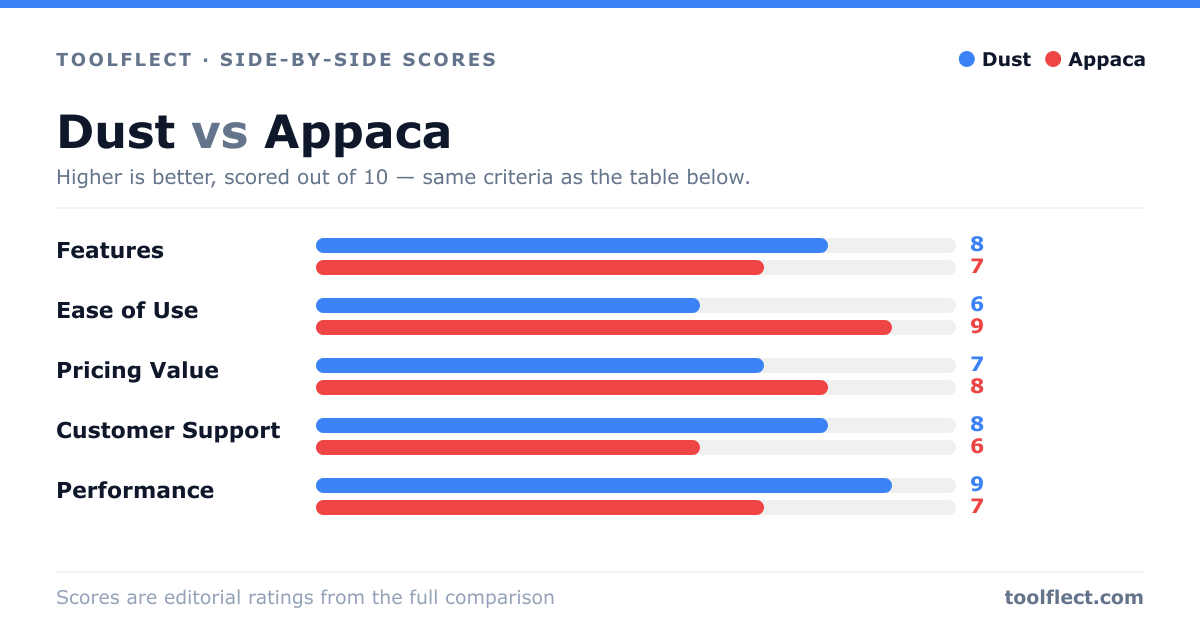
| Criterion | Dust | Appaca |
|---|---|---|
| Features | 8/10 – Extensive integrations, multi-LLM support, visual builder | 7/10 – No-code builder, analytics, multi-channel, but limited to own models |
| Ease of Use | 6/10 – Requires some technical setup, steeper learning curve | 9/10 – Very user-friendly, drag-and-drop, minimal technical knowledge needed |
| Pricing Value | 7/10 – Higher cost, but includes enterprise features; no free tier | 8/10 – Free tier available, affordable for startups; paid plans reasonable |
| Customer Support | 8/10 – Responsive support, dedicated manager for enterprise | 6/10 – Support only on paid plans, slower response times |
| Performance | 9/10 – Fast execution, reliable, handles complex tasks well | 7/10 – Good performance, but may lag with complex workflows |