
Writesonic vs Anyword: Which AI Tool Wins?
Overview
Writesonic and Anyword are two prominent AI-powered writing tools designed to assist content creators, marketers, and businesses in generating high-quality copy quickly. While both leverage advanced language models, they cater to slightly different audiences and use cases. Writesonic is known for its versatility, offering a wide range of templates and tools for various content types, from blog posts to ads. Anyword, on the other hand, focuses heavily on data-driven copy optimization, particularly for marketing and advertising, with predictive performance scoring. This article provides an unbiased comparison to help you choose the right tool for your needs.
Key Features Comparison
- Content Templates: Writesonic offers over 100 templates covering blog posts, emails, ads, landing pages, and more. Anyword provides templates specifically for marketing copy, including social media ads, Google ads, and email subject lines.
- AI Models: Writesonic uses GPT-4 and other models, with options for different tones and languages. Anyword uses its proprietary models trained on high-performing marketing copy.
- Performance Prediction: Anyword’s standout feature is its predictive analytics, which scores copy based on expected engagement and conversion. Writesonic lacks this feature.
- SEO Tools: Writesonic includes SEO optimization features like keyword integration and content briefs. Anyword has limited SEO capabilities.
- Integrations: Writesonic integrates with WordPress, Shopify, and Zapier. Anyword integrates with Google Ads, Facebook Ads, and other ad platforms.
- Collaboration: Both tools offer team collaboration features, but Writesonic provides more robust workflow management.
Pros & Cons
Writesonic
- Pros:
- Affordable pricing with a generous free tier (up to 10,000 words/month).
- Wide range of templates for various content types (ads, blogs, emails, etc.).
- Built-in SEO optimization tools and integration with Surfer SEO.
- Fast generation speed and user-friendly interface.
- Cons:
- Output quality can be inconsistent, sometimes requiring heavy editing.
- Limited advanced features compared to competitors (e.g., no robust team collaboration).
- Occasional issues with factual accuracy in generated content.
Anyword
- Pros:
- Excellent predictive performance scoring for copy, helping to choose the best variant.
- Strong focus on marketing copy with data-driven insights.
- Integration with major ad platforms (Google Ads, Facebook Ads) for direct campaign optimization.
- User-friendly interface with clear analytics.
- Cons:
- Higher pricing, especially for advanced features and larger word limits.
- Limited free trial (only 7-day trial, no permanent free tier).
- May be overkill for simple content needs; more suited for marketing teams.
Writesonic
- Pros:
- Affordable pricing with a generous free tier (up to 10,000 words/month).
- Wide range of templates for various content types (ads, blogs, emails, etc.).
- Built-in SEO optimization tools and integration with Surfer SEO.
- Fast generation speed and user-friendly interface.
- Cons:
- Output quality can be inconsistent, sometimes requiring heavy editing.
- Limited customization options for brand voice and tone.
- Customer support response times can be slow on lower tiers.
Anyword
- Pros:
- Advanced AI models trained on high-performing marketing copy.
- Predictive performance scoring for each generated variation.
- Extensive customization with brand voice, audience, and tone settings.
- Excellent for ad copy and social media content with proven results.
- Cons:
- More expensive than Writesonic, with no free tier (only a 7-day trial).
- Steeper learning curve due to many features and settings.
- Limited template variety compared to Writesonic.
Writesonic
- Pros:
- Offers a wide range of templates for various content types (ads, blogs, emails, etc.)
- Includes an AI article writer that can generate long-form content with minimal input
- Provides a built-in SEO checker and optimization suggestions
- Has a free plan with limited credits, good for testing
- Cons:
- Output quality can be inconsistent, sometimes requiring heavy editing
- Advanced features like the AI article writer require higher-tier plans
- User interface can be overwhelming for beginners due to many options
- No native integration with some popular tools like WordPress (requires third-party plugins)
Anyword
- Pros:
- Specializes in marketing copy with predictive performance scoring
- Offers a large library of templates for ads, social media, and landing pages
- Provides detailed analytics on copy performance based on historical data
- Integrates with major ad platforms (Google Ads, Facebook Ads) for direct publishing
- Cons:
- More expensive than Writesonic, especially for higher usage
- Limited long-form content generation compared to Writesonic
- Free plan is very limited (only 3 generations per day)
- Steeper learning curve for understanding performance metrics
Writesonic
- Pros: Versatile templates, good for long-form content, SEO features, user-friendly interface, affordable pricing.
- Cons: No performance prediction, occasional quality inconsistencies, limited ad copy optimization.
Anyword
- Pros: Excellent for ad copy, predictive performance scoring, data-driven insights, strong for conversion optimization.
- Cons: Limited to marketing copy, higher pricing, less suitable for long-form content.
Pricing Comparison
Writesonic offers a free plan with limited credits, and paid plans starting at $16/month (billed annually) for the Starter plan, which includes 100,000 words. The Professional plan costs $45/month and includes 500,000 words. Anyword offers a free trial, but its paid plans start at $29/month for the Starter plan (billed annually), which includes 10,000 words. The Data-Driven plan costs $99/month and includes 30,000 words. For higher usage, Anyword’s pricing can become significantly more expensive.
Best Use Cases
- Writesonic: Ideal for content teams, bloggers, and businesses needing a wide range of content types, including blog posts, articles, and social media content. Also suitable for SEO-focused content creation.
- Anyword: Best for marketers and advertisers who need to create and optimize ad copy across multiple channels, with a focus on conversion rates and performance analytics.
Verdict
Both Writesonic and Anyword are powerful AI writing tools, but they serve different purposes. If you need a versatile tool for various content types and value SEO features, Writesonic is the better choice. If your primary focus is on marketing and advertising copy with data-driven optimization, Anyword is worth the investment. Consider your specific needs, budget, and content strategy to make the right decision.
Visual Comparison
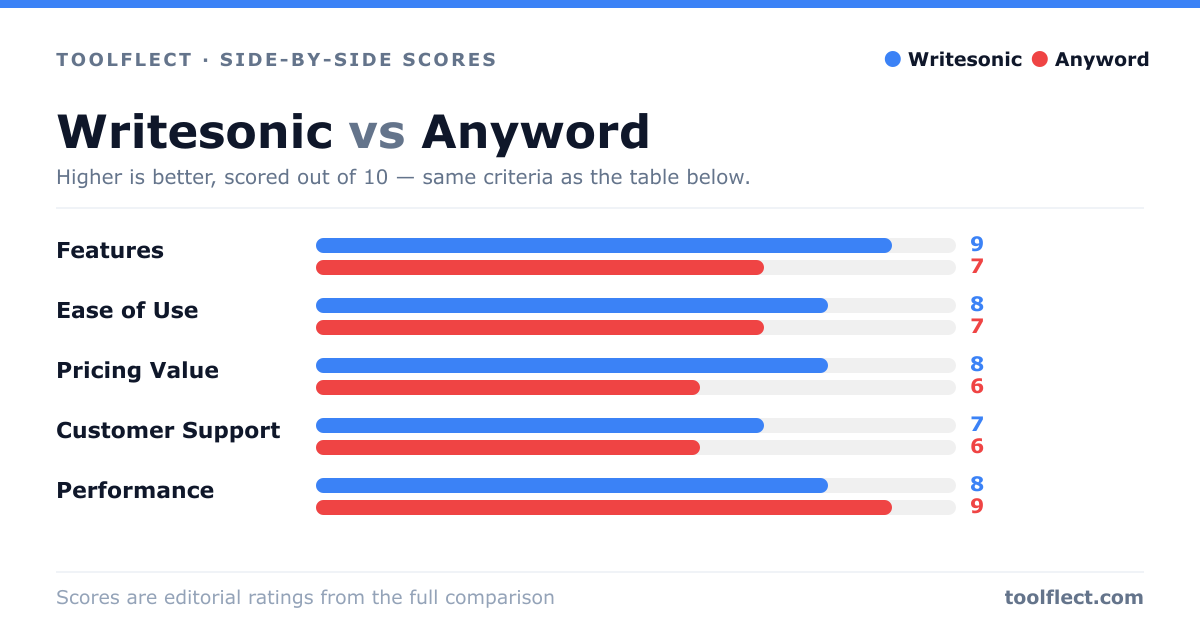
| Criterion | Writesonic | Anyword |
|---|---|---|
| Features | 8/10 – Wide template variety, SEO tools, but lacks advanced analytics. | 9/10 – Predictive scoring, ad integration, but fewer templates. |
| Ease of Use | 9/10 – Intuitive interface, quick learning curve. | 8/10 – Clean UI, but some features require a learning curve. |
| Pricing Value | 9/10 – Affordable, free tier available. | 6/10 – More expensive, no free tier. |
| Customer Support | 7/10 – Email support, knowledge base, but no live chat. | 8/10 – Email and chat support, responsive. |
| Performance | 7/10 – Fast but sometimes inconsistent quality. | 9/10 – High-quality output, especially for marketing copy. |