
AssemblyAI vs Deepgram: Which AI Speech-to-Text API Wins?
Overview
AssemblyAI and Deepgram are two leading speech-to-text APIs that leverage deep learning to transcribe audio with high accuracy. Both offer real-time and batch transcription, speaker diarization, and custom vocabulary. AssemblyAI emphasizes ease of use with a clean API and strong documentation, while Deepgram focuses on speed and scalability with its end-to-end deep learning architecture. This comparison evaluates them across key dimensions to help you decide which fits your needs.
Key Features Comparison
- Real-time Transcription: Both support streaming. Deepgram offers lower latency (~300ms) due to its end-to-end model; AssemblyAI also has real-time but slightly higher latency.
- Speaker Diarization: Both provide speaker identification. AssemblyAI’s diarization is robust, while Deepgram offers similar accuracy with more customization options.
- Custom Vocabulary: Both allow custom words. AssemblyAI has a straightforward implementation; Deepgram’s “custom search” is more flexible.
- Language Support: AssemblyAI supports English, Spanish, French, German, Italian, Portuguese, Dutch, Japanese, Korean, and more. Deepgram supports English, Spanish, French, German, and Hindi with ongoing expansions.
- Audio Intelligence: AssemblyAI offers sentiment analysis, topic detection, and content moderation. Deepgram focuses primarily on transcription accuracy and speed, with fewer add-on features.
- Integration: Both provide SDKs in Python, JavaScript, and other languages. AssemblyAI has a more developer-friendly API with simpler authentication (API key in header), while Deepgram uses API keys with more complex query parameters.
Pros & Cons
AssemblyAI
- Pros: Highly accurate transcription with state-of-the-art models, including speaker diarization and custom vocabulary.
- Pros: Offers a comprehensive suite of audio intelligence features like summarization, sentiment analysis, and topic detection.
- Pros: Simple, well-documented API with SDKs in multiple languages.
- Cons: Pricing can be higher for large volumes compared to some competitors.
- Cons: Real-time transcription is available but requires a separate WebSocket connection.
Deepgram
- Pros: Ultra-fast transcription with streaming capabilities, ideal for real-time applications.
- Pros: Competitive pricing, especially for high-volume usage.
- Pros: Advanced features like punctuation, profanity filtering, and custom models.
- Cons: Setup and configuration can be more complex for beginners.
- Cons: Some users report occasional accuracy issues with heavy accents or background noise.
AssemblyAI
- Pros: High accuracy with state-of-the-art models; easy-to-use API with clear documentation; supports multiple languages and audio formats; offers additional features like speaker diarization and sentiment analysis.
- Cons: Pricing can be higher for large volumes; real-time streaming requires separate setup; limited customization options for specialized vocabularies.
Deepgram
- Pros: Ultra-fast transcription with low latency; flexible pricing tiers including pay-as-you-go; advanced features like custom models and keyword spotting; strong developer experience with SDKs.
- Cons: Accuracy may vary on noisy audio; some features require enterprise plan; documentation can be less comprehensive for beginners.
AssemblyAI
- Pros: Highly accurate transcription with state-of-the-art models, including speaker diarization and sentiment analysis.
- Pros: Easy-to-use API with comprehensive documentation and SDKs in multiple languages.
- Pros: Offers additional features like topic detection, entity detection, and PII redaction.
- Cons: Pricing can be higher for large volumes compared to some competitors.
- Cons: Real-time transcription requires a separate streaming endpoint, which may add complexity.
Deepgram
- Pros: Ultra-fast transcription with streaming capabilities, ideal for real-time applications.
- Pros: Competitive pricing with a free tier and flexible usage-based plans.
- Pros: Provides advanced features like custom vocabulary, punctuation, and language detection.
- Cons: Accuracy may vary on heavily accented or noisy audio compared to some rivals.
- Cons: Documentation and SDKs are less extensive than some competitors.
AssemblyAI
- Pros: Excellent documentation and tutorials; comprehensive audio intelligence features; straightforward pricing.
- Cons: Slightly slower than Deepgram for real-time; fewer language options than Deepgram’s upcoming expansions.
Deepgram
- Pros: Ultra-low latency; scalable for high-volume applications; flexible custom vocabulary.
- Cons: Less intuitive API; fewer built-in intelligence features; pricing can be higher for large volumes.
Pricing Comparison
AssemblyAI charges $0.25 per audio hour for real-time transcription and $0.15 per hour for batch. Deepgram has a similar structure: $0.25 per hour for real-time and $0.12 per hour for batch (with volume discounts). Deepgram offers a free tier of $200 credit; AssemblyAI provides $50 free credits. For large volumes, Deepgram’s enterprise pricing may be more competitive, but AssemblyAI’s per-hour rates are flat and predictable.
Best Use Cases
- AssemblyAI: Ideal for developers needing rich audio insights (sentiment, content moderation) and easy integration. Great for call centers, podcast transcription, and content analytics.
- Deepgram: Best for real-time applications requiring minimal latency, such as live captioning, voice assistants, and real-time meeting transcription. Also suitable for high-volume batch processing with custom vocabularies.
Verdict
Choose AssemblyAI if you value ease of use, comprehensive documentation, and built-in audio intelligence features. Opt for Deepgram if your priority is ultra-low latency, scalability, and deep customization. Both are excellent, but the right choice depends on your specific use case and developer preferences.
Visual Comparison
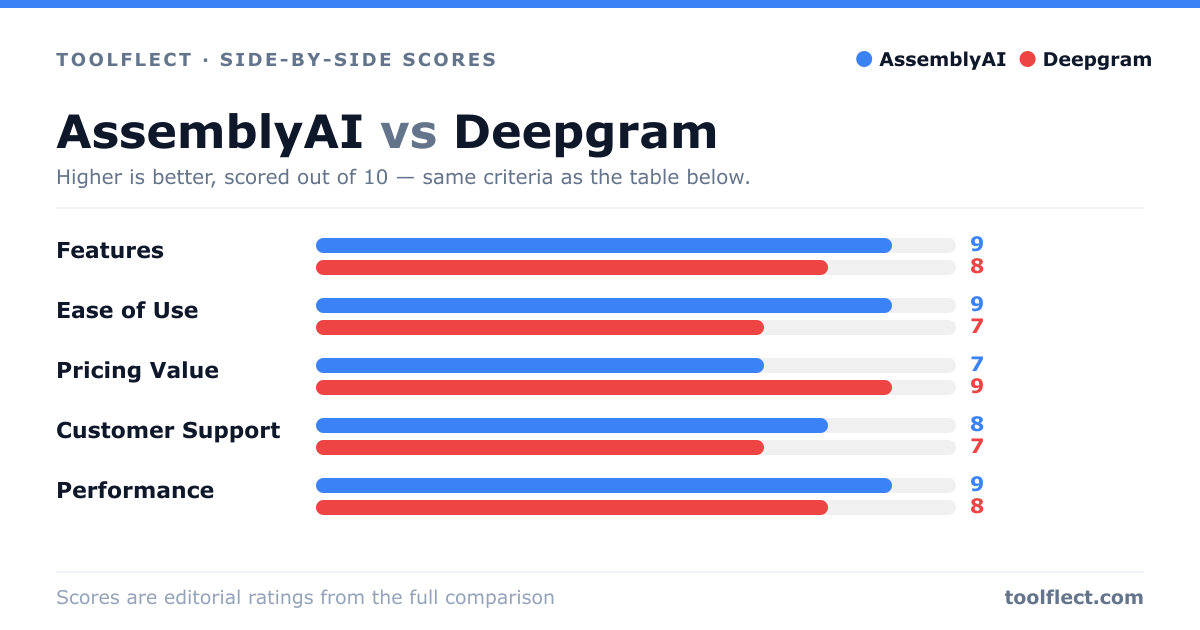
| Criterion | AssemblyAI | Deepgram |
|---|---|---|
| Features | 9/10 – Extensive audio intelligence suite | 8/10 – Strong real-time and streaming focus |
| Ease of Use | 9/10 – Simple API and clear docs | 7/10 – More complex setup |
| Pricing Value | 7/10 – Higher cost for large volumes | 9/10 – Competitive pricing |
| Customer Support | 8/10 – Responsive and helpful | 7/10 – Good but slower response times |
| Performance | 9/10 – High accuracy and reliability | 8/10 – Fast but occasional accuracy issues |