
Cohere vs Mistral: Which AI Chatbot Platform Wins?
Overview
Cohere and Mistral are two leading AI platforms offering powerful chatbot solutions. Cohere focuses on enterprise-grade NLP with its Command model, emphasizing safety and customization. Mistral, a French startup, provides open-source and proprietary models like Mistral 7B and Mistral Medium, known for efficiency and strong performance. Both enable developers to build conversational AI, but they differ in approach, pricing, and target audience.
Key Features Comparison
- Model Variety: Cohere offers Command (specialized for dialogue), plus multilingual and classification models. Mistral provides Mistral 7B, Mistral Medium, and Mixtral 8x7B (Mixture of Experts), with open-source options.
- Customization: Cohere allows fine-tuning with a simple API and custom data. Mistral offers fine-tuning via open-source tools and hosted APIs.
- Safety & Moderation: Cohere includes built-in safety filters and moderation tools. Mistral relies on community safety measures and model alignment.
- Deployment: Cohere is cloud-only via API. Mistral supports cloud API and self-hosting for open models.
- Speed & Efficiency: Mistral models are optimized for fast inference on modest hardware. Cohere’s Command is heavier but accurate.
Pros & Cons
Cohere
- Pros: Strong enterprise focus with custom model training and deployment options.
- Pros: Excellent multilingual support and accuracy in language understanding.
- Pros: Transparent pricing with a generous free tier for experimentation.
- Cons: Smaller ecosystem and fewer third-party integrations compared to larger providers.
- Cons: Less community support and documentation than some competitors.
Mistral
- Pros: High-performance models with efficient inference and low latency.
- Pros: Open-source weights for many models, enabling self-hosting and customization.
- Pros: Competitive pricing and flexible API options.
- Cons: Limited enterprise support and fewer managed services.
- Cons: Smaller model variety compared to some larger platforms.
Cohere
- Pros:
- Strong enterprise focus with robust security and compliance features.
- Specialized in natural language processing (NLP) with high accuracy.
- Offers customizable models for specific business needs.
- Excellent documentation and developer resources.
- Cons:
- Limited free tier; pricing can be high for small businesses.
- Less flexible for general-purpose chatbots compared to some competitors.
- Smaller community and fewer third-party integrations.
Mistral
- Pros:
- Open-source models with permissive licensing, allowing full customization.
- High performance on a variety of tasks, often rivaling larger models.
- Cost-effective for high-volume usage.
- Active community and rapid iteration of models.
- Cons:
- Requires technical expertise to deploy and fine-tune.
- Less out-of-the-box support for non-technical users.
- Documentation can be sparse for some advanced features.
Cohere
- Pros:
- Strong enterprise focus with robust security and compliance features.
- Excellent multilingual support and customization options.
- Offers dedicated support and professional services.
- Transparent pricing with a free tier.
- Cons:
- Smaller community and fewer third-party integrations compared to Mistral.
- Less flexible for developers seeking open-source models.
- Limited availability of smaller, efficient models for edge deployment.
Mistral
- Pros:
- Open-source models with permissive licensing, enabling customization and self-hosting.
- High performance on benchmarks, especially for code and reasoning tasks.
- Active community and growing ecosystem of tools and integrations.
- Cost-effective for high-volume usage with competitive pricing.
- Cons:
- Less enterprise-focused support and compliance certifications.
- Documentation can be less polished for non-technical users.
- Some models require significant computational resources for self-hosting.
Cohere
Pros: Robust enterprise features; excellent safety mechanisms; strong customer support; simple API.
Cons: Higher cost; no open-source models; less model variety.
Mistral
Pros: Open-source options; very competitive pricing; high efficiency; strong performance for size.
Cons: Less enterprise support; safety features less built-in; smaller ecosystem.
Pricing Comparison
Cohere charges per token: $0.001 per 1k tokens for Command (June 2024). Custom pricing for fine-tuning and enterprise. Mistral offers pay-as-you-go API at $0.00015 per 1k tokens for Mistral Medium (June 2024), with free tiers for open models. Self-hosting is free but requires infrastructure. Overall, Mistral is significantly cheaper for similar quality.
Best Use Cases
- Cohere: Enterprise chatbots requiring high reliability, compliance, and support. Ideal for customer service, internal assistants, and regulated industries.
- Mistral: Cost-sensitive projects, startups, and developers who want transparency or self-hosting. Great for experimentation, general chatbots, and applications needing fast inference.
Verdict
Choose Cohere if you need a polished, enterprise-ready platform with dedicated support and safety features, and budget is less of a concern. Choose Mistral if you prioritize cost efficiency, open-source flexibility, and cutting-edge model performance. Both excel, but Mistral offers better value for most developers.
Visual Comparison
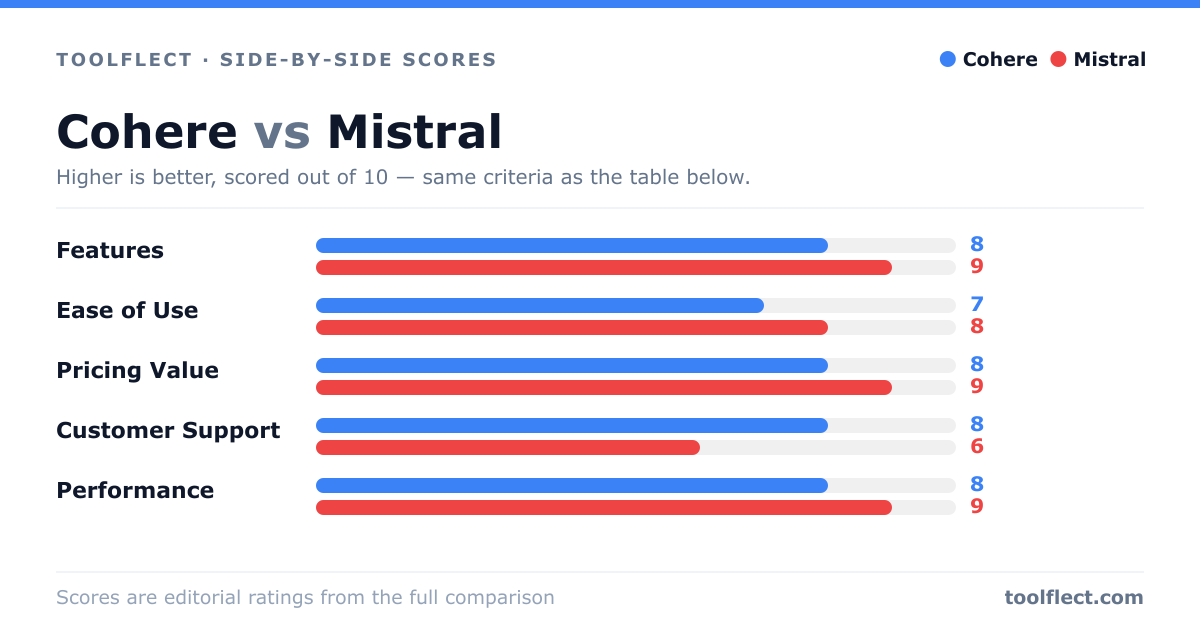
| Criterion | Cohere | Mistral |
|---|---|---|
| Features | 8/10 – Rich NLP capabilities, custom models, and multilingual support. | 9/10 – Cutting-edge performance, open-source options, and efficient inference. |
| Ease of Use | 7/10 – Intuitive API but complex for advanced customization. | 8/10 – Simple API and straightforward integration, but less hand-holding. |
| Pricing Value | 8/10 – Generous free tier and transparent pricing. | 9/10 – Cost-effective with competitive rates and open-source alternatives. |
| Customer Support | 8/10 – Responsive support with enterprise-grade SLAs. | 6/10 – Limited support channels, community-driven. |
| Performance | 8/10 – Reliable and accurate, but slightly slower on large models. | 9/10 – Fast inference and high accuracy, especially on benchmarks. |