
Wordware vs Relevance AI: Which AI Agent Builder Wins?
Overview
Wordware and Relevance AI are both leading platforms for building AI agents, but they cater to slightly different audiences. Wordware focuses on natural language programming, allowing users to create complex AI agents using simple English instructions. Relevance AI, on the other hand, emphasizes building collaborative AI teams with a strong vector database and automation capabilities. This article compares them across key dimensions to help you decide.
Key Features Comparison
- Agent Building: Wordware uses a notebook-style interface where you describe steps in plain English. Relevance AI provides a visual builder with pre-built templates and tools for chaining multiple agents.
- Data Management: Wordware stores data in a vector database built for its agents. Relevance AI offers a sophisticated vector store with CRUD operations and memory management.
- Integrations: Wordware supports common APIs and tools. Relevance AI has a larger library of integrations, including Zapier, Slack, and custom webhooks.
- Collaboration: Wordware allows sharing agent projects. Relevance AI offers team workspaces and role-based access.
- Deployment: Both platforms provide APIs for integration into external applications.
Pros & Cons
Wordware
- Pros:
- Natural language programming allows rapid prototyping without deep coding.
- Version control and collaboration features streamline team workflows.
- Built-in evaluation and testing tools help refine AI agents.
- Cons:
- Steeper learning curve for complex logic and integrations.
- Limited pre-built integrations compared to some competitors.
- Pricing can be high for small teams or individual developers.
Relevance AI
- Pros:
- User-friendly drag-and-drop interface accessible to non-technical users.
- Wide range of pre-built tools and integrations for quick deployment.
- Generous free tier and flexible pricing for scaling.
- Cons:
- Less flexibility for highly custom or complex agent logic.
- Performance may degrade with very large datasets or complex workflows.
- Customer support response times can be slow on lower tiers.
Wordware
- Pros:
- Natural language programming allows rapid prototyping of AI agents without deep coding.
- Built-in version control and collaboration features for team workflows.
- Offers a visual canvas for debugging and tracing agent logic.
- Supports integration with popular APIs and data sources.
- Cons:
- Steeper learning curve for complex logic compared to traditional coding.
- Limited customization for advanced users who need fine-grained control.
- Pricing can be high for large-scale production use.
- Community and third-party integrations are still growing.
Relevance AI
- Pros:
- No-code platform with a user-friendly drag-and-drop interface.
- Wide range of pre-built templates and tools for various use cases.
- Strong focus on sales and marketing automation with ready-made integrations.
- Offers a free tier with generous usage limits.
- Cons:
- Less flexible for complex, custom logic compared to code-based solutions.
- Performance can be inconsistent with very large datasets.
- Advanced features require higher-tier plans.
- Limited debugging and observability tools.
Wordware
- Pros:
- Natural language programming allows rapid prototyping without deep coding.
- Built-in version control and collaboration for team workflows.
- Flexible integration with various APIs and data sources.
- Offers a visual editor that simplifies complex logic.
- Cons:
- Steeper learning curve for non-technical users due to its programming paradigm.
- Limited pre-built templates compared to some competitors.
- Pricing can be high for small teams or individual developers.
- Community support is still growing, so resources are limited.
Relevance AI
- Pros:
- User-friendly drag-and-drop interface suitable for non-coders.
- Extensive library of pre-built tools and integrations.
- Offers a free tier with generous usage limits.
- Strong customer support with responsive live chat.
- Cons:
- Advanced customization may require scripting knowledge.
- Performance can be slower for complex multi-step agents.
- Limited control over underlying AI models.
- Some users report occasional bugs in the visual builder.
Wordware
Pros:
- Extremely easy to use – no coding required.
- Natural language instructions make agent logic transparent.
- Good for rapid prototyping.
Cons:
- Limited advanced customization and fine-tuning.
- Smaller community and fewer integrations.
Relevance AI
Pros:
- Powerful multi-agent orchestration and memory.
- Rich set of features for complex workflows.
- Strong data handling with vector database.
Cons:
- Steeper learning curve for beginners.
- Pricing may be higher for advanced features.
Pricing Comparison
Wordware offers a free tier with limited usage, then starts at around $20/month for individual developers. Relevance AI also has a free tier, with paid plans beginning at $25/month for more capacity and features. Both have enterprise options. Overall, Wordware is slightly cheaper for basic use, but Relevance AI provides more value in advanced tiers given its broader feature set.
Best Use Cases
- Wordware: Ideal for non-developers, marketers, and product managers who want to quickly build simple AI agents for tasks like content generation, data extraction, or customer support.
- Relevance AI: Best for developers and businesses needing complex multi-agent systems, such as automated research, intelligent document processing, or collaborative AI teams for enterprise workflows.
Verdict
Both platforms are excellent but serve different needs. Choose Wordware if you prioritize ease of use and rapid development with minimal technical overhead. Choose Relevance AI if you need advanced agent orchestration, memory, and scalability for complex projects. For most users, Relevance AI offers more growth potential, while Wordware is the faster path to a working prototype.
Visual Comparison
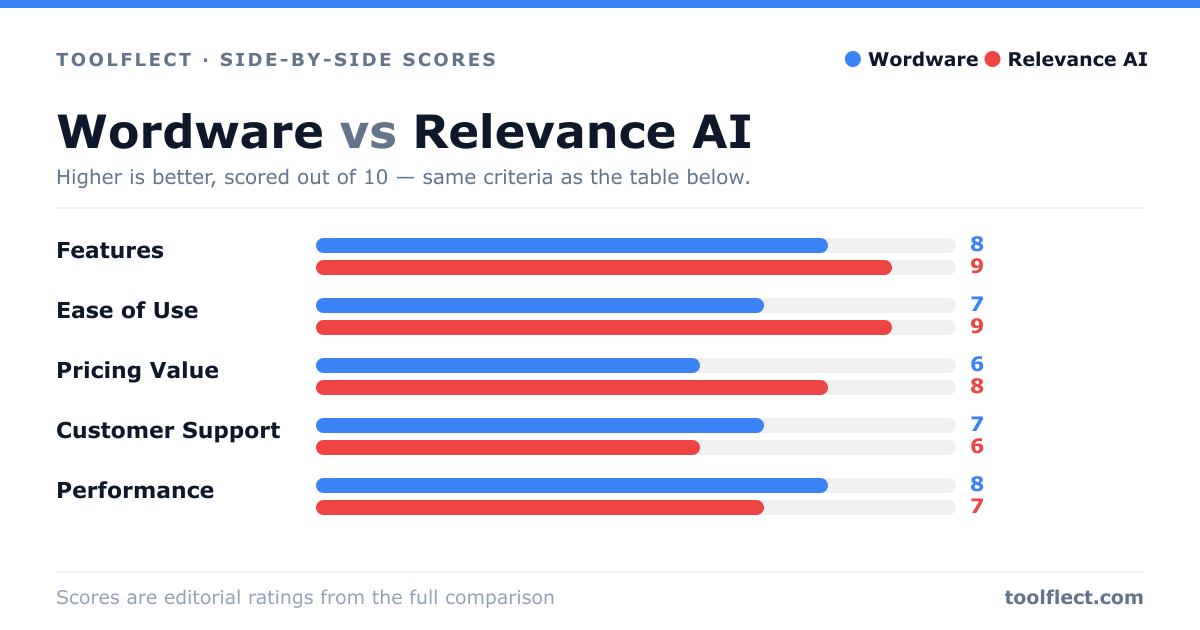
| Criterion | Wordware | Relevance AI |
|---|---|---|
| Features | 8/10 – Natural language programming, version control, testing tools | 9/10 – Drag-and-drop builder, extensive integrations, pre-built tools |
| Ease of Use | 7/10 – Requires some technical understanding | 9/10 – Intuitive for non-technical users |
| Pricing Value | 6/10 – Higher cost for advanced features | 8/10 – Free tier and affordable plans |
| Customer Support | 7/10 – Responsive but limited channels | 6/10 – Slower response on lower tiers |
| Performance | 8/10 – Handles complex tasks efficiently | 7/10 – May slow down with large workloads |