
Leonardo.ai vs Ideogram: Which AI Image Generator Wins?
Overview
Leonardo.ai and Ideogram are two prominent AI image generation platforms, each with distinct strengths. Leonardo.ai, launched in 2022, focuses on providing a comprehensive suite of creative tools, including fine-tuned models, real-time canvas, and 3D texture generation. Ideogram, founded by former Google Brain researchers, debuted in 2023 with a strong emphasis on typography and text rendering within images, making it ideal for designs that require legible text.
While both tools generate images from text prompts, they cater to different user needs. Leonardo.ai appeals to artists, game developers, and marketers seeking versatility and control, whereas Ideogram targets graphic designers, social media creators, and anyone needing text-integrated visuals. This comparison examines their features, pros and cons, pricing, and best use cases to help you decide which tool suits your workflow.
Key Features Comparison
Leonardo.ai
- Model Variety: Offers multiple fine-tuned models (e.g., Leonardo Diffusion, Kino XL, Vision XL) for different styles like photorealism, anime, and concept art.
- Real-Time Canvas: Allows interactive editing and generation on a canvas, with instant feedback.
- 3D Texture Generation: Unique feature to generate textures for 3D models, useful for game development.
- Custom Model Training: Users can train their own models on uploaded datasets (available on paid plans).
- AI Canvas & Prompt Magic: Enhances prompts and provides tools for inpainting, outpainting, and upscaling.
Ideogram
- Superior Text Rendering: Excels at generating images with accurate, legible text, including logos, posters, and typography.
- Magic Prompt: Automatically enhances user prompts for better results, with a toggle option.
- Style Variety: Offers diverse styles like 3D, cinematic, and illustration, with a focus on design-oriented outputs.
- Remix & Variations: Easily create variations of existing images or remix them with new prompts.
- Batch Generation: Generates multiple images at once, with options to upscale and download.
Pros & Cons
Leonardo.ai
- Pros:
- Extensive model library and customization options for advanced users.
- Real-time canvas and 3D texture generation set it apart for game and concept artists.
- Generous free tier with daily credits, allowing users to test features.
- Cons:
- Steeper learning curve due to many settings and models.
- Text rendering in images is often inaccurate or illegible.
- Free tier has slower generation speeds and limited credits.
Ideogram
- Pros:
- Best-in-class text rendering, ideal for designs with typography.
- User-friendly interface with quick prompt enhancement via Magic Prompt.
- High-quality outputs with strong adherence to prompts.
- Cons:
- Limited model variety and customization compared to Leonardo.ai.
- No free tier for commercial use; free plan restricts usage and adds watermarks.
- Lacks advanced editing tools like inpainting or 3D generation.
Pricing Comparison
Leonardo.ai offers a free tier with 150 daily credits (up to 30 images), and paid plans start at $12/month for 8,500 credits, $30/month for 25,000 credits, and $60/month for 60,000 credits. Annual billing provides discounts. Ideogram has a free plan with 25 images per day (non-commercial, watermarked) and paid plans: Basic at $8/month for 400 images, Plus at $20/month for 1,000 images, and Pro at $60/month for 3,000 images. Both offer commercial usage rights on paid plans, but Ideogram’s free tier is more restrictive.
Best Use Cases
Leonardo.ai
- Game development: Generate 3D textures and concept art.
- Digital art: Create detailed illustrations with custom models.
- Marketing: Produce versatile visuals for campaigns with fine-tuned control.
Ideogram
- Graphic design: Create posters, logos, and social media graphics with text.
- Branding: Develop marketing materials with legible typography.
- Quick content: Generate high-quality images with minimal prompt engineering.
Verdict
Choosing between Leonardo.ai and Ideogram depends on your primary needs. Leonardo.ai is the better choice for artists, game developers, and users who require extensive customization, model variety, and advanced tools like 3D texture generation. Its free tier is more generous, making it accessible for experimentation. However, if your work involves text in images—such as logos, posters, or social media content—Ideogram is superior due to its unmatched text rendering capabilities and user-friendly design. Ideogram also produces high-quality results with less effort, but it lacks the depth of customization found in Leonardo.ai. Ultimately, Leonardo.ai wins for versatility and advanced features, while Ideogram excels for typography-focused and design-centric tasks.
FAQ
Is Leonardo.ai or Ideogram better for generating images with text?
Ideogram is significantly better for images containing text. It was specifically designed to render legible typography, making it ideal for logos, posters, and designs where text accuracy is crucial. Leonardo.ai often struggles with text generation, producing garbled or illegible characters.
Can I use Leonardo.ai and Ideogram for free?
Yes, both offer free tiers. Leonardo.ai provides 150 daily credits (about 30 images) with no watermark, while Ideogram offers 25 images per day but with watermarks and non-commercial usage restrictions. Paid plans remove these limitations.
Which tool is more suitable for professional game development?
Leonardo.ai is more suitable for game development due to its 3D texture generation, custom model training, and a wide range of styles for concept art. Ideogram lacks these specialized features and is more focused on graphic design.
Do both tools offer commercial usage rights?
Yes, both Leonardo.ai and Ideogram grant commercial usage rights on their paid plans. However, Ideogram’s free tier is for non-commercial use only, while Leonardo.ai’s free tier allows commercial use with attribution.
Visual Comparison
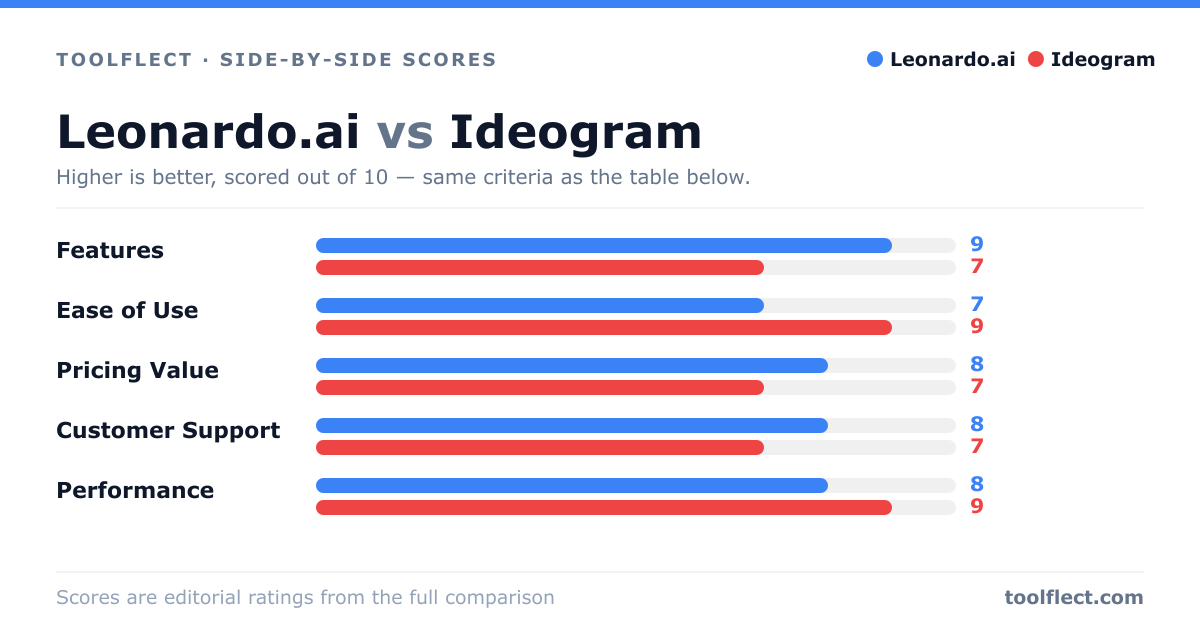
| Criterion | Leonardo.ai | Ideogram |
|---|---|---|
| Features | 9/10 | 7/10 |
| Ease of Use | 7/10 | 9/10 |
| Pricing Value | 8/10 | 7/10 |
| Customer Support | 8/10 | 7/10 |
| Performance | 8/10 | 9/10 |