
Kith vs AI Spend Console: Which Wins?
Overview
Kith and AI Spend Console are two distinct tools serving different business needs. Kith is a customer relationship management (CRM) platform designed to streamline sales and marketing workflows. AI Spend Console, on the other hand, is a specialized platform for monitoring and optimizing cloud AI spending. This comparison will evaluate both tools across key criteria to help you decide which aligns with your business goals.
Key Features Comparison
Kith
- Contact management and pipeline tracking
- Email automation and campaign management
- Sales analytics and reporting dashboards
- Integration with popular tools like Slack and Zapier
AI Spend Console
- Real-time tracking of AI API usage and costs
- Budget alerts and anomaly detection
- Cost allocation by project or team
- Integration with major AI providers (OpenAI, Anthropic, etc.)
Pros & Cons
Kith
- Pros: Intuitive interface for sales teams; robust automation features; strong reporting capabilities.
- Pros: Scalable for small to medium businesses; good customer support.
- Pros: Seamless integrations with common business tools.
- Cons: Limited advanced customization; pricing can be high for small teams.
- Cons: No dedicated AI cost management features.
- Cons: Steeper learning curve for non-sales users.
AI Spend Console
- Pros: Specialized focus on AI cost optimization; real-time visibility.
- Pros: Easy setup with API keys; automated alerts prevent overspending.
- Pros: Helps allocate costs accurately across teams.
- Cons: Not a CRM; lacks sales features.
- Cons: Limited to AI-related expenses; no general business analytics.
- Cons: May require technical knowledge to configure advanced rules.
Pricing Comparison
Kith offers tiered pricing starting at $15/user/month (Essential), $35/user/month (Professional), and custom pricing for Enterprise. AI Spend Console typically charges a percentage of monitored spend (e.g., 2-5%) or a flat monthly fee based on usage volume, with a free tier for small projects. For a small team, Kith may cost more upfront, while AI Spend Console scales with your AI usage.
Best Use Cases
Kith is best for sales teams needing a comprehensive CRM to manage leads, automate follow-ups, and track performance. AI Spend Console is ideal for engineering and finance teams that need to control and optimize cloud AI costs, especially in organizations with heavy AI usage.
Verdict
Choose Kith if your primary need is sales and customer relationship management. Choose AI Spend Console if you’re focused on managing AI-related expenses. They serve different purposes, so the right choice depends on your specific business requirements.
FAQ
Can Kith integrate with AI Spend Console?
There is no direct integration, but both can be used separately. You could manually export data from AI Spend Console and import into Kith for reporting, but it’s not seamless.
Which tool is more cost-effective for a startup?
For a startup with limited sales needs, AI Spend Console’s free tier might be more cost-effective. However, if you need a CRM, Kith’s Essential plan is reasonably priced.
Do both tools offer customer support?
Yes, both offer customer support. Kith provides email and chat support on all plans, while AI Spend Console offers support via email and a knowledge base.
Can I use AI Spend Console for non-AI expenses?
No, AI Spend Console is specifically designed for AI-related costs. For general expense management, you’d need a different tool.
Visual Comparison
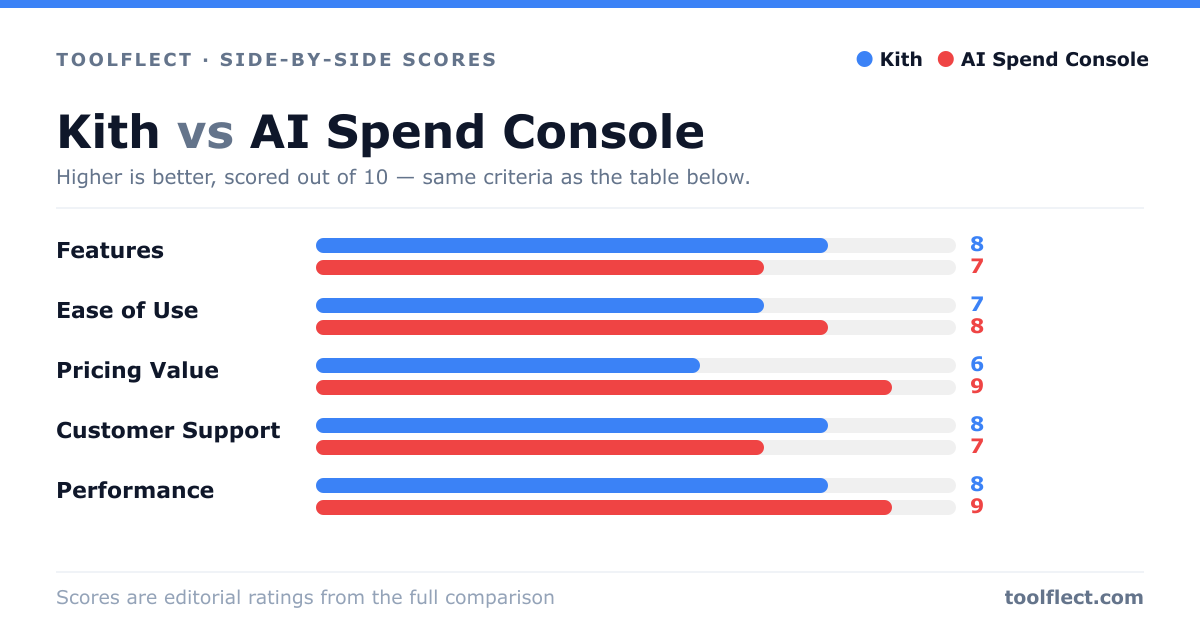
| Criterion | Kith | AI Spend Console |
|---|---|---|
| Features | 8/10 | 7/10 |
| Ease of Use | 7/10 | 8/10 |
| Pricing Value | 6/10 | 9/10 |
| Customer Support | 8/10 | 7/10 |
| Performance | 8/10 | 9/10 |