
AssemblyAI vs Deepgram: Which Speech-to-Text API is Right for You?
Overview
AssemblyAI and Deepgram are two of the most popular speech-to-text APIs in the market, each offering advanced AI-powered transcription services. Both support real-time and batch processing, speaker diarization, and custom vocabulary, but they differ in architecture, pricing, and use-case specialization. This article provides an unbiased comparison to help you decide which tool aligns with your needs.
Key Features Comparison
- Accuracy: Both boast high accuracy, but Deepgram claims up to 95% on clean audio, while AssemblyAI focuses on robustness with noisy environments.
- Real-time Transcription: Deepgram excels with low-latency streaming (under 300ms), while AssemblyAI offers real-time but with slightly higher latency.
- Speaker Diarization: Both support multiple speakers; AssemblyAI provides more granular control over labeling.
- Custom Models: Deepgram allows fine-tuning on domain-specific data; AssemblyAI offers custom vocabulary but no full model training.
- Language Support: AssemblyAI supports over 20 languages; Deepgram supports over 30, with better multilingual accent handling.
- On-Premise Deployment: Deepgram offers on-premise solutions; AssemblyAI is cloud-only.
Pros & Cons
AssemblyAI
- Pros: High accuracy with state-of-the-art models; easy-to-use REST API; supports multiple languages and audio formats; offers additional features like speaker diarization and sentiment analysis.
- Cons: Pricing can be higher for large volumes; real-time streaming requires WebSocket setup; limited customization options for specialized vocabularies.
Deepgram
- Pros: Ultra-fast transcription with on-premise and cloud options; flexible pricing tiers; supports multiple languages and custom models; provides detailed analytics and confidence scores.
- Cons: Slightly steeper learning curve for advanced features; documentation could be more comprehensive; some users report occasional accuracy issues with noisy audio.
AssemblyAI
- Pros: High accuracy (state-of-the-art models), easy-to-use API with clear documentation, supports multiple languages and audio formats, offers features like speaker diarization and sentiment analysis.
- Cons: Pricing can be higher for large volumes, real-time transcription requires a separate WebSocket connection, limited customization options for specialized vocabularies.
Deepgram
- Pros: Fast real-time transcription with low latency, flexible pricing tiers including a free tier, supports multiple languages and custom models, offers advanced features like keyword spotting and translation.
- Cons: Accuracy may vary on noisy audio, documentation can be less comprehensive, some features require additional setup or are not available in all plans.
AssemblyAI
- Pros: High accuracy with state-of-the-art models, including Universal-1; supports multiple languages and audio intelligence features like summarization and topic detection.
- Cons: Pricing can be higher for large volumes; real-time streaming is not as robust as Deepgram’s; limited customization options for specialized vocabularies.
Deepgram
- Pros: Exceptional real-time streaming with low latency; flexible pricing tiers and a generous free tier; offers on-premise deployment options for enterprise.
- Cons: Accuracy may vary on noisy audio compared to AssemblyAI; fewer built-in audio intelligence features; documentation can be less comprehensive for beginners.
AssemblyAI
Pros:
- Excellent accuracy in noisy environments.
- Simple, developer-friendly API with clear documentation.
- Content moderation and topic detection features.
- Transparent pay-as-you-go pricing.
Cons:
- No on-premise option.
- Higher latency for real-time streaming compared to Deepgram.
- Limited custom model training.
Deepgram
Pros:
- Ultra-low latency real-time transcription.
- Custom model fine-tuning for industry-specific jargon.
- On-premise deployment for security-sensitive use cases.
- Support for larger language set and accents.
Cons:
- Pricing can be confusing with tiered plans.
- Steeper learning curve for advanced features.
- Less mature content moderation features.
Pricing Comparison
AssemblyAI offers a simple pay-as-you-go model at $0.015 per minute for high-accuracy transcription (with a free tier of 90 minutes). Additional features like speaker diarization are included at no extra cost. Deepgram uses a credit-based system: the pay-as-you-go plan is $0.015 per minute for base accuracy, but real-time and custom models cost more. Deepgram also offers volume discounts and enterprise plans. Overall, AssemblyAI is more straightforward and often cheaper for standard use, while Deepgram can be more cost-effective at high volumes with negotiated deals.
Best Use Cases
- AssemblyAI: Ideal for developers needing a robust, easy-to-integrate API for podcasts, call center analytics, and content moderation with high accuracy in noisy audio.
- Deepgram: Best for real-time applications like live captioning, virtual assistants, and enterprise deployments requiring on-premise or highly customizable models.
Verdict
Both AssemblyAI and Deepgram are top-tier speech-to-text APIs. Choose AssemblyAI if you prioritize simplicity, consistent pricing, and strong accuracy in varied audio conditions. Choose Deepgram if you need ultra-low latency, on-premise deployment, or custom model training for specialized domains. Neither is universally better; your decision should hinge on your specific workload requirements and infrastructure preferences.
Visual Comparison
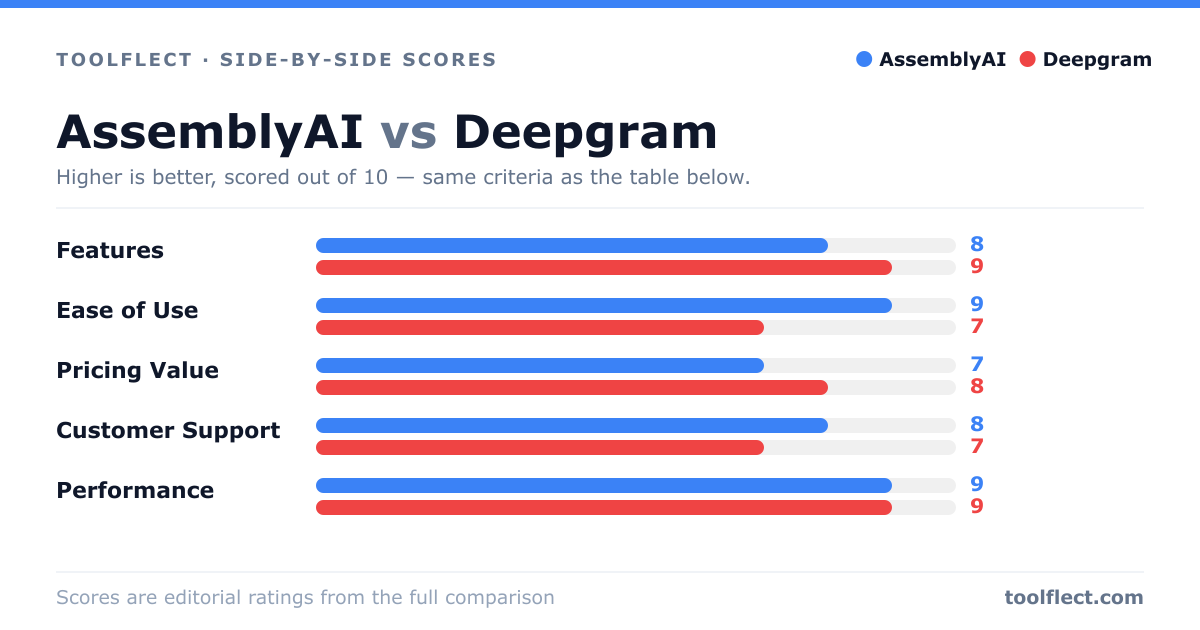
| Criterion | AssemblyAI | Deepgram |
|---|---|---|
| Features | 8/10 – Rich feature set including diarization, sentiment, and entity detection. | 9/10 – Advanced features like custom models, keyword spotting, and real-time streaming. |
| Ease of Use | 9/10 – Simple REST API and clear documentation. | 7/10 – More complex setup for advanced features, but manageable. |
| Pricing Value | 7/10 – Higher cost per hour, but includes many features. | 8/10 – Competitive pricing with flexible plans and volume discounts. |
| Customer Support | 8/10 – Responsive support with helpful resources. | 7/10 – Support is available but response times vary. |
| Performance | 9/10 – High accuracy and low latency. | 9/10 – Extremely fast and accurate, especially for real-time use. |