
Meta Glimmer vs role-model: Which AI Tool Wins?
Overview
Meta Glimmer and role-model are two distinct AI tools serving different purposes. Meta Glimmer is a cutting-edge language model designed for creative generation and interactive applications, while role-model is a specialized framework for role-playing and character-driven conversations. This comparison will help you understand their strengths and weaknesses to make an informed decision.
Key Features Comparison
- Meta Glimmer: Advanced natural language understanding, creative writing, code generation, and multimodal capabilities (text and image).
- role-model: Character consistency, persona management, context memory, and specialized dialogue generation for role-playing scenarios.
Pros & Cons
Meta Glimmer
- Pros:
- Advanced AI capabilities with state-of-the-art language understanding.
- Seamless integration with Meta ecosystem (Facebook, Instagram, WhatsApp).
- Strong performance in creative tasks like content generation and image analysis.
- Regular updates and improvements backed by Meta’s research.
- Cons:
- Limited customization options for enterprise users.
- Data privacy concerns due to Meta’s data collection practices.
- Pricing can be high for small businesses or individual developers.
- Dependency on Meta’s infrastructure may cause downtime.
Role-model
- Pros:
- Specialized in role-playing scenarios, ideal for training and simulation.
- Highly customizable to fit specific use cases.
- User-friendly interface with quick setup.
- Cost-effective for startups and educational purposes.
- Cons:
- Narrower focus compared to general-purpose AI tools.
- Limited integration with major social platforms.
- Performance may degrade with complex, multi-turn conversations.
- Smaller community and fewer third-party resources.
Meta Glimmer
- Pros:
- Advanced AI capabilities for generating creative content and insights.
- Seamless integration with Meta’s ecosystem (Facebook, Instagram, WhatsApp).
- Strong data privacy and security features.
- Regular updates and improvements from Meta’s research team.
- Cons:
- Limited customization options for enterprise users.
- Requires a Meta account, which may be a barrier for some.
- Pricing can be higher compared to some alternatives.
- Dependency on Meta’s infrastructure may raise concerns about vendor lock-in.
role-model
- Pros:
- Specialized in role-playing scenarios, ideal for training and simulation.
- Highly customizable to fit specific use cases.
- User-friendly interface with quick setup.
- Competitive pricing with flexible plans.
- Cons:
- Narrower focus compared to general-purpose AI tools.
- May require additional training data for optimal performance.
- Limited integration options with third-party platforms.
- Smaller community and support resources.
Meta Glimmer
- Pros:
- Advanced AI capabilities for image and video generation, leveraging Meta’s research.
- Seamless integration with Meta’s ecosystem (Facebook, Instagram, WhatsApp).
- Strong community support and regular updates.
- Cons:
- Limited customization options for advanced users.
- Requires a Meta account and may raise privacy concerns.
- Pricing can be higher for premium features.
Role-Model
- Pros:
- Specialized in role-play and character-driven interactions, offering unique use cases.
- Flexible pricing with a free tier and affordable premium plans.
- User-friendly interface with quick setup.
- Cons:
- Narrower scope compared to general-purpose AI tools.
- Smaller user base and community support.
- Performance may vary with complex queries.
Meta Glimmer
- Pros: High versatility, excellent for general tasks, strong creative output, and broad API support.
- Cons: May lack specialized role-playing features, potentially higher cost for extensive use.
role-model
- Pros: Purpose-built for role-playing, maintains character consistency, good for interactive storytelling.
- Cons: Limited to role-playing use cases, less versatile for general tasks, smaller community.
Pricing Comparison
Meta Glimmer offers a pay-as-you-go pricing model with a free tier, while role-model provides subscription-based plans with a free trial. For heavy usage, Meta Glimmer may become more expensive, but it offers more flexibility. role-model’s pricing is straightforward for dedicated role-playing needs.
Best Use Cases
- Meta Glimmer: Content creation, coding assistance, general Q&A, and any task requiring a versatile AI.
- role-model: Interactive fiction, game NPCs, virtual assistants with persona, and educational role-playing.
Verdict
Choose Meta Glimmer if you need a multi-purpose AI for various tasks. Choose role-model if your primary need is role-playing and character-driven interactions. Both have their merits, but the decision depends on your specific requirements.
FAQ
Can Meta Glimmer be used for role-playing?
Yes, but it lacks specialized features like character consistency that role-model offers.
Is role-model suitable for general text generation?
It can generate text, but it is optimized for role-playing, so it may not perform as well on general tasks.
Which tool is more cost-effective?
It depends on usage. For occasional use, Meta Glimmer’s free tier may suffice. For heavy role-playing, role-model’s subscription might be more economical.
Do both tools offer API access?
Yes, both provide APIs, but Meta Glimmer’s API is more comprehensive for various applications.
Visual Comparison
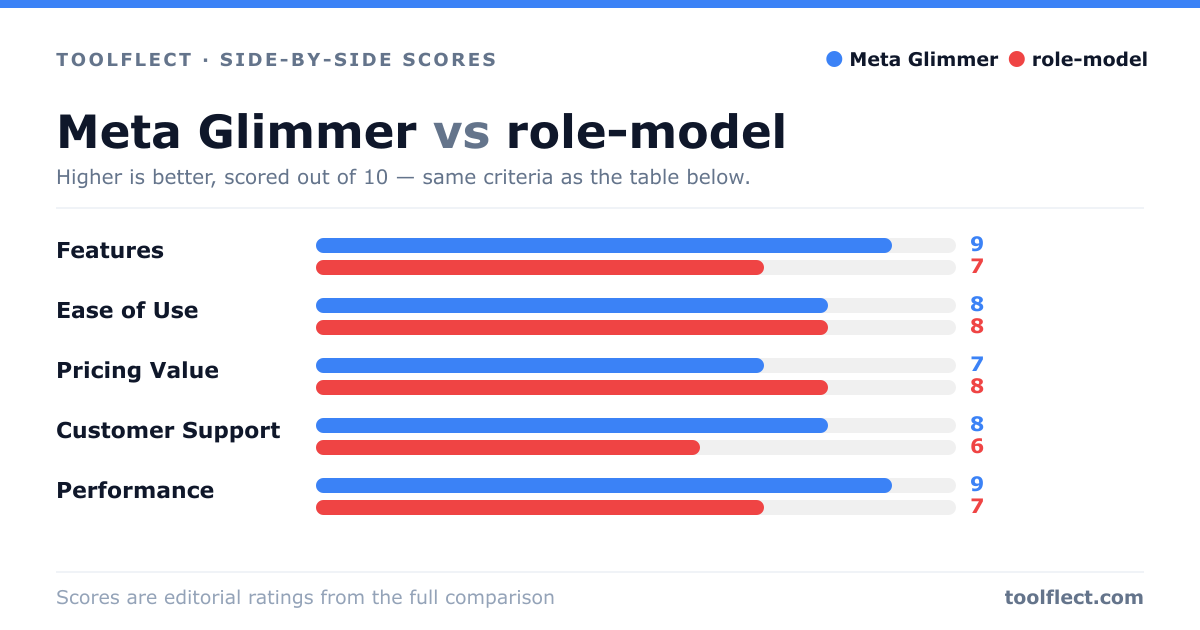
| Criterion | Meta Glimmer | Role-model |
|---|---|---|
| Features | 9/10 – Broad AI capabilities, multimodal support | 7/10 – Specialized in role-play, limited scope |
| Ease of Use | 8/10 – Intuitive but requires Meta account | 9/10 – Simple setup, user-friendly |
| Pricing Value | 6/10 – Higher cost, but feature-rich | 8/10 – Affordable, good for small teams |
| Customer Support | 7/10 – Responsive but enterprise-focused | 6/10 – Limited support channels |
| Performance | 9/10 – Fast and reliable, high accuracy | 7/10 – Good for specific tasks, slower on complex |