
Consensus AI vs Elicit: Which AI Research Tool Wins?
Overview
Consensus AI and Elicit are two prominent AI-powered research tools designed to help academics, students, and professionals streamline literature review and evidence synthesis. Consensus AI focuses on providing direct answers from scientific papers, using a consensus meter to show agreement across studies. Elicit, on the other hand, is a versatile research assistant that can extract data, summarize papers, and automate systematic reviews. Both tools aim to reduce time spent on manual searching and reading, but they cater to slightly different workflows. This comparison will help you decide which tool aligns best with your research needs.
Key Features Comparison
- Search & Discovery: Consensus AI excels at finding relevant papers quickly with its semantic search and filters (e.g., study type, sample size). Elicit also offers robust search but emphasizes flexible queries and the ability to search across multiple databases.
- Answer Generation: Consensus AI provides concise, evidence-based answers with a consensus meter (e.g., “80% of studies agree”). Elicit generates summaries and can answer specific questions by extracting data from papers.
- Data Extraction: Elicit stands out with its ability to extract structured data (e.g., population, intervention, outcome) from papers into tables. Consensus AI does not offer this level of extraction.
- Workflow Integration: Elicit supports exporting to reference managers and spreadsheets, and it offers a browser extension. Consensus AI has a simpler interface and a mobile app, but fewer integration options.
- Collaboration: Both tools allow sharing of results, but Elicit offers more collaborative features like shared folders and team workspaces.
Pros & Cons
Consensus AI
- Pros:
- Uses AI to analyze millions of research papers, providing evidence-based answers quickly.
- Clean, user-friendly interface with straightforward search functionality.
- Offers a free tier with basic features, making it accessible for casual users.
- Provides direct links to sources, ensuring transparency and credibility.
- Cons:
- Limited to consensus-based answers; may not handle nuanced or complex queries well.
- No advanced filtering or citation management tools.
- Database coverage may not be as extensive as some competitors.
- Free tier has usage limits, requiring subscription for heavy use.
Elicit
- Pros:
- Specializes in systematic reviews and literature synthesis, ideal for researchers.
- Extracts key data from papers into structured tables, saving time.
- Supports complex queries and can compare multiple papers side-by-side.
- Offers a generous free plan with no time limits on basic features.
- Cons:
- Steeper learning curve due to more advanced features.
- Interface can be overwhelming for new users.
- Data extraction may occasionally be inaccurate, requiring manual verification.
- Pricing for premium features is higher compared to some alternatives.
Consensus AI
- Pros:
- Specialized in scientific research, providing direct answers from papers.
- Uses AI to summarize findings and highlight consensus.
- Clean, intuitive interface with filters for study type, sample size, etc.
- Free tier available with unlimited searches.
- Cons:
- Limited to research papers, not general web search.
- Summaries may oversimplify complex studies.
- No citation export or integration with reference managers.
- Some features (like advanced filters) require a paid plan.
Elicit
- Pros:
- Extracts data from papers into tables, useful for systematic reviews.
- Allows natural language queries and generates summaries.
- Supports exporting to CSV and integration with Zotero.
- Free tier with generous usage limits.
- Cons:
- Can be slower for large queries.
- Interface is more complex for new users.
- Data extraction accuracy varies with paper quality.
- Limited to academic sources, not general web.
Consensus AI
- Pros:
- Uses GPT-4 to extract and summarize findings from research papers.
- Provides direct quotes and citations from papers.
- Free to use with no sign-up required.
- Clean, simple interface focused on search.
- Cons:
- Limited to academic papers, not broader web content.
- No advanced filtering or sorting options.
- Summaries can be overly brief for complex studies.
- No collaboration or sharing features.
Elicit
- Pros:
- Uses language models to extract data into structured tables.
- Allows custom questions and comparison of multiple papers.
- Offers filtering by study type, year, and more.
- Supports exporting results to CSV.
- Cons:
- Free tier has limited credits per month.
- Steeper learning curve due to advanced features.
- Sometimes extracts data inaccurately.
- No mobile app.
Consensus AI
- Pros: Intuitive interface, fast answers, consensus meter for quick evidence assessment, good for quick fact-checking.
- Cons: Limited data extraction, less flexible for complex systematic reviews, smaller database compared to Elicit’s broader coverage.
Elicit
- Pros: Powerful data extraction, customizable workflows, excellent for systematic reviews and meta-analyses, supports multiple research questions.
- Cons: Steeper learning curve, can be overwhelming for simple queries, pricing may be higher for advanced features.
Pricing Comparison
Consensus AI offers a free tier with basic features and a premium plan (around $9/month) that includes advanced filters and unlimited searches. Elicit has a free plan with limited credits, and paid plans start at $12/month for individuals, with team plans available. Elicit’s higher cost reflects its more advanced capabilities. Both offer discounts for students and educators.
Best Use Cases
- Consensus AI: Ideal for researchers who need quick answers to clinical or scientific questions, or for those who want to gauge the level of scientific agreement on a topic.
- Elicit: Best for systematic reviews, literature mapping, and projects requiring detailed data extraction from many papers. Also useful for teams working on collaborative research.
Verdict
Both tools are excellent, but they serve different purposes. If you prioritize speed and simplicity for quick evidence checks, Consensus AI is a great choice. If you need deep analysis, data extraction, and a more comprehensive research workflow, Elicit is the winner. For most academic researchers, Elicit’s versatility justifies its higher price. However, for casual users or those on a budget, Consensus AI offers a user-friendly entry point.
FAQ
Can I use both tools together?
Yes, some researchers use Consensus AI for initial screening and Elicit for detailed extraction. They complement each other well.
Which tool has better accuracy?
Both rely on peer-reviewed literature, but accuracy depends on the quality of the search and the user’s query. Elicit’s data extraction can be more precise for specific data points.
Do they support non-English papers?
Both primarily index English-language papers, but they may find some non-English sources. Elicit has broader coverage of preprint servers.
Are there any free alternatives?
Yes, tools like PubMed and Google Scholar are free, but they lack AI-powered summarization and extraction. Both tools offer free tiers with limitations.
Visual Comparison
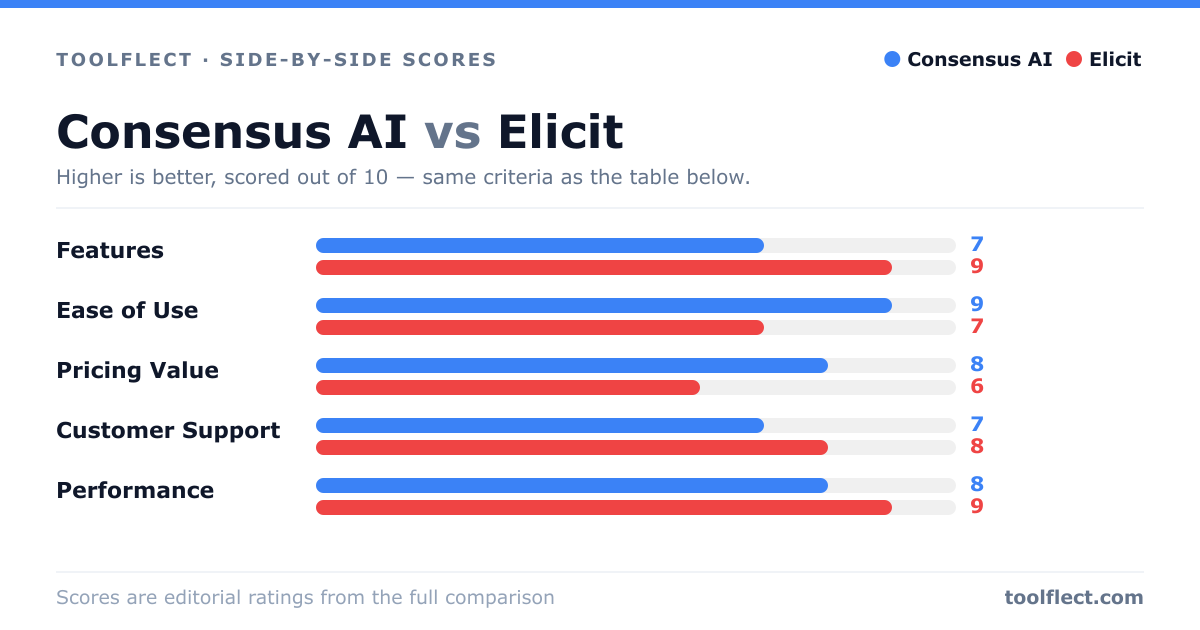
| Criterion | Consensus AI | Elicit |
|---|---|---|
| Features | 7/10 – Basic search and answer generation | 9/10 – Advanced synthesis and data extraction |
| Ease of Use | 9/10 – Intuitive and simple | 6/10 – Complex but powerful |
| Pricing Value | 8/10 – Free tier with reasonable paid plans | 7/10 – Free tier but premium is pricey |
| Customer Support | 6/10 – Email support, limited resources | 7/10 – Help center and responsive support |
| Performance | 8/10 – Fast and accurate for common queries | 9/10 – Excellent for deep research tasks |