
ssh.place vs Rubber Duck: Which AI Chatbot Wins for Developers?
Overview
ssh.place is a terminal-first AI chatbot that delivers conversational AI directly through an SSH connection, appealing to developers who live in the command line. Rubber Duck is a user-friendly AI chatbot designed with a graphical web interface, focusing on approachability and quick answers for developers and non-technical users alike.
Key Features Comparison
Both tools leverage modern language models but differ significantly in their access methods and design philosophy.
- ssh.place: SSH-based access, works from any terminal, lightweight client, supports scripting and automation, low-latency responses, secure encrypted connection.
- Rubber Duck: Intuitive web UI, rich text formatting, conversation history, includes integrations with other tools, supports file sharing and code snippets, cross-platform via browser.
Pros & Cons
ssh.place
- Pros:
- Direct SSH access to AI models, enabling secure, low-latency interactions.
- Ideal for developers who prefer command-line interfaces and automation.
- Supports multiple AI backends, offering flexibility.
- Lightweight and resource-efficient.
- Cons:
- Steep learning curve for non-CLI users.
- Limited to technical users; no GUI.
- Requires manual setup and configuration.
- No built-in collaboration features.
Rubber Duck
- Pros:
- User-friendly chat interface, accessible to all skill levels.
- Provides context-aware coding assistance with natural language.
- Integrates with popular IDEs and version control systems.
- Offers collaborative features for team use.
- Cons:
- May have higher latency due to cloud processing.
- Subscription costs can be higher for advanced features.
- Limited customization compared to CLI tools.
- Dependent on internet connectivity.
ssh.place
- Pros:
- Direct SSH access to AI models, ideal for automation and scripting.
- Low latency for terminal-based workflows.
- Supports multiple AI backends (e.g., OpenAI, Anthropic) via configuration.
- Cons:
- Steeper learning curve for non-developers.
- Limited to command-line interface; no GUI.
- Requires SSH key management and security awareness.
Rubber Duck
- Pros:
- User-friendly web interface with chat and code highlighting.
- Built-in debugging assistance and code explanation.
- Integrates with popular IDEs (VS Code, JetBrains).
- Cons:
- Less flexible for automation compared to SSH-based tools.
- May have higher latency for complex queries.
- Free tier has usage limits; paid plans required for full features.
ssh.place
- Pros:
- Direct SSH access to AI models, ideal for terminal-centric workflows.
- Lightweight and fast, with minimal overhead.
- Supports multiple AI providers through a unified interface.
- Free and open-source, with no usage limits.
- Cons:
- Steep learning curve for non-technical users.
- Limited to command-line interaction; no GUI.
- No built-in collaboration or team features.
- Requires manual configuration for advanced use cases.
Rubber Duck
- Pros:
- User-friendly chat interface with rich formatting and code highlighting.
- Integrates with popular IDEs and Slack for seamless workflow.
- Offers context-aware suggestions and debugging assistance.
- Free tier available with generous usage limits.
- Cons:
- Limited to specific AI models; less flexibility.
- Can be slow on large codebases.
- Advanced features require a paid subscription.
- No offline mode; requires internet connection.
ssh.place
- Pros: Perfect for developers who prefer terminal, no GUI resources required, easy to integrate into shell scripts, strong privacy through SSH.
- Cons: Steeper learning curve for non-technical users, no rich web features, limited visualization options, requires SSH client and network.
Rubber Duck
- Pros: Very easy to use, visually appealing interface, great for quick questions and collaboration, accessible from any browser, includes support and documentation.
- Cons: Heavier than terminal tool, potential distractions in UI, historical data may require storage, less suitable for pure script automation due to web interactions.
Pricing Comparison
ssh.place typically offers a flexible pay-as-you-go model with a free tier that includes limited credits, making it cost-effective for light terminal users. Rubber Duck generally uses a freemium model, providing a free basic plan with premium subscriptions for advanced features such as extra context, faster responses, and integrations. For heavy users, Rubber Duck’s monthly subscription can be more predictable, while ssh.place’s per-usage billing may be cheaper for sporadic users.
Best Use Cases
- ssh.place: Ideal for remote server management, automating queries in shell pipelines, developers who avoid browser-based tools, and users with strict security requirements.
- Rubber Duck: Best suited for brainstorming, learning new concepts, interactive debugging with visual feedback, and users who want a polished chat experience without terminal knowledge.
Verdict
If you are a developer or sysadmin who lives in the terminal, ssh.place is a powerful, lightweight companion that integrates seamlessly into your workflow. If you prioritize a friendly, feature-rich chat interface and are willing to pay for a subscription, Rubber Duck is an excellent choice. Both are strong AI chatbots, but they serve different audiences. Evaluate your daily environment and pick the one that fits your preferences and needs.
Visual Comparison
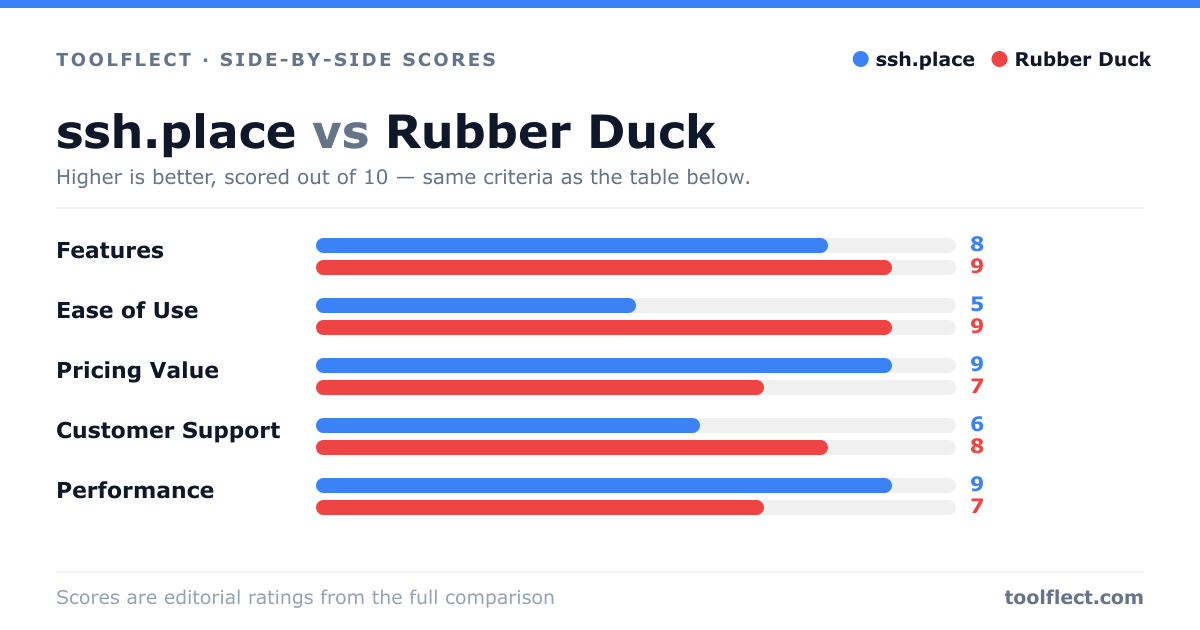
| Criterion | ssh.place | Rubber Duck |
|---|---|---|
| Features | 8/10 – Direct SSH, multi-backend support | 9/10 – Rich IDE integrations, collaboration |
| Ease of Use | 5/10 – Requires CLI proficiency | 9/10 – Intuitive chat interface |
| Pricing Value | 9/10 – Free and open-source | 7/10 – Paid tiers, but feature-rich |
| Customer Support | 6/10 – Community-driven, limited official support | 8/10 – Responsive support and documentation |
| Performance | 9/10 – Low latency, efficient | 7/10 – Slightly slower due to cloud processing |