
Semantic Scholar vs Scite: Which AI Research Tool Should You Use?
Overview
Semantic Scholar and Scite are AI-powered platforms designed to help researchers discover and analyze scientific literature. Semantic Scholar, developed by the Allen Institute for AI, is a free search engine that uses machine learning to extract key insights and provide citation graphs. Scite, a paid tool, focuses on citation context, showing how papers are cited—whether they support, contradict, or merely mention the work. Both tools aim to streamline research but cater to different needs and budgets.
Key Features Comparison
- Search & Discovery: Semantic Scholar offers a vast free database with AI-powered summaries and topic pages. Scite provides similar search but emphasizes citation statements.
- Citation Analysis: Scite excels with its Smart Citations, showing the context and sentiment of citations. Semantic Scholar offers citation graphs and influence scores but lacks context.
- AI Summarization: Semantic Scholar includes TL;DR summaries and highlights key contributions. Scite does not have built-in summarization.
- Integrations: Both support browser extensions and APIs. Scite integrates with Zotero and Mendeley; Semantic Scholar integrates with Zotero and offers a Chrome extension.
- Collaboration: Scite provides shared reading lists; Semantic Scholar offers a save-to-library feature but limited sharing.
Pros & Cons
Semantic Scholar
- Pros: Free to use; AI-powered search with natural language processing; extensive coverage of computer science and neuroscience; provides citation graphs and influence scores.
- Cons: Limited to academic papers; no full-text analysis; user interface can be overwhelming for new users; lacks collaborative features.
Scite
- Pros: Unique Smart Citations showing how papers are cited (supporting/contrasting); browser extension for easy access; useful for evaluating research credibility; integrates with Zotero and Mendeley.
- Cons: Premium features require subscription; smaller database compared to Semantic Scholar; not all papers have Smart Citations; limited search filters.
Semantic Scholar
- Pros: Free to use with no subscription required; AI-powered search ranks papers by relevance and impact; integrates with citation managers like Zotero; provides API for developers.
- Cons: Limited to academic papers, no full-text analysis; lacks citation context and comparison features; user interface can be overwhelming for new users; no browser extension for quick access.
Scite
- Pros: Provides citation context (supporting, contrasting, mentioning); visual citation network maps; browser extension for instant access; useful for evaluating research credibility.
- Cons: Premium features require paid subscription; limited coverage of preprints and non-English papers; interface can be cluttered; no API for free tier.
Semantic Scholar
- Pros:
- Free to use with no subscription required.
- Strong AI-powered search and recommendation engine.
- Access to a vast database of academic papers.
- Provides citation graphs and influence scores.
- Cons:
- Limited to academic content; no coverage of news or web sources.
- No collaborative features for teams.
- Lacks advanced analytics for research impact.
- User interface can be overwhelming for new users.
Scite
- Pros:
- Unique Smart Citations showing how papers cite each other.
- Provides context for citations (supporting or contrasting).
- Chrome extension for easy access while browsing.
- Useful for evaluating research credibility.
- Cons:
- Free tier is limited; full features require subscription.
- Coverage may not be as comprehensive as Semantic Scholar.
- Interface can be slow with large datasets.
- Learning curve for understanding citation contexts.
Semantic Scholar
- Pros: Free and open to all; AI-powered summaries; strong citation network; easy to use.
- Cons: No citation context; limited filtering options; less focus on recent preprints.
Scite
- Pros: Unique citation context (supporting, contrasting); detailed citation analysis; robust reference checking.
- Cons: Paid subscription; steeper learning curve; smaller database than Semantic Scholar.
Pricing Comparison
Semantic Scholar: Completely free to use, with no premium tiers. Users can access all features without payment.
Scite: Offers a free tier with limited searches. Paid plans start at $10/month for individuals (annual billing) up to $20/month for the Premium plan. Institutional pricing is available.
Best Use Cases
- Semantic Scholar: Ideal for broad literature discovery, staying updated in a field, and quick access to paper summaries. Best for students and researchers on a budget.
- Scite: Best for in-depth citation analysis, verifying claims, and understanding how a paper is received. Essential for systematic reviews and researchers needing citation context.
Verdict
Semantic Scholar is the go-to free tool for general research and discovery, while Scite is a powerful paid tool for those who need detailed citation context. For most users, combining both—using Semantic Scholar for exploration and Scite for validation—offers the best result. Your choice depends on whether you value cost savings or citation depth.
Visual Comparison
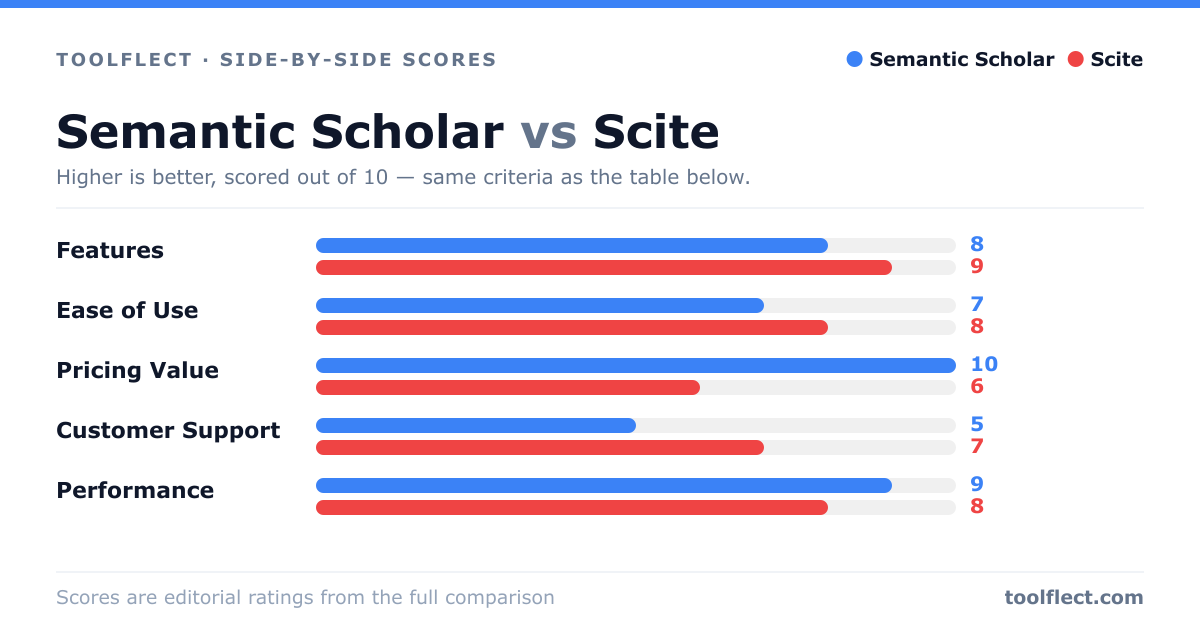
| Criterion | Semantic Scholar | Scite |
|---|---|---|
| Features | 8/10 – AI search, citation graphs, influence scores | 9/10 – Smart Citations, browser extension, integrations |
| Ease of Use | 7/10 – Clean but complex interface | 8/10 – Intuitive with helpful visualizations |
| Pricing Value | 10/10 – Free for all users | 6/10 – Free tier limited, premium costly |
| Customer Support | 5/10 – Limited support, mainly FAQ | 7/10 – Responsive email support, help center |
| Performance | 9/10 – Fast and accurate search results | 8/10 – Reliable but slower on large datasets |