Google Gemini vs Poe: Which AI Chatbot Platform Reigns Supreme?
Overview
Google Gemini is Google’s flagship multimodal AI model, capable of understanding text, images, audio, video, and code natively. Poe, developed by Quora, aggregates multiple AI models (including GPT-4, Claude, Gemini, and more) into a single interface, allowing users to switch between models seamlessly.
Key Features Comparison
- Native Multimodality: Gemini is natively multimodal, processing text, images, audio, video, and code. Poe relies on individual models for specific modalities, requiring model switching.
- Model Variety: Poe offers access to many models (GPT-4, Claude, Gemini, Llama, etc.). Gemini focuses on its own model, with different versions (Ultra, Pro, Nano).
- Context Window: Gemini has a large context window (up to 1 million tokens in Gemini 1.5 Pro). Poe’s context depends on the underlying model selected.
- Integration: Gemini integrates deeply with Google services (Search, Workspace, Android). Poe is standalone but offers API access for developers.
- Customizability: Poe allows users to create custom bots (using prompts and model selection). Gemini offers limited customizability but is optimized for Google products.
Pros & Cons
Google Gemini
- Pros:
- Deep integration with Google ecosystem (Search, Workspace, Android).
- Strong multimodal capabilities (text, image, audio, video).
- Access to Google’s vast data and AI research.
- Free tier available with generous limits.
- Cons:
- Limited third-party integrations compared to Poe.
- Less customizable for advanced users.
- Performance can be inconsistent on complex tasks.
- Privacy concerns due to data collection.
Poe
- Pros:
- Aggregates multiple AI models (GPT-4, Claude, etc.) in one platform.
- Highly customizable with user-created bots.
- Active community and frequent updates.
- Cross-platform support (web, iOS, Android).
- Cons:
- Subscription required for full access to premium models.
- Interface can be overwhelming for new users.
- Dependent on third-party models, which may have usage limits.
- No offline functionality.
Google Gemini
- Pros: Deep integration with Google Workspace and Search; strong multimodal capabilities (text, image, audio, video); free tier available with generous limits; regular updates and improvements.
- Cons: Limited availability in some regions; user interface can be overwhelming for beginners; privacy concerns due to data collection; some features require a Google One subscription.
Poe
- Pros: Access to multiple AI models (GPT-4, Claude, etc.) in one place; user-friendly interface with easy model switching; customizable bots and prompts; free tier with daily credits.
- Cons: Credits system can be limiting for heavy users; no offline access; some advanced features require a subscription; performance varies depending on the underlying model.
Google Gemini
- Pros:
- Deep integration with Google ecosystem (Gmail, Docs, Search)
- Strong multimodal capabilities (text, image, audio, video)
- High accuracy and factual grounding via Google Search
- Generous free tier with access to latest models
- Cons:
- Limited customization and fine-tuning options
- User interface can be cluttered with Google branding
- Some advanced features require Google One subscription
- Occasional factual errors in complex queries
Poe
- Pros:
- Access to multiple AI models (GPT-4, Claude, Llama, etc.) in one place
- Customizable bots and ability to create your own
- Clean, user-friendly interface
- Active community and frequent updates
- Cons:
- Free tier has limited daily messages
- Subscription required for full access to all models
- No native integration with Google services
- Performance varies by model and can be inconsistent
Google Gemini
Pros:
- Exceptional multimodal understanding across text, images, audio, video, and code.
- Deep integration with Google ecosystem (Search, Workspace, Android).
- Large context window (1M tokens) for handling lengthy documents.
- Free tier available with competitive performance.
Cons:
- Limited to Google’s model; no access to other AI models (e.g., GPT-4 or Claude).
- Less customizable for specific use cases compared to Poe.
- Regional availability restrictions in some countries.
Poe
Pros:
- One interface to access multiple top-tier AI models (GPT-4, Claude, Gemini, etc.).
- Highly customizable: users can create and share custom bots with specific prompts.
- Cross-platform support (web, iOS, Android).
- Free tier includes access to several models with daily limits.
Cons:
- Dependent on third-party models; quality varies by selection.
- No native multimodal capability; must switch models for different media types.
- Context window limited by the underlying model (usually smaller than Gemini).
- Subscription needed for higher usage limits and access to latest models.
Pricing Comparison
Google Gemini: Free tier available (Gemini Pro). Gemini Advanced (previously Google One AI Premium) costs $19.99/month and includes Gemini Ultra, 2TB cloud storage, and more. Enterprise pricing available for Google Workspace customers.
Poe: Free tier with limited daily messages (varies by model). Poe Premium costs $19.99/month (annual) or $29.99/month (monthly), offering unlimited messages, priority access, and ability to use the latest models (e.g., GPT-4, Claude 3.5). Poe also offers a Creator Plan with additional features for bot builders.
Best Use Cases
- Google Gemini: Ideal for users deeply embedded in Google’s ecosystem, requiring real-time multimodal analysis (e.g., analyzing videos, images, or code), handling large documents, or needing a reliable all-in-one AI assistant across Google products.
- Poe: Best for users who want flexibility to choose the best model for each task, need to compare outputs from different AI models, or want to build and share custom AI bots (e.g., for customer support, education, or creative writing).
Verdict
Both platforms excel in different areas. Choose Google Gemini if you value native multimodal capabilities, deep integration with Google services, and a large context window. Choose Poe if you need access to multiple AI models, high customizability, and the ability to switch between models for different tasks. For most general users, Gemini offers a more seamless experience, while Poe provides unmatched flexibility for power users and developers.
Visual Comparison
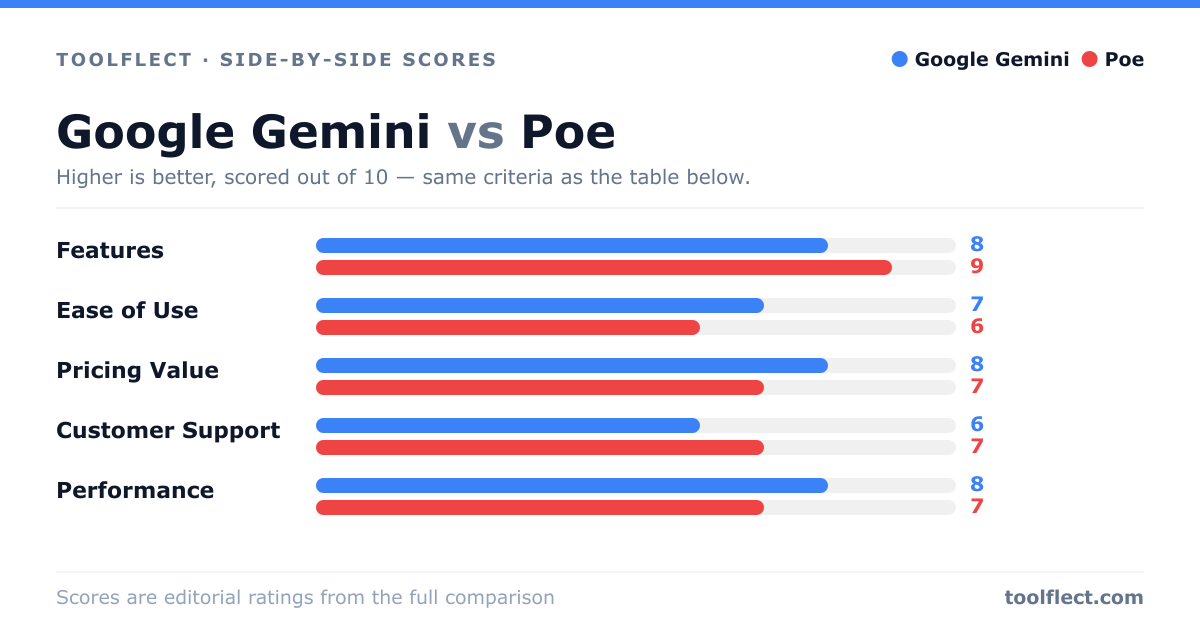
| Criterion | Google Gemini | Poe |
|---|---|---|
| Features | 8/10 – Multimodal, Google integration | 9/10 – Multiple models, custom bots |
| Ease of Use | 7/10 – Simple but limited customization | 6/10 – Powerful but steeper learning curve |
| Pricing Value | 8/10 – Free tier, competitive paid plans | 7/10 – Subscription required for premium |
| Customer Support | 6/10 – Standard Google support | 7/10 – Community forums, responsive |
| Performance | 8/10 – Fast, reliable for most tasks | 7/10 – Varies by model, occasional delays |