
Anthropic vs DeepSeek: Which AI Model API Wins in 2026?
Overview
Anthropic and DeepSeek are two prominent players in the LLM API space, each offering powerful models with distinct strengths. Anthropic is known for its safety-focused Claude models, while DeepSeek has gained attention for its cost-effective and high-performance open-source models. This comparison provides an unbiased look at their features, pricing, and ideal use cases to help you decide which API fits your needs.
Key Features Comparison
- Model Variety: Anthropic offers Claude 3 (Haiku, Sonnet, Opus) with varying capabilities; DeepSeek provides DeepSeek-V2 and DeepSeek-Coder, including open-source options.
- Context Window: Anthropic supports up to 200K tokens; DeepSeek supports up to 128K tokens.
- Multimodal Support: Anthropic’s Claude 3 models accept image inputs; DeepSeek is primarily text-only.
- Programming Focus: DeepSeek-Coder is specialized for code generation; Anthropic’s Claude excels in general reasoning and safety.
- Deployment: Anthropic offers a managed API; DeepSeek provides both API and open-source weights for self-hosting.
- Safety & Alignment: Anthropic emphasizes constitutional AI and safety; DeepSeek focuses on performance and efficiency.
Pros & Cons
Anthropic
- Pros:
- Strong focus on safety and interpretability, with Constitutional AI reducing harmful outputs.
- Excellent at complex reasoning and long-context tasks (up to 200k tokens).
- High-quality, nuanced responses in creative and analytical writing.
- Robust API with fine-tuning and batch processing capabilities.
- Cons:
- Generally more expensive per token compared to DeepSeek.
- Limited availability in some regions and requires approval for certain use cases.
- Slower response times under heavy load.
- Less customizable for niche domains without extensive fine-tuning.
DeepSeek
- Pros:
- Cost-effective pricing, significantly cheaper per token.
- Fast inference speed, suitable for real-time applications.
- Open-source models allow for self-hosting and customization.
- Strong performance in coding and mathematical tasks.
- Cons:
- Less emphasis on safety features compared to Anthropic.
- Smaller context window (up to 64k tokens) may limit some use cases.
- Occasional inconsistency in factual accuracy.
- Community support rather than dedicated enterprise support.
Anthropic
- Pros: Exceptional reasoning and safety features; strong performance on complex tasks; robust API with detailed documentation.
- Cons: Higher pricing compared to some competitors; limited availability in certain regions; less flexible customization options.
DeepSeek
- Pros: Cost-effective with competitive pricing; good performance on coding and math tasks; open-source model with community support.
- Cons: Less mature ecosystem; fewer enterprise features; occasional inconsistencies in output quality.
Anthropic
- Pros: Strong focus on safety and interpretability, making it suitable for enterprise applications.
- Pros: Excellent at complex reasoning and nuanced language understanding.
- Pros: Offers a generous free tier and competitive pricing for its capabilities.
- Cons: Smaller ecosystem and fewer third-party integrations compared to some competitors.
- Cons: Limited multimodal support (text-focused) compared to some rivals.
DeepSeek
- Pros: Exceptional performance on coding and mathematical tasks, often outperforming larger models.
- Pros: Highly cost-effective, with significantly lower API prices than many alternatives.
- Pros: Open-source model weights allow for customization and local deployment.
- Cons: Less established brand and smaller community support.
- Cons: Documentation and developer tools are less polished than Anthropic’s.
Anthropic
- Pros: Excellent safety features, strong reasoning, multimodal support, reliable API, good for enterprise.
- Cons: Higher cost, less transparent about training data, closed-source.
DeepSeek
- Pros: Cost-effective, open-source options, strong coding capabilities, good performance for price.
- Cons: Smaller context window, limited multimodal support, less emphasis on safety features.
Pricing Comparison
Anthropic’s pricing is usage-based: Claude 3 Haiku starts at $0.25 per million input tokens and $1.25 per million output tokens; Sonnet is $3/$15; Opus is $15/$75. DeepSeek offers significantly lower prices: DeepSeek-V2 is $0.14 per million input tokens and $0.28 per million output tokens (cache miss), with even lower rates for cache hits. DeepSeek also provides open-source models that can be self-hosted at no API cost.
Best Use Cases
- Anthropic: Ideal for applications requiring high safety, nuanced reasoning, and multimodal understanding, such as legal analysis, healthcare, and customer support.
- DeepSeek: Best for cost-sensitive projects, code generation, and scenarios where open-source flexibility is needed, like research and rapid prototyping.
Verdict
Both APIs are excellent, but they cater to different priorities. Choose Anthropic if you value safety, multimodal capabilities, and are willing to pay a premium. Choose DeepSeek if you need budget-friendly, high-performance models, especially for coding tasks, and prefer open-source options.
FAQ
Which API is more affordable?
DeepSeek is significantly more affordable, with prices up to 100x lower than Anthropic’s top-tier models.
Can I use DeepSeek for free?
Yes, DeepSeek offers open-source models that you can self-host for free, though you’ll need your own infrastructure.
Does Anthropic support image inputs?
Yes, Claude 3 models accept image inputs, making them multimodal.
Which is better for coding?
DeepSeek-Coder is specialized for code generation and often outperforms Anthropic in coding benchmarks, but Anthropic’s Claude also handles code well with strong reasoning.
Visual Comparison
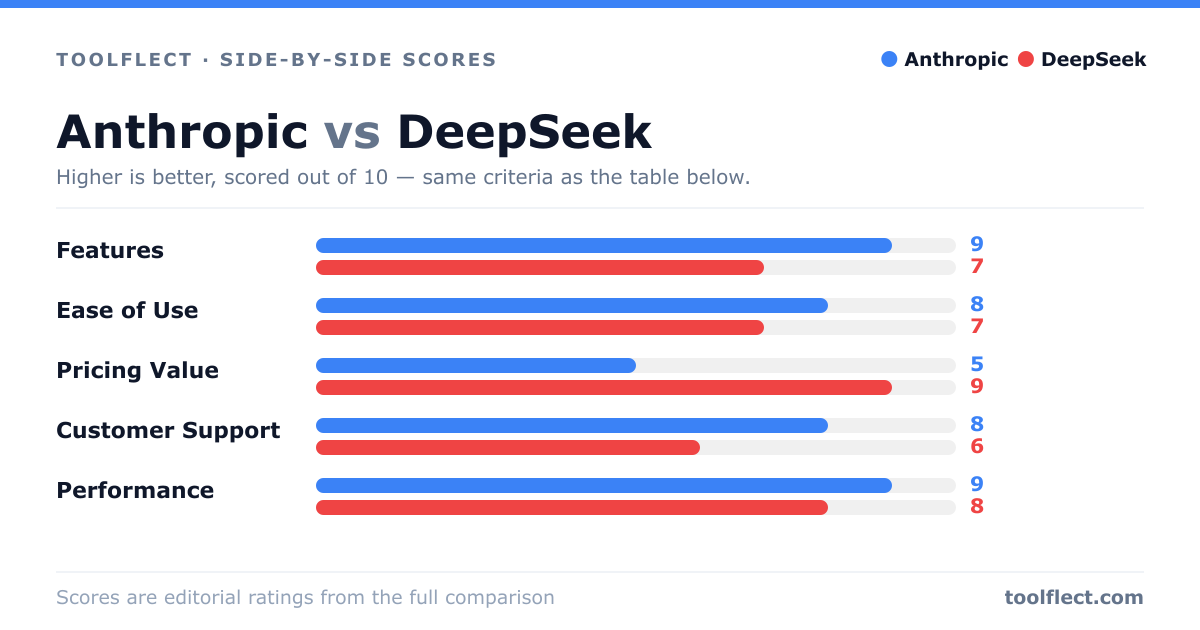
| Criterion | Anthropic | DeepSeek |
|---|---|---|
| Features | 8/10 – Advanced safety, long context, fine-tuning | 7/10 – Open-source, coding focus, but fewer safety features |
| Ease of Use | 7/10 – Comprehensive docs, but setup can be complex | 8/10 – Simple API, easy integration |
| Pricing Value | 6/10 – Premium pricing, but high quality | 9/10 – Very affordable, excellent value |
| Customer Support | 8/10 – Dedicated support, enterprise options | 5/10 – Community forums, limited direct support |
| Performance | 9/10 – Top-tier reasoning and accuracy | 8/10 – Fast and efficient, but slightly less accurate |