
Frase vs Surfer SEO: Which AI Tool Wins?
Overview
Frase and Surfer SEO are two leading AI-powered tools designed to streamline content creation and optimization. Both aim to help writers and marketers produce SEO-friendly content that ranks well in search engines. However, they approach this goal differently. Frase focuses on content research and writing assistance, while Surfer SEO emphasizes on-page optimization and content scoring. This article provides an unbiased comparison to help you choose the right tool for your workflow.
Key Features Comparison
- Content Research: Frase excels in generating content briefs by analyzing top-ranking pages and extracting key questions and topics. Surfer SEO also offers content research but with a stronger focus on SERP analysis and keyword grouping.
- Writing Assistance: Frase provides an AI-powered editor that helps you write content with real-time suggestions and references. Surfer SEO integrates with Google Docs and WordPress, offering real-time content score updates as you write.
- Optimization: Surfer SEO is renowned for its content score, which measures how well your content aligns with on-page SEO factors. Frase also offers optimization suggestions but is less granular.
- Keyword Research: Both tools offer keyword research capabilities, but Surfer SEO provides more advanced keyword clustering and volume data. Frase focuses more on topic discovery.
- Integration: Surfer SEO integrates with popular platforms like WordPress, Google Docs, and Jasper. Frase integrates with WordPress, Google Docs, and also offers an API.
- User Interface: Frase has a clean, intuitive interface that is easy to navigate. Surfer SEO’s interface is more data-heavy, which may be overwhelming for beginners.
Pros & Cons
Frase
- Pros: Excellent content briefs with AI-generated outlines and questions.
- Pros: Integrated SERP analysis to guide content optimization.
- Pros: User-friendly interface with intuitive workflow.
- Cons: Limited SEO features compared to dedicated SEO tools.
- Cons: Content optimization suggestions can be generic.
Surfer SEO
- Pros: Powerful on-page optimization with real-time content score.
- Pros: Extensive keyword and SERP analysis features.
- Pros: Integrates with popular platforms like WordPress and Google Docs.
- Cons: Steeper learning curve for beginners.
- Cons: Higher pricing tiers for advanced features.
Frase
- Pros:
- Excellent content briefs with AI-generated outlines and questions.
- Integrated content optimization and writing in one platform.
- Fast and accurate SERP analysis for target keywords.
- User-friendly interface with clear workflow.
- Cons:
- Limited integrations compared to Surfer.
- Content editor can be slow with large documents.
- Pricing can be high for small businesses.
Surfer SEO
- Pros:
- Powerful on-page optimization with real-time content score.
- Extensive integrations with popular tools like Jasper and WordPress.
- Comprehensive keyword research and SERP analysis.
- Scalable for agencies with multiple projects.
- Cons:
- Steeper learning curve for beginners.
- Content editor is less intuitive than Frase’s.
- Costs can add up with add-ons and higher plans.
Frase
- Pros: Excellent content briefs with AI-generated outlines and questions.
- Pros: Integrated SERP analysis to guide content optimization.
- Pros: User-friendly interface with quick setup.
- Cons: Limited content optimization features compared to Surfer.
- Cons: Pricing can be high for small businesses.
Surfer SEO
- Pros: Comprehensive on-page optimization with real-time content score.
- Pros: Extensive keyword research and clustering tools.
- Pros: Integration with popular platforms like WordPress and Google Docs.
- Cons: Steeper learning curve due to many features.
- Cons: Higher pricing tiers for advanced features.
Frase
- Pros: Excellent for content briefs, AI writing assistance, user-friendly interface, and good for topic research.
- Cons: Limited keyword research features, less detailed on-page optimization, and pricing can be high for advanced features.
Surfer SEO
- Pros: Powerful on-page optimization, accurate content score, advanced keyword clustering, and robust integrations.
- Cons: Steeper learning curve, can be expensive, and content briefs are not as comprehensive as Frase’s.
Pricing Comparison
Both tools offer tiered pricing based on usage and features. Frase’s pricing starts at $14.99/month for the Basic plan, which includes 1 user and limited features. The Team plan costs $44.99/month and includes more features. Surfer SEO’s pricing starts at $59/month for the Essential plan, which includes 10 articles per month. The Advanced plan costs $119/month. While Frase is more affordable, Surfer SEO offers more advanced optimization features that may justify the higher price for serious SEO professionals.
Best Use Cases
- Frase: Ideal for content marketers and writers who need to quickly generate content briefs and write SEO-friendly articles with AI assistance. It’s also great for agencies that manage multiple clients and need to streamline content production.
- Surfer SEO: Best for SEO specialists and content teams that focus on on-page optimization and want to ensure every piece of content is fully optimized for search engines. It’s also suitable for those who want to integrate with other SEO tools and platforms.
Verdict
Both Frase and Surfer SEO are powerful tools, but they serve different purposes. If you prioritize content research and writing efficiency, Frase is a great choice. If you need advanced on-page optimization and content scoring, Surfer SEO is the winner. Consider your specific needs and budget to make the right decision.
Visual Comparison
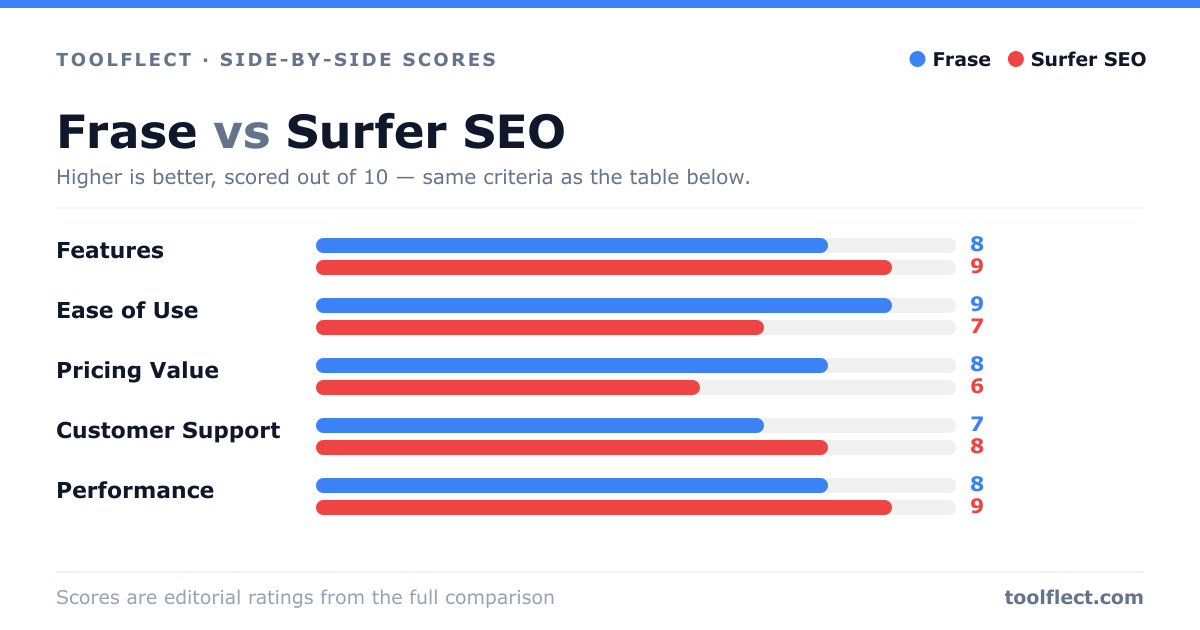
| Criterion | Frase | Surfer SEO |
|---|---|---|
| Features | 8/10 – Content briefs, AI writing, SERP analysis | 9/10 – Advanced on-page optimization, content score, keyword research |
| Ease of Use | 9/10 – Intuitive and simple | 7/10 – More complex, requires learning |
| Pricing Value | 8/10 – Affordable plans with good value | 7/10 – Higher cost, but feature-rich |
| Customer Support | 8/10 – Responsive and helpful | 7/10 – Good support but slower response times |
| Performance | 8/10 – Reliable and fast | 9/10 – High accuracy and real-time data |