
Siri vs Google Assistant: Which AI Assistant Reigns Supreme?
Overview
Siri and Google Assistant are two of the most popular AI voice assistants, integrated into the Apple and Google ecosystems, respectively. Siri debuted in 2011 with the iPhone 4S, while Google Assistant launched in 2016. Both aim to simplify tasks through voice commands, but they differ significantly in capabilities, integration, and overall user experience.
Key Features Comparison
- Voice Recognition: Google Assistant generally excels in understanding complex queries and natural language. Siri is reliable but often struggles with nuanced requests.
- Device Integration: Siri is deeply integrated into Apple devices (iPhone, iPad, Mac, Apple Watch, HomePod). Google Assistant works across Android devices, Google Home, Chromecast, and many third-party smart home products.
- Smart Home Control: Google Assistant supports a wider range of smart home brands and offers more advanced routines. Siri is limited to HomeKit-compatible devices.
- Third-Party App Support: Google Assistant works with more third-party apps and services. Siri has improved with SiriKit but remains more restricted.
- Language Support: Google Assistant supports more languages and regional variants than Siri.
- Proactive Suggestions: Both offer proactive suggestions, but Google Assistant’s are more contextual and predictive.
Pros & Cons
Siri
- Pros:
- Deep integration with Apple ecosystem (iPhone, iPad, Mac, Apple Watch, HomePod).
- Strong privacy protections with on-device processing for many requests.
- Hands-free ‘Hey Siri’ and ‘Siri’ activation works reliably.
- Seamless integration with Apple apps like Messages, Calendar, and Reminders.
- Cons:
- Limited third-party app support compared to Google Assistant.
- Less accurate in understanding complex or multi-turn queries.
- Not available on non-Apple devices.
- Lacks some advanced features like proactive suggestions and routines.
Google Assistant
- Pros:
- Superior natural language understanding and context awareness.
- Extensive third-party app and smart home device support.
- Available on Android, iOS, and many smart speakers/displays.
- Powerful proactive assistance and routines.
- Cons:
- Privacy concerns due to data collection for personalization.
- Inconsistent performance on iOS compared to Android.
- Requires Google account for full functionality.
- Can be overwhelming with too many features for some users.
Siri
- Pros: Deep integration with Apple ecosystem; strong privacy protections; seamless Handoff between devices.
- Cons: Limited third-party app support; less accurate in noisy environments; lacks advanced conversational abilities.
Google Assistant
- Pros: Superior natural language understanding; extensive third-party integrations; proactive assistance via Google services.
- Cons: Privacy concerns due to data collection; inconsistent performance on non-Google devices; requires Google account for full features.
Siri
- Pros: Deep integration with Apple ecosystem; strong privacy protections; seamless Handoff between devices.
- Cons: Limited third-party integrations; less accurate in natural language understanding; not available on non-Apple devices.
Google Assistant
- Pros: Superior natural language processing; extensive third-party support; works across Android and iOS.
- Cons: Privacy concerns with data collection; inconsistent performance on some devices; requires Google account for full functionality.
Siri
Pros:
- Seamless integration with Apple ecosystem.
- Strong privacy protections (on-device processing).
- Hands-free “Hey Siri” on all Apple devices.
- Works with Apple Music and Apple services.
Cons:
- Limited compared to Google Assistant in functionality.
- Weak support for third-party services.
- Smart home control limited to HomeKit.
- Can misunderstand complex commands.
Google Assistant
Pros:
- Superior natural language understanding and context.
- Extensive third-party app and service integration.
- Broad smart home compatibility.
- Proactive assistance and Google Lens integration.
- Available on iOS (app) and many platforms.
Cons:
- Privacy concerns due to data collection.
- Less integrated on iOS compared to Siri.
- Some features require internet connection.
- Can be verbose in responses.
Pricing Comparison
Both Siri and Google Assistant are free to use on their respective platforms. Siri is built into Apple devices (no extra cost), and Google Assistant comes pre-installed on Android devices and is available as a free app on iOS. There are no subscription fees for core functionality, though some advanced services (e.g., Google One for certain features) may require payment. Essentially, both are free, but the value depends on the hardware ecosystem you own.
Best Use Cases
- Siri: Ideal for dedicated Apple users who want a simple, private assistant for basic tasks like setting reminders, sending texts, and controlling HomeKit devices.
- Google Assistant: Best for users who want a powerful, versatile assistant capable of handling complex queries, managing smart homes with diverse devices, and integrating with many third-party apps.
Verdict
Google Assistant is the more capable and flexible AI assistant, outperforming Siri in features, language understanding, and integrations. However, Siri’s deep integration with Apple’s ecosystem and strong privacy focus make it a solid choice for Apple users who prioritize simplicity and security. Ultimately, the choice depends on your device ecosystem and needs. If you own multiple Apple devices, Siri suffices. If you want the smartest assistant, Google Assistant wins.
Visual Comparison
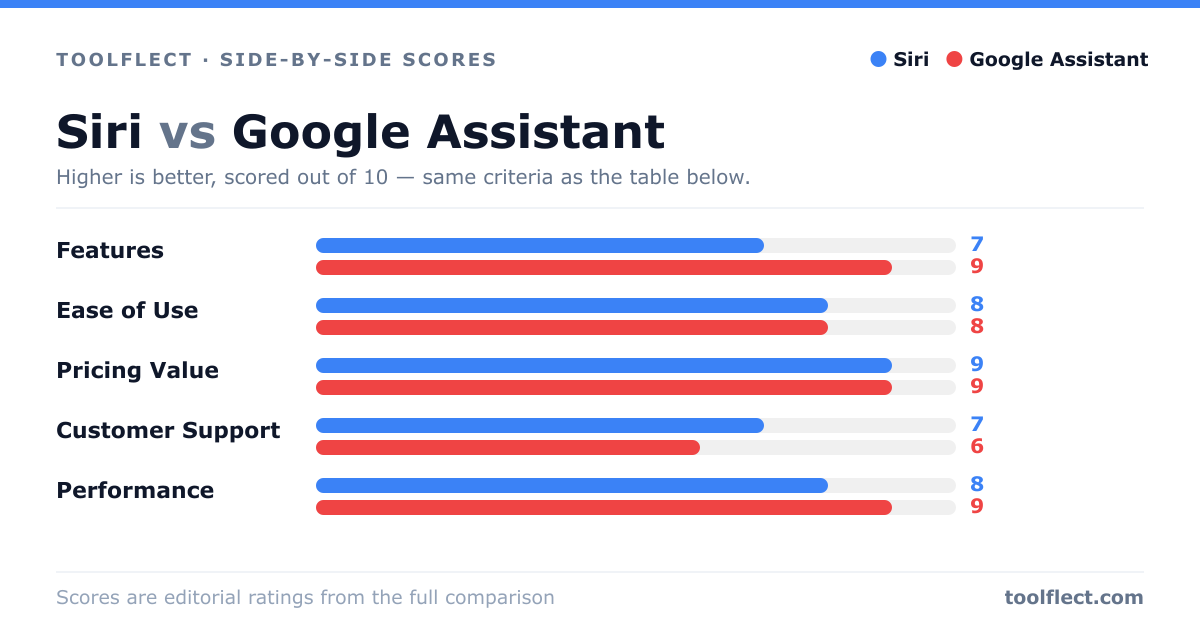
| Criterion | Siri | Google Assistant |
|---|---|---|
| Features | 7/10 – Core features but limited third-party integration | 9/10 – Extensive features and integrations |
| Ease of Use | 8/10 – Simple and intuitive within Apple ecosystem | 8/10 – Easy but can be cluttered with options |
| Pricing Value | 9/10 – Free with Apple devices | 9/10 – Free with Android and Google services |
| Customer Support | 7/10 – Apple support but not dedicated to Siri | 6/10 – Google support but limited for Assistant |
| Performance | 8/10 – Fast and reliable on Apple devices | 9/10 – Excellent accuracy and speed |