
Ironclad AI vs Luminance: Which AI Contract Tool Wins?
Overview
Ironclad AI and Luminance are two leading AI-powered platforms in the legal and business contract space. Ironclad focuses on end-to-end contract lifecycle management (CLM), automating workflows, approvals, and storage. Luminance specializes in AI-driven contract analysis, review, and risk detection, often used by legal teams for due diligence and compliance. While both leverage AI, their core strengths differ: Ironclad excels in process automation, while Luminance offers deep document intelligence. This comparison evaluates them across key dimensions to help you choose the right tool.
Key Features Comparison
- Ironclad AI: Contract lifecycle management, workflow automation, e-signature integration, repository with search, AI-powered metadata extraction, clause library, and approval routing.
- Luminance: AI document review, clause extraction and comparison, risk scoring, compliance checks, automated playbooks, and bulk analysis.
Pros & Cons
Ironclad AI
- Pros:
- Advanced AI for contract review and redlining
- Strong workflow automation and collaboration features
- Integrates with popular tools like Salesforce and Slack
- Robust security and compliance standards
- Cons:
- Steep learning curve for new users
- Higher pricing may not suit small businesses
- Customization options can be complex
Luminance
- Pros:
- Powerful AI for contract analysis and due diligence
- User-friendly interface with quick onboarding
- Excellent for large-scale contract review
- Competitive pricing for mid-sized firms
- Cons:
- Limited workflow automation compared to Ironclad
- Fewer integrations with third-party apps
- Advanced features may require training
Ironclad AI
- Pros:
- Strong workflow automation for contract lifecycle management.
- Excellent integration with Salesforce and other enterprise tools.
- User-friendly interface with drag-and-drop functionality.
- Robust reporting and analytics features.
- Cons:
- Higher pricing compared to some competitors.
- Steeper learning curve for advanced features.
- Limited customization for non-standard contract types.
Luminance
- Pros:
- Advanced AI for contract analysis and clause extraction.
- Fast processing of large volumes of contracts.
- Strong focus on legal-specific needs.
- Good collaboration features for legal teams.
- Cons:
- Less intuitive for non-legal users.
- Limited integration options compared to Ironclad.
- Pricing may be high for small firms.
Ironclad AI
- Pros: Strong workflow automation for contract lifecycle management; excellent integration with Salesforce and Slack; robust audit trail and version control.
- Cons: Steeper learning curve for non-technical users; pricing can be high for small teams; limited customization in reporting.
Luminance
- Pros: Advanced AI for clause extraction and risk analysis; user-friendly interface with quick onboarding; strong support for multiple languages.
- Cons: Less comprehensive workflow features compared to Ironclad; integration options are more limited; occasional inaccuracies in complex legal documents.
Ironclad AI
- Pros: Intuitive interface, strong workflow automation, seamless e-signature integration, centralized repository, good for teams managing contract lifecycles.
- Cons: Higher price point for full features, steep learning curve for advanced customization, AI analysis less granular than Luminance.
Luminance
- Pros: Powerful AI for document review, scalable for large datasets, excellent clause comparison, strong risk and compliance features.
- Cons: Less workflow automation, steeper setup for non-legal users, pricing can be opaque, limited integration with business CRMs.
Pricing Comparison
Both platforms use custom pricing based on deployment size and features. Ironclad typically charges per user per month with tiers (Starter, Business, Enterprise) starting around $100/user/month but quickly scaling up for full CLM capabilities. Luminance often charges based on document volume or subscription per legal team, with estimates ranging from $500 to $2,000 per month for mid-sized teams. Exact pricing requires contacting sales.
Best Use Cases
- Ironclad AI: Best for organizations needing end-to-end contract lifecycle management, especially sales, procurement, and legal operations teams that handle a high volume of standard contracts requiring workflow automation and easy execution.
- Luminance: Ideal for legal departments, law firms, and compliance teams that need deep contract analysis, due diligence, and risk detection on existing contracts or large document sets.
Verdict
Both tools are excellent but serve different primary needs. Choose Ironclad AI if you prioritize automated contract processes, seamless e-signing, and a user-friendly platform for non-legal stakeholders. Choose Luminance if your main focus is AI‑powered contract review, clause extraction, and risk analysis—especially for large-scale or complex document sets. For many organizations, a combination of both might be optimal, but individually, Ironclad wins on process efficiency, while Luminance wins on content intelligence.
Visual Comparison
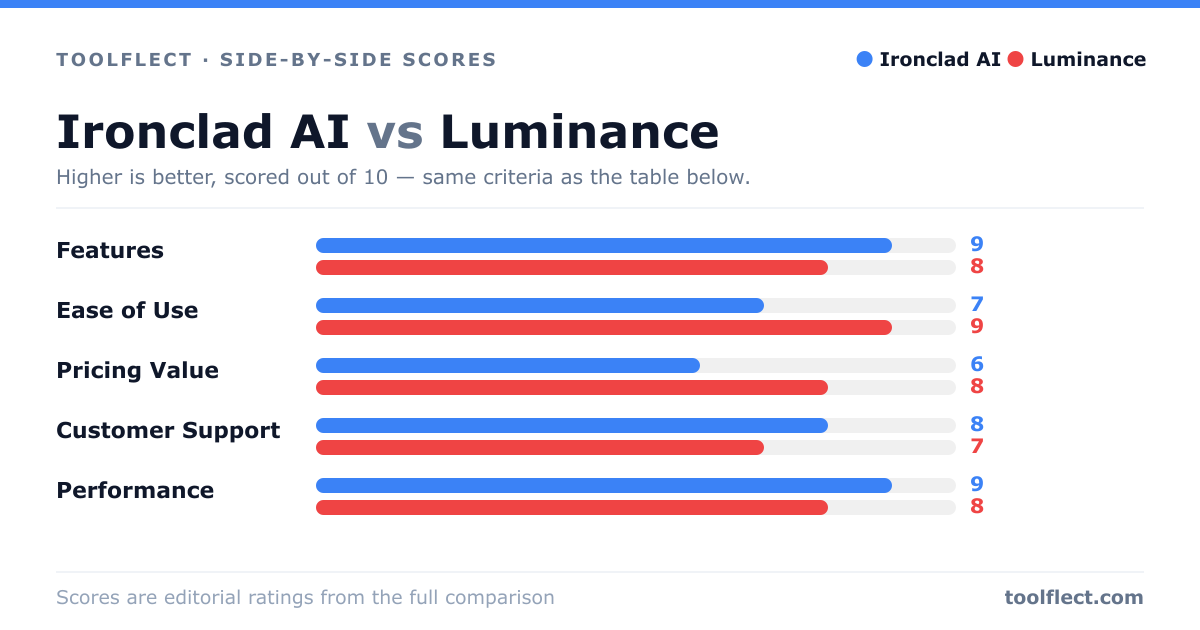
| Criterion | Ironclad AI | Luminance |
|---|---|---|
| Features | 9/10 – Comprehensive contract lifecycle management | 8/10 – Strong AI analysis, but less workflow automation |
| Ease of Use | 7/10 – Powerful but complex interface | 9/10 – Intuitive and easy to navigate |
| Pricing Value | 6/10 – Premium pricing, best for enterprises | 8/10 – More affordable for mid-sized firms |
| Customer Support | 8/10 – Responsive and knowledgeable support | 7/10 – Good support, but slower response times |
| Performance | 9/10 – Fast and reliable, handles large volumes | 8/10 – Accurate, but occasional delays on huge datasets |