
DALL-E vs Stable Diffusion: Which AI Image Generator Wins?
Overview
DALL-E, developed by OpenAI, and Stable Diffusion, an open-source model by Stability AI, are two leading AI image generators. DALL-E is known for its high-quality, creative outputs and user-friendly interface, while Stable Diffusion offers flexibility, customization, and cost-effectiveness through open-source access. This comparison explores their key differences to help you choose.
Key Features Comparison
- Image Quality: DALL-E produces highly detailed, coherent images with strong adherence to prompts. Stable Diffusion can match quality with proper tuning but may require more effort.
- Customization: DALL-E offers limited control via prompt engineering. Stable Diffusion allows fine-tuning, inpainting, outpainting, and integration with other tools.
- Speed: DALL-E generates images quickly on cloud servers. Stable Diffusion’s speed depends on local hardware; high-end GPUs can be fast.
- Access: DALL-E is available via API and web interface. Stable Diffusion can be run locally or via cloud services.
- Licensing: DALL-E images are owned by OpenAI with usage rights. Stable Diffusion’s open-source model offers more freedom but varies by platform.
Pros & Cons
DALL-E
- Pros: Exceptional text-to-image accuracy, especially for complex prompts; high-quality, photorealistic outputs; integrated with OpenAI ecosystem.
- Cons: Less control over composition and style; limited resolution options; requires API access for commercial use; can be expensive for high-volume use.
Stable Diffusion
- Pros: Open-source and free to use; highly customizable with fine-tuning and community models; runs locally, offering privacy and unlimited generations; supports various resolutions and aspect ratios.
- Cons: Requires technical setup and a decent GPU; output quality can vary, often needing prompt engineering; less intuitive for beginners; potential for biased or inappropriate content without proper filters.
DALL-E
- Pros: Exceptional text-to-image accuracy, especially for complex prompts; high-quality, photorealistic outputs; strong content moderation and safety features; seamless integration with OpenAI ecosystem.
- Cons: Limited control over fine details (e.g., exact composition); requires subscription or API credits, which can be costly; no built-in editing tools; less flexible for custom styles compared to open-source alternatives.
Stable Diffusion
- Pros: Open-source and free to use locally; extensive customization via models and LoRA; supports inpainting, outpainting, and img2img; large community and constant updates.
- Cons: Steeper learning curve for setup and fine-tuning; requires powerful hardware for optimal performance; output quality can vary and may need post-processing; less intuitive for beginners.
DALL-E
- Pros: Exceptional text-to-image accuracy, producing highly detailed and contextually relevant images.
- Pros: Strong natural language understanding, allowing complex prompts to be interpreted accurately.
- Pros: Seamless integration with OpenAI’s ecosystem (e.g., ChatGPT, API).
- Cons: Limited customization options compared to open-source alternatives.
- Cons: Requires a paid subscription for full access, with usage limits.
Stable Diffusion
- Pros: Open-source and free to use, with the ability to run locally on your own hardware.
- Pros: Highly customizable, with a vast array of community-trained models and extensions.
- Pros: Offers fine-grained control over generation parameters (e.g., steps, CFG scale).
- Cons: Steeper learning curve for beginners due to technical setup and configuration.
- Cons: Output quality can vary significantly depending on the model and prompt engineering.
DALL-E
Pros: Exceptional image quality, intuitive interface, strong prompt understanding, minimal setup.
Cons: Higher cost, limited customization, usage restrictions, less control over outputs.
Stable Diffusion
Pros: Free to use (open-source), high customization, multiple community models, runs locally, no censorship.
Cons: Steeper learning curve, requires powerful hardware, inconsistent quality without fine-tuning, slower on low-end systems.
Pricing Comparison
DALL-E: Pay-per-use via OpenAI API ($0.02 per image for 1024×1024) or subscription plans (ChatGPT Plus at $20/month gives limited access).
Stable Diffusion: Free for local use (software cost is zero). Cloud services like DreamStudio start at $10 per month for credits.
Best Use Cases
- DALL-E: Quick professional mockups, social media graphics, concept art for non-technical users, commercial projects needing consistent quality.
- Stable Diffusion: Research, experimental art, privacy-sensitive projects, custom model training, integration into software, generating large volumes of images.
Verdict
Choose DALL-E for ease of use and top-tier quality without technical hassle. Choose Stable Diffusion for control, cost savings, and flexibility, especially if you have the hardware or willingness to learn. Both are powerful—your priorities determine the winner.
Visual Comparison
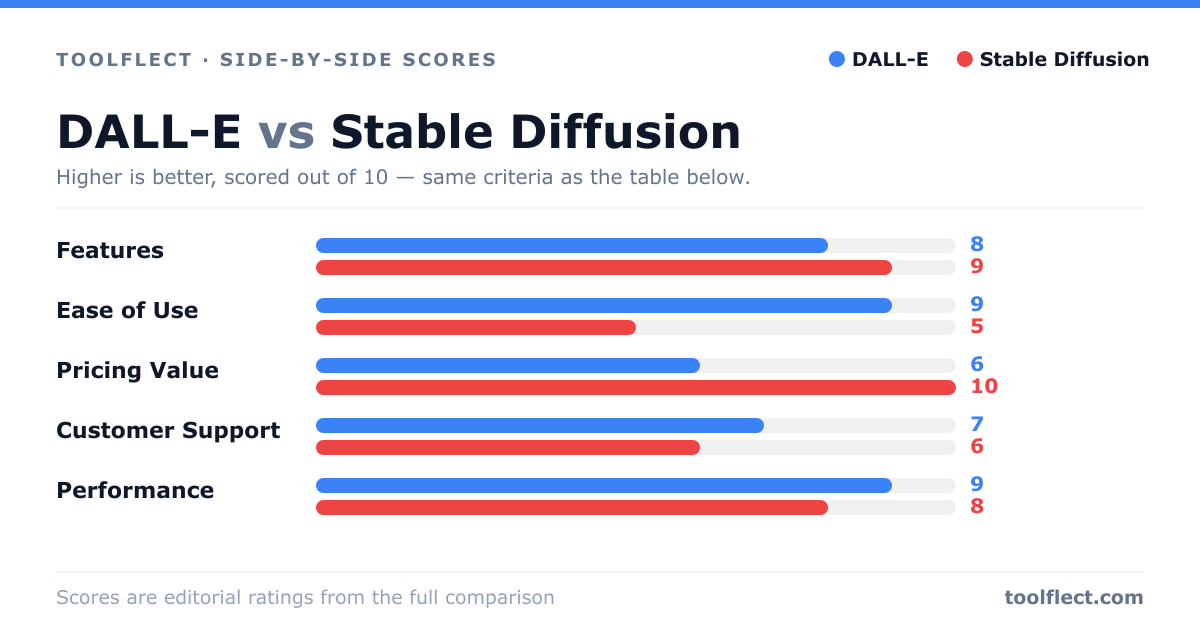
| Criterion | DALL-E | Stable Diffusion |
|---|---|---|
| Features | 8/10 – Advanced text understanding, inpainting, variations | 9/10 – Extensive customization, img2img, inpainting, ControlNet |
| Ease of Use | 9/10 – Simple web interface, no setup | 5/10 – Requires installation and technical knowledge |
| Pricing Value | 6/10 – Pay-per-use, can be costly | 10/10 – Free and open-source |
| Customer Support | 7/10 – OpenAI support, documentation, community | 6/10 – Community forums, no official support |
| Performance | 9/10 – Fast, reliable cloud processing | 8/10 – Depends on hardware, can be slower on CPU |