
Lindy vs Relevance AI: Which AI Agent Platform Wins?
Overview
Lindy and Relevance AI are both AI agent platforms designed to automate workflows and enhance productivity. Lindy focuses on creating personalized AI assistants that can handle scheduling, email, and other administrative tasks. Relevance AI, on the other hand, offers a more comprehensive suite for building and deploying AI agents, with a strong emphasis on customization and integration. This comparison will help you understand their differences and choose the right one for your needs.
Key Features Comparison
- Lindy: User-friendly interface, natural language processing, integrations with calendar and email, customizable workflows, and a focus on personal assistant tasks.
- Relevance AI: Advanced agent builder, multi-step workflows, extensive integrations (including databases and APIs), team collaboration tools, and a broader range of use cases beyond administrative tasks.
Pros & Cons
Lindy
- Pros:
- User-friendly no-code interface with drag-and-drop builder
- Strong integrations with popular tools like Slack, Gmail, and Notion
- Good for automating simple, repetitive tasks quickly
- Offers a free tier with limited usage
- Cons:
- Limited customization for complex workflows
- Performance can be inconsistent with large data sets
- Pricing scales quickly for advanced features
- Customer support is slow on free plan
Relevance AI
- Pros:
- Advanced AI capabilities with support for multiple models
- Highly customizable workflows and tools
- Scalable for enterprise-level use cases
- Strong API and developer tools
- Cons:
- Steeper learning curve for non-technical users
- Higher pricing tiers for full functionality
- Limited pre-built integrations compared to Lindy
- Customer support can be slow for basic plans
Lindy
- Pros:
- User-friendly no-code interface with drag-and-drop builder
- Strong integrations with popular tools like Slack, Gmail, and Notion
- AI-powered automation that learns from user feedback
- Flexible pricing with a free tier and scalable plans
- Cons:
- Limited customization for complex workflows
- Advanced features require higher-tier plans
- Occasional latency in AI responses
Relevance AI
- Pros:
- Powerful AI agent builder with extensive customization options
- Supports multiple AI models and integrations
- Scalable for enterprise-level use cases
- Detailed analytics and monitoring tools
- Cons:
- Steeper learning curve for beginners
- Pricing can be higher for advanced features
- Customer support response times vary
Lindy
- Pros:
- User-friendly interface with no-code automation
- Strong integrations with popular apps like Gmail, Slack, and Notion
- Flexible pricing with a free tier
- Good for automating repetitive tasks
- Cons:
- Limited advanced AI capabilities compared to competitors
- Customization options are somewhat limited
- Performance can be slow with complex workflows
- Customer support response times can be slow
Relevance AI
- Pros:
- Advanced AI agent capabilities with multi-step reasoning
- Highly customizable with a wide range of tools and integrations
- Scalable for enterprise use
- Strong performance in complex tasks
- Cons:
- Steeper learning curve due to complexity
- Pricing can be expensive for small teams
- Requires some technical knowledge to fully utilize
- Customer support is limited to higher-tier plans
Lindy
- Pros: Easy to set up, intuitive for non-technical users, excellent for personal productivity, quick deployment.
- Cons: Limited customization, fewer integrations, not suitable for complex enterprise workflows.
Relevance AI
- Pros: Highly customizable, powerful for complex automations, supports multiple agents, robust API and integrations.
- Cons: Steeper learning curve, may be overkill for simple tasks, pricing can be higher for advanced features.
Pricing Comparison
Lindy offers a free tier with limited features and paid plans starting at $99/month for more advanced capabilities. Relevance AI has a free trial, with paid plans starting at $19/month for basic features, but advanced features and higher usage can cost significantly more. For enterprise-level needs, both offer custom pricing.
Best Use Cases
- Lindy: Ideal for individuals and small teams needing a personal AI assistant for scheduling, email management, and simple task automation.
- Relevance AI: Best for businesses and developers who need to build complex AI agents for customer support, data processing, and multi-step workflows.
Verdict
Choose Lindy if you want a simple, user-friendly AI assistant for personal productivity. Choose Relevance AI if you need a powerful, customizable platform for building sophisticated AI agents for business processes. Both are excellent, but they serve different audiences.
Visual Comparison
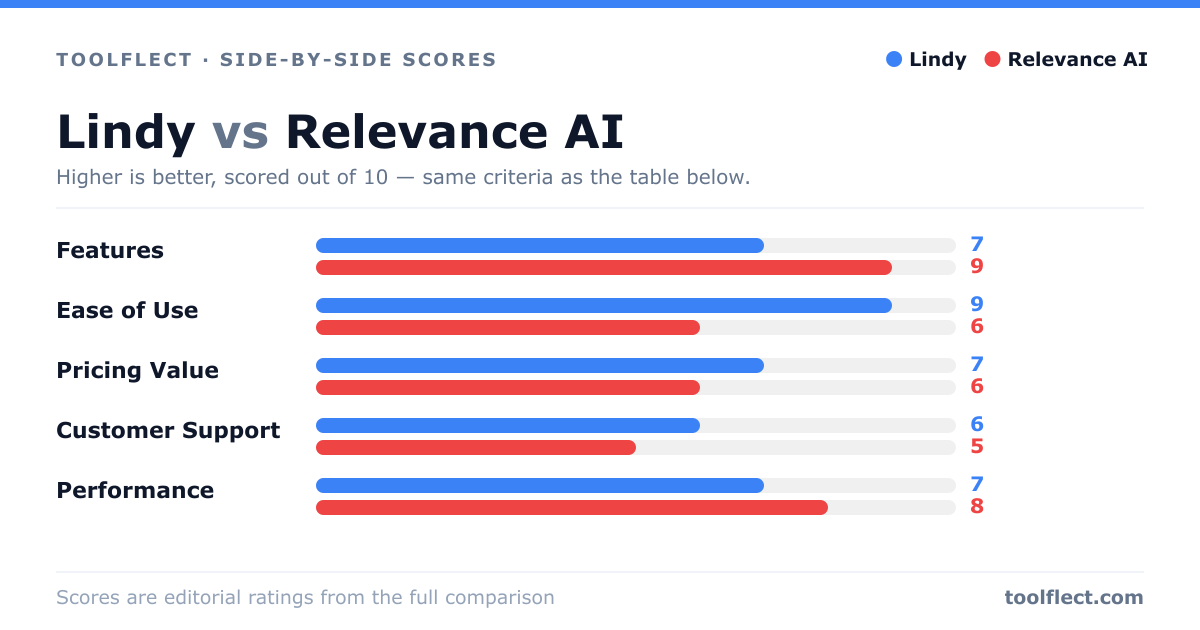
| Criterion | Lindy | Relevance AI |
|---|---|---|
| Features | 7/10 – Good for simple automations, limited advanced AI | 9/10 – Advanced AI, multi-model support, highly customizable |
| Ease of Use | 9/10 – Intuitive no-code interface | 6/10 – Steeper learning curve, more technical |
| Pricing Value | 7/10 – Free tier available, but paid plans can be pricey | 6/10 – Higher cost, but more features for enterprise |
| Customer Support | 6/10 – Slow on free plan, better on paid | 5/10 – Limited support on lower tiers |
| Performance | 7/10 – Reliable for small tasks, can lag with complex | 8/10 – Handles complex tasks well, but may require tuning |