
Elicit vs Consensus: Which AI Research Tool Is Right for You?
Overview
Elicit and Consensus are two leading AI-powered research tools designed to help students, academics, and professionals find and synthesize scientific literature. Elicit focuses on literature review automation and extracting key insights from papers, while Consensus acts as a search engine that directly answers research questions using evidence from scientific studies. Both tools aim to accelerate the research process, but they have distinct strengths and weaknesses.
Key Features Comparison
- Search & Discovery: Elicit allows users to search for papers using natural language queries and provides a list of relevant results with key information extracted automatically. Consensus also uses natural language but focuses on delivering concise, evidence-based answers, often summarizing conflicting findings.
- Data Extraction: Elicit excels at extracting specific data points like sample sizes, effect sizes, and methodologies from papers. Consensus does not extract data but instead provides direct answer summaries with citations.
- Literature Review Assistance: Elicit offers tools to organize papers, extract claims, and create summaries, making it ideal for systematic reviews. Consensus is better for quick fact-checking or getting an overview of a topic.
- Integration & Usability: Both are web-based with browser extensions. Elicit integrates with reference managers like Zotero, while Consensus offers a simpler, more streamlined interface.
Pros & Cons
Elicit
- Pros:
- Automates systematic literature reviews with AI-powered extraction of key findings.
- Intuitive interface for searching and organizing papers by concept.
- Supports exporting data to CSV for further analysis.
- Free tier available for basic use.
- Cons:
- Limited database coverage compared to PubMed or Google Scholar.
- Extraction accuracy can vary, requiring manual verification.
- Advanced features require a paid subscription.
- No citation management integration (e.g., Zotero).
Consensus
- Pros:
- Provides clear ‘Yes/No/Maybe’ answers to research questions based on paper abstracts.
- Uses a large database of over 200 million papers.
- Offers a Chrome extension for quick access.
- Includes a consensus meter to gauge scientific agreement.
- Cons:
- Limited to yes/no questions; not suitable for complex queries.
- Free tier has limited searches per day.
- No advanced filtering options (e.g., by study type).
- Lacks integration with reference managers.
Elicit
- Pros: Automates systematic literature reviews with AI-powered paper screening.
- Pros: Extracts key data points (e.g., sample size, outcomes) into tables.
- Pros: Intuitive interface for non-technical researchers.
- Cons: Limited to academic papers; no support for patents or grey literature.
- Cons: Data extraction accuracy can vary for complex studies.
Consensus
- Pros: Fast, simple search interface with AI-generated summaries.
- Pros: Covers a wide range of scientific topics, including medical and social sciences.
- Pros: Provides direct links to full-text papers.
- Cons: Summaries may oversimplify nuanced findings.
- Cons: Limited advanced filtering compared to Elicit.
Elicit
- Pros: Automates systematic literature reviews, saving hours of manual screening.
- Pros: Extracts key data points (e.g., sample size, outcomes) into tables for easy comparison.
- Pros: Uses AI to rank papers by relevance, improving discovery efficiency.
- Cons: Limited to academic papers; not suitable for broader web research.
- Cons: Can be inaccurate with complex or ambiguous queries, requiring manual verification.
- Cons: Free tier has limited credits; advanced features require subscription.
Consensus
- Pros: Provides direct answers with citations from millions of research papers.
- Pros: User-friendly interface with a simple search bar and clear results.
- Pros: Includes a consensus meter showing agreement among studies.
- Cons: Focuses on biomedical and life sciences; less coverage in other fields.
- Cons: Does not extract detailed data points like Elicit.
- Cons: Free version has limited searches per day; premium is needed for full access.
Elicit
- Pros: Deep data extraction; excellent for systematic reviews; supports complex queries; integrates with Zotero.
- Cons: Steeper learning curve; free tier limited to 5,000 results/month; slower for simple questions.
Consensus
- Pros: Fast answer generation; easy to use; clear citation display; free tier generous (unlimited searches, limited views).
- Cons: Limited data extraction; less useful for in-depth analysis; answer summaries may oversimplify nuances.
Pricing Comparison
Elicit offers a free plan with 5,000 search results per month. Paid plans start at $10/month for individuals (unlimited results, advanced features). Consensus provides a free tier with unlimited searches but limits the number of answer views per day. Its premium plan costs $11.99/month for unlimited access and additional features like PDF export. Both offer discounts for academic institutions.
Best Use Cases
- Elicit: Best for researchers conducting systematic reviews, meta-analyses, or need to extract detailed data from many papers.
- Consensus: Ideal for quick literature checks, getting answers to specific research questions, or for students who need a fast overview of a topic.
Verdict
Both tools are valuable but serve different purposes. Choose Elicit if you need deep data extraction and are managing a large literature review. Choose Consensus if you want quick, evidence-backed answers and ease of use. For many researchers, using both in tandem can cover the full spectrum from broad overview to detailed analysis.
Visual Comparison
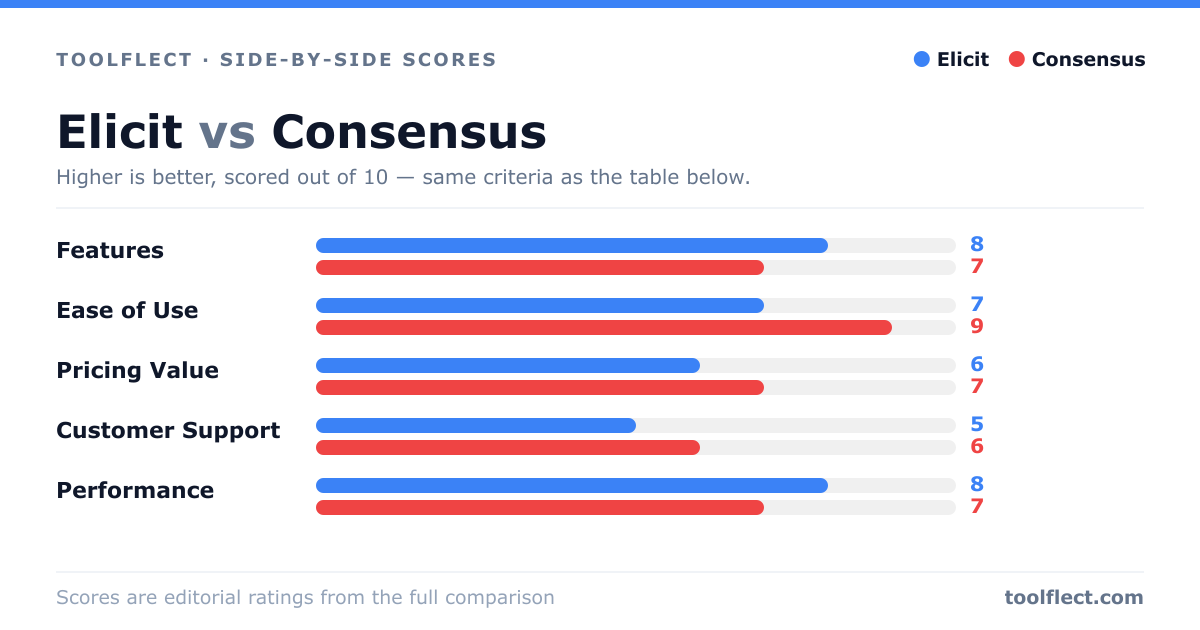
| Criterion | Elicit | Consensus |
|---|---|---|
| Features | 8/10 – AI extraction, systematic review workflow | 7/10 – Consensus meter, Chrome extension |
| Ease of Use | 7/10 – Clean UI, but learning curve for complex tasks | 9/10 – Simple question-answer interface |
| Pricing Value | 6/10 – Free tier limited, paid plans from $12/mo | 7/10 – Free tier with daily limits, Pro at $9/mo |
| Customer Support | 5/10 – Email support, limited documentation | 6/10 – Email support, active community forum |
| Performance | 8/10 – Accurate extraction, but slower on large datasets | 7/10 – Fast responses, but limited to abstract-level insights |