
Needle2 vs Qwen3-0.6B: Which LLM API Wins?
Overview
Needle2 and Qwen3-0.6B are two distinct offerings in the LLM API and model space. Needle2 is a proprietary, API-first language model optimized for retrieval-augmented generation and tool use, while Qwen3-0.6B is a compact, open-source model from Alibaba’s Qwen series, designed for efficient on-device or self-hosted deployment. This comparison examines their features, pricing, performance, and ideal use cases to help you decide which fits your needs.
Key Features Comparison
Needle2 focuses on seamless integration with external data sources, offering built-in connectors for databases, APIs, and document stores. It supports long context windows and advanced function calling. Qwen3-0.6B, being a small open-weight model, emphasizes low-latency inference and fine-tuning flexibility. It lacks native tool integration but can be extended via frameworks like LangChain. Needle2 is accessible only via API, while Qwen3-0.6B can be downloaded and run locally.
Pros & Cons
Needle2
- Pros: Easy API access with no infrastructure management.
- Pros: Built-in retrieval and tool-use capabilities.
- Pros: Scalable and maintained by the provider.
- Cons: Vendor lock-in and potential data privacy concerns.
- Cons: Higher cost per token compared to open models.
- Cons: Limited customization of the underlying model.
Qwen3-0.6B
- Pros: Free to use and modify (open-source).
- Pros: Runs locally, ensuring data privacy.
- Pros: Highly customizable and fine-tunable.
- Cons: Requires technical expertise to deploy and maintain.
- Cons: Smaller model size may limit complex reasoning.
- Cons: No built-in retrieval or tool integration.
Pricing Comparison
Needle2 operates on a pay-per-token model, with costs varying by usage tier. Typical pricing ranges from $0.50 to $2.00 per million tokens, depending on volume and features. Qwen3-0.6B is free to download and use, but incurs infrastructure costs if self-hosted (e.g., cloud GPU instances). For high-volume applications, Qwen3-0.6B can be more cost-effective, while Needle2 offers predictable operational expenses without maintenance overhead.
Best Use Cases
Needle2 excels in enterprise settings requiring quick integration with existing data pipelines, such as customer support chatbots with knowledge base access or internal document Q&A. Qwen3-0.6B is ideal for developers building privacy-sensitive applications, edge devices, or research projects where fine-tuning and low latency are critical. It also suits prototyping when budget is a constraint.
Verdict
Choose Needle2 if you need a managed, feature-rich API with strong retrieval capabilities and don’t mind ongoing costs. Opt for Qwen3-0.6B if you prioritize customization, data control, and cost savings, and have the resources to handle deployment. Both serve different niches, so the best choice depends on your technical capacity and project requirements.
FAQ
Is Needle2 open-source?
No, Needle2 is a proprietary model accessible only via API.
Can Qwen3-0.6B be used commercially?
Yes, Qwen3-0.6B is released under a permissive license that allows commercial use.
Which model has better performance for complex tasks?
Needle2 generally outperforms Qwen3-0.6B on complex reasoning and retrieval tasks due to its larger size and specialized architecture.
Do I need a GPU to run Qwen3-0.6B?
While it can run on CPU, a GPU is recommended for optimal inference speed, especially in production.
Visual Comparison
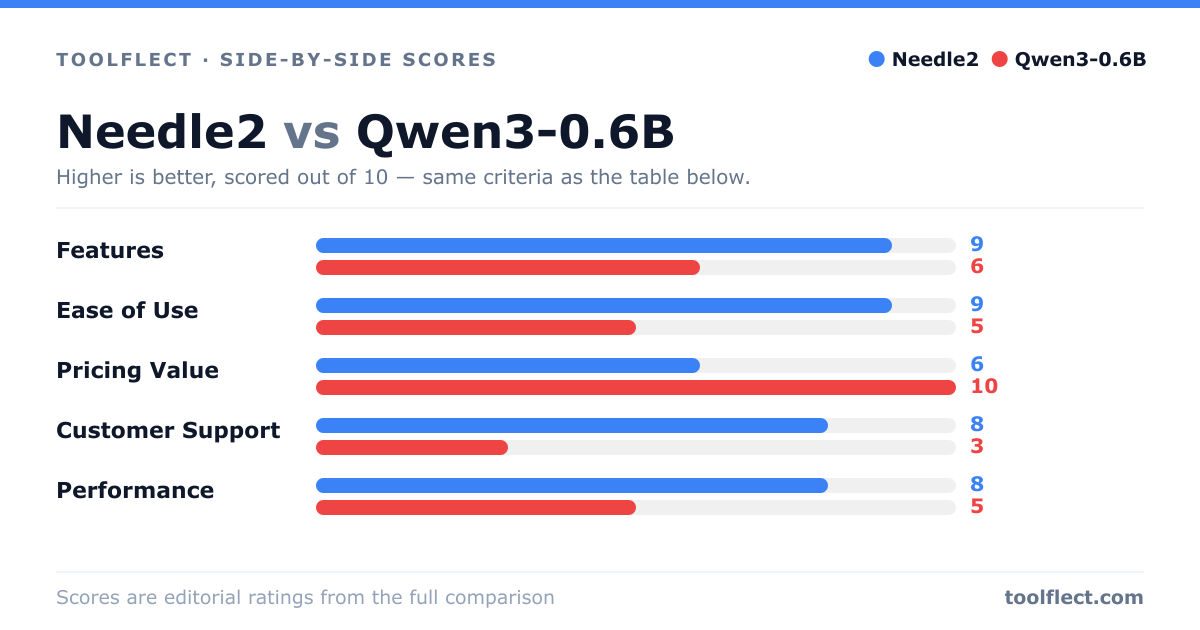
| Criterion | Needle2 | Qwen3-0.6B |
|---|---|---|
| Features | 9/10 | 6/10 |
| Ease of Use | 9/10 | 5/10 |
| Pricing Value | 6/10 | 10/10 |
| Customer Support | 8/10 | 3/10 |
| Performance | 8/10 | 5/10 |