
OpenAI vs Anthropic: Which AI Model API Wins in 2026?
Overview
OpenAI and Anthropic are two leading providers of large language model (LLM) APIs. OpenAI, known for GPT-4 and GPT-4o, offers a versatile range of models with strong multimodal capabilities. Anthropic, with its Claude 3.5 family, emphasizes safety, interpretability, and long-context handling. Both APIs are widely used in production, but they differ in philosophy, performance, and pricing. This article provides an unbiased comparison to help you decide which is better for your use case.
Key Features Comparison
- Model Variety: OpenAI offers GPT-4o, GPT-4 Turbo, and specialized models like Whisper for audio. Anthropic offers Claude 3.5 Sonnet, Haiku, and Opus, with a focus on text and code.
- Multimodal Support: OpenAI’s GPT-4o natively handles text, images, and audio. Anthropic’s Claude 3.5 also supports image input but not audio.
- Context Window: Anthropic’s Claude 3.5 supports up to 200k tokens, while OpenAI’s GPT-4o supports 128k tokens.
- Safety and Alignment: Anthropic places a strong emphasis on constitutional AI and safety, while OpenAI also implements safety measures but with a different approach.
- API Reliability: Both offer robust APIs with high uptime, but OpenAI has a longer track record and broader ecosystem.
Pros & Cons
OpenAI
- Pros:
- Wide range of models (GPT-4o, o1, etc.) with strong performance in reasoning and creative tasks.
- Extensive ecosystem: plugins, APIs, and integrations with major platforms.
- Continuous updates and improvements, including multimodal capabilities.
- Strong developer support and documentation.
- Cons:
- Higher pricing compared to some competitors, especially for high-volume usage.
- Occasional rate limits and latency issues during peak times.
- Less transparent about model architecture and training data.
- Some users report inconsistent output quality across different models.
Anthropic
- Pros:
- Claude models excel in safety, ethical reasoning, and long-context understanding.
- Competitive pricing, especially for larger context windows.
- Strong focus on interpretability and responsible AI.
- Excellent for tasks requiring nuanced judgment and summarization.
- Cons:
- Fewer model options compared to OpenAI.
- Smaller ecosystem and fewer third-party integrations.
- Some features (e.g., vision) are less mature than OpenAI’s.
- Documentation and community support are less extensive.
OpenAI
- Pros:
- State-of-the-art models with broad capabilities (text, image, audio).
- Extensive ecosystem and integrations (plugins, APIs).
- Strong developer support and documentation.
- Advanced features like function calling and fine-tuning.
- Cons:
- Higher pricing for high-volume usage.
- Less transparent about model training data and safety.
- Rate limits can be restrictive for production.
- Occasional performance variability.
Anthropic
- Pros:
- Focus on safety and interpretability.
- Long context windows (up to 200k tokens).
- Competitive pricing for similar performance.
- Strong performance on reasoning and coding tasks.
- Cons:
- Fewer integrations compared to OpenAI.
- Smaller ecosystem and community.
- Limited multimodal capabilities (text-only for now).
- Less mature tooling for fine-tuning.
OpenAI
- Pros:
- Extensive model ecosystem (GPT-4o, o1, etc.) with strong performance across diverse tasks.
- Mature API with robust documentation, SDKs, and community support.
- Advanced features like function calling, JSON mode, and fine-tuning.
- Competitive pricing for high-volume usage with tiered plans.
- Cons:
- Less transparent about model training and safety practices compared to Anthropic.
- Rate limits and occasional downtime during peak usage.
- Some users report inconsistent output quality on nuanced tasks.
- Pricing can escalate with high token usage, especially for o1 models.
Anthropic
- Pros:
- Superior safety and alignment features (Constitutional AI, interpretability tools).
- Excellent at long-context tasks with Claude 3.5 Sonnet and Opus.
- Strong performance on reasoning and coding benchmarks.
- Transparent about model capabilities and limitations.
- Cons:
- Smaller model variety compared to OpenAI.
- API is less mature with fewer third-party integrations.
- Higher pricing for top-tier models like Opus.
- Limited availability in some regions.
OpenAI
- Pros: Extensive documentation, wide range of models, strong multimodal capabilities, mature ecosystem with many integrations, and frequent updates.
- Cons: Pricing can be higher for high-volume use, and some users have concerns about data privacy and content moderation.
Anthropic
- Pros: Excellent long-context handling, strong safety features, competitive pricing, and high-quality code generation.
- Cons: Fewer model options, less multimodal support (no audio), and a smaller ecosystem compared to OpenAI.
Pricing Comparison
Pricing varies by model and usage. OpenAI’s GPT-4o costs $2.50 per 1M input tokens and $10 per 1M output tokens. Anthropic’s Claude 3.5 Sonnet costs $3 per 1M input tokens and $15 per 1M output tokens. However, Anthropic’s Haiku model is cheaper at $0.25 per 1M input and $1.25 per 1M output. For high-volume applications, Anthropic may offer better value, but OpenAI’s pricing is competitive for its flagship model.
Best Use Cases
- OpenAI: Ideal for applications requiring multimodal input (text, image, audio), such as virtual assistants, content generation, and real-time transcription.
- Anthropic: Best for tasks that require deep reasoning over long documents, like legal analysis, research summarization, and complex coding tasks.
Verdict
Both OpenAI and Anthropic are top-tier LLM APIs. Choose OpenAI if you need multimodal capabilities and a broad ecosystem. Choose Anthropic if you prioritize long-context understanding, safety, and cost-effectiveness for text-heavy tasks. Ultimately, the best choice depends on your specific requirements.
FAQ
Which API is more affordable for large-scale use?
Anthropic’s Haiku model is significantly cheaper than OpenAI’s GPT-4o for high-volume text generation, but for multimodal tasks, OpenAI may be the only option.
Can both APIs handle image inputs?
Yes, both GPT-4o and Claude 3.5 support image inputs, but OpenAI also supports audio, while Anthropic does not.
Which API has better safety features?
Anthropic emphasizes constitutional AI and safety, but OpenAI also has robust safety measures. The choice depends on your specific safety requirements.
Do both APIs offer fine-tuning?
Yes, both OpenAI and Anthropic offer fine-tuning options for their models, though availability may vary by model.
Visual Comparison
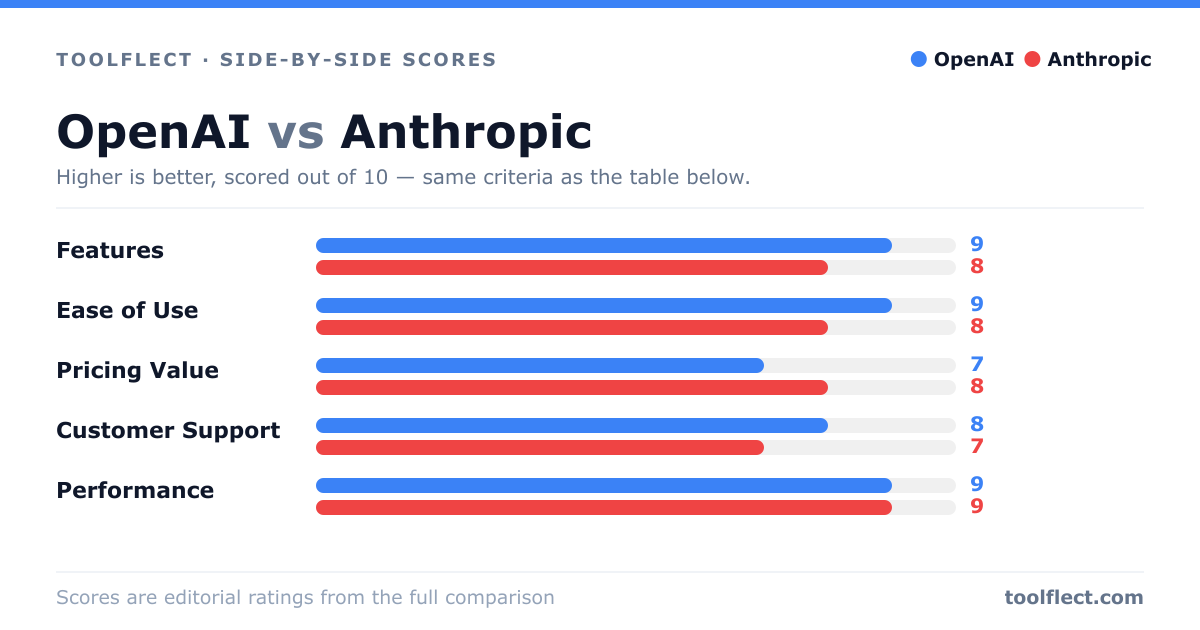
| Criterion | OpenAI | Anthropic |
|---|---|---|
| Features | 9/10 – Broad model range, multimodal, plugins | 8/10 – Strong in safety and long context, but fewer models |
| Ease of Use | 8/10 – Simple API, but complex pricing tiers | 8/10 – Clean API, but less documentation |
| Pricing Value | 7/10 – Higher cost, but flexible plans | 9/10 – Competitive pricing, especially for large contexts |
| Customer Support | 8/10 – Responsive, but only for paid tiers | 7/10 – Limited support, community-driven |
| Performance | 9/10 – State-of-the-art on many benchmarks | 8/10 – Excellent on reasoning and safety, slightly behind on creative tasks |