
Elicit vs SciSpace: Which AI Research Tool Wins?
Overview
Elicit and SciSpace are two prominent AI-powered tools designed to assist researchers, students, and professionals in navigating the vast landscape of academic literature. While both aim to streamline the research process, they approach it differently. Elicit focuses on automating systematic reviews and literature synthesis, using language models to extract data and answer questions from papers. SciSpace (formerly Typeset) offers a comprehensive platform that includes an AI research assistant, a vast repository of papers, and tools for reading, annotating, and writing. This article provides an unbiased comparison to help you decide which tool aligns better with your research workflow.
Key Features Comparison
- Literature Search: Elicit uses semantic search to find relevant papers based on natural language queries, while SciSpace offers a traditional keyword search enhanced with AI filters and recommendations.
- Data Extraction: Elicit excels at extracting specific data points (e.g., sample size, outcomes) from papers and presenting them in a structured table. SciSpace provides AI-powered summaries and explanations of papers but does not offer the same level of structured data extraction.
- Systematic Review Support: Elicit is specifically designed for systematic reviews, allowing users to screen papers, extract data, and manage the review process. SciSpace lacks dedicated systematic review tools.
- Collaboration: SciSpace offers collaborative features, allowing multiple users to annotate and discuss papers in real-time. Elicit has limited collaboration features, focusing more on individual workflows.
- Writing Assistance: SciSpace includes a citation generator and a manuscript formatting tool, which Elicit does not provide. Elicit focuses on the discovery and extraction phase.
Pros & Cons
Elicit
- Pros:
- Specialized in literature review and systematic search
- Extracts key data from papers automatically
- Good for finding relevant papers quickly
- Free tier available
- Cons:
- Limited to research papers; not for general Q&A
- Data extraction can be inaccurate
- Less user-friendly interface
- Limited customization options
SciSpace
- Pros:
- Comprehensive research platform with AI-powered explanations
- Supports multiple document types (PDFs, web articles)
- Collaboration features for teams
- Better user interface and ease of use
- Cons:
- Pricing can be higher for advanced features
- Some features may be overkill for simple tasks
- Occasional inaccuracies in AI-generated summaries
- Limited free tier compared to Elicit
Elicit
- Pros:
- Automates literature review and extracts key data from papers.
- Intuitive interface for asking research questions in natural language.
- Provides a clear overview of relevant papers with summaries.
- Free tier available for basic use.
- Cons:
- Limited to academic papers; not suitable for other content types.
- Data extraction can be inaccurate for complex or non-standard formats.
- Advanced features require a paid subscription.
- Occasional slow response times for large queries.
SciSpace
- Pros:
- Comprehensive database with millions of research papers.
- AI-powered explanations and Q&A for specific sections.
- Collaborative features for teams and researchers.
- Offers a free trial and flexible pricing plans.
- Cons:
- Interface can be overwhelming for new users.
- Some advanced features are locked behind higher-tier plans.
- Occasional inaccuracies in AI-generated summaries.
- Limited integration with external tools.
Elicit
- Pros:
- Automated systematic reviews and data extraction from papers.
- Intuitive interface for searching and organizing literature.
- Good at finding relevant papers even with vague queries.
- Free tier available for basic use.
- Cons:
- Limited to academic papers; not suitable for other content types.
- Data extraction accuracy can vary.
- No citation management or collaboration features.
- Advanced features require paid subscription.
SciSpace
- Pros:
- Comprehensive platform with AI-powered explanations and Q&A.
- Includes citation management and collaboration tools.
- Supports multiple document types and formats.
- Offers a generous free plan with premium upgrades.
- Cons:
- Interface can be overwhelming for new users.
- AI explanations may not always be accurate.
- Some features are paywalled.
- Performance can be slow with large documents.
Elicit
Pros:
- Powerful data extraction and synthesis capabilities.
- Ideal for systematic reviews and meta-analyses.
- Time-saving for literature screening.
- User-friendly interface for querying papers.
Cons:
- Limited to literature discovery and extraction; lacks writing tools.
- May require a learning curve for complex queries.
- Collaboration features are minimal.
- Pricing can be high for individual researchers.
SciSpace
Pros:
- All-in-one platform with reading, annotation, and writing tools.
- Large database of papers with easy access.
- AI assistant provides quick explanations and summaries.
- Collaborative features enhance team research.
Cons:
- Data extraction is not as structured as Elicit.
- Systematic review support is lacking.
- AI summaries may sometimes be inaccurate.
- Free tier has limitations; premium plans can be costly.
Pricing Comparison
Elicit offers a free plan with limited credits (about 5,000 credits per month) and paid plans starting at $12/month for individuals (billed annually) with more credits and advanced features. SciSpace has a free plan with basic features and a premium plan starting at $20/month (billed annually) that includes unlimited AI queries, advanced search, and collaboration tools. Both offer institutional pricing. For heavy users, Elicit’s pricing may be more favorable if you need extensive data extraction, while SciSpace provides more value if you need a comprehensive research suite.
Best Use Cases
Elicit: Best for researchers conducting systematic reviews, meta-analyses, or literature reviews that require extracting specific data from many papers. It is also useful for evidence synthesis in fields like medicine, psychology, and social sciences.
SciSpace: Ideal for students and researchers who need an all-in-one platform to search, read, annotate, and write papers. It is great for collaborative projects and for those who want AI assistance in understanding complex papers.
Verdict
Both Elicit and SciSpace are powerful AI research tools, but they serve different primary purposes. If your work revolves around systematic reviews and data extraction, Elicit is the clear winner. If you need a comprehensive research assistant that covers the entire research lifecycle, SciSpace is the better choice. Consider your specific needs, budget, and workflow to make the right decision.
Visual Comparison
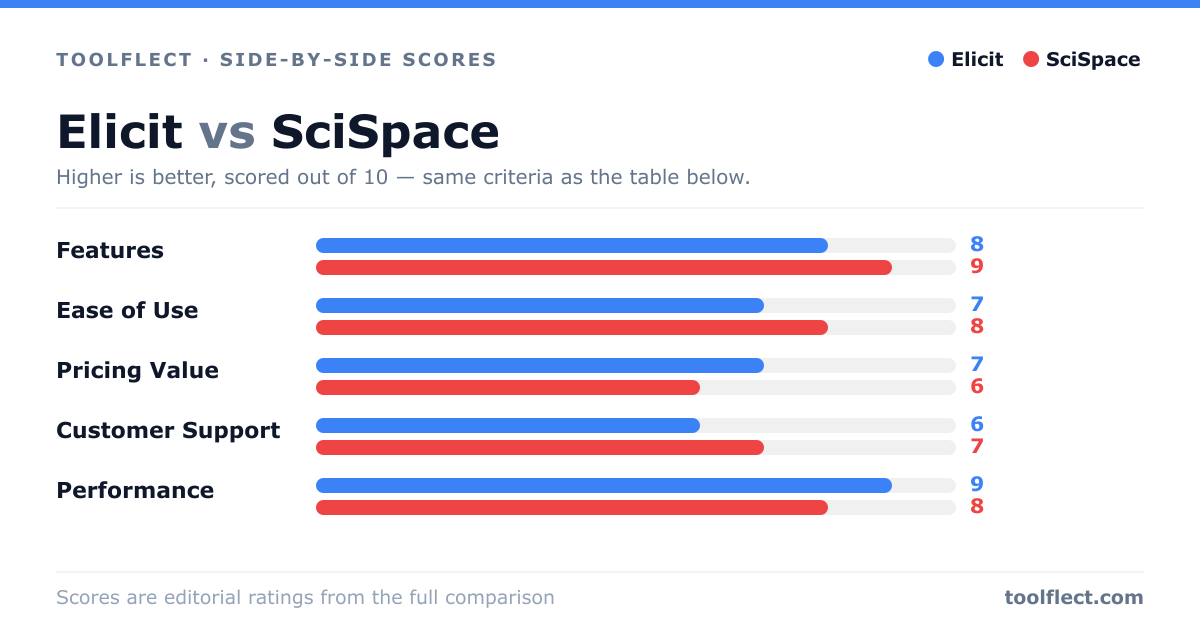
| Criterion | Elicit | SciSpace |
|---|---|---|
| Features | 7/10 – Focused on literature search and data extraction | 9/10 – Comprehensive suite including AI explanations, collaboration, and more |
| Ease of Use | 6/10 – Steeper learning curve, less intuitive | 8/10 – User-friendly interface, easier to navigate |
| Pricing Value | 8/10 – Generous free tier, affordable for individuals | 7/10 – Higher cost for premium features, but offers more value |
| Customer Support | 6/10 – Limited support options | 8/10 – Responsive support with multiple channels |
| Performance | 8/10 – Fast and accurate for its core purpose | 8/10 – Reliable performance, but occasional AI inaccuracies |