
CrewAI vs AutoGPT: Which AI Agent Framework Wins?
Overview
CrewAI and AutoGPT are two prominent AI agent frameworks that enable autonomous task execution. CrewAI focuses on role-based collaborative agents, while AutoGPT is an open-source project that leverages GPT-4 to break down complex goals into subtasks. This article provides an unbiased comparison to help you choose the right tool for your projects.
Key Features Comparison
- Architecture: CrewAI uses a role-playing system where agents have specific roles, goals, and backstories, working together as a crew. AutoGPT uses a single autonomous agent that iteratively plans and executes tasks.
- Customization: CrewAI offers high flexibility with custom tools and processes. AutoGPT allows custom commands and memory but is less structured.
- Memory: CrewAI supports both short-term and long-term memory. AutoGPT has a vector-based memory for storing past interactions.
- Integration: CrewAI integrates with LangChain and other tools. AutoGPT can use web browsing, file operations, and API calls.
- User Interface: CrewAI is primarily code-based, requiring Python. AutoGPT has a CLI and a web UI (in some versions).
Pros & Cons
CrewAI
- Pros:
- Role-based agent design for structured workflows
- Seamless integration with LangChain and LangGraph
- Active community and frequent updates
- Flexible for both simple and complex tasks
- Cons:
- Steeper learning curve for beginners
- Requires more manual configuration
- Limited built-in tools compared to AutoGPT
- Documentation can be sparse in places
AutoGPT
- Pros:
- Autonomous task execution with minimal human intervention
- Large user base and extensive community support
- Built-in internet access and file operations
- Easy to get started with a simple setup
- Cons:
- Can be resource-intensive and slow
- Less structured, leading to unpredictable behavior
- Limited customization for specific workflows
- Occasional instability and bugs
CrewAI
- Pros:
- Role-based agent design simplifies complex workflows.
- Strong focus on collaboration and task delegation.
- Lightweight and easy to integrate with existing LLMs.
- Active community and regular updates.
- Cons:
- Less autonomous compared to AutoGPT; requires more manual orchestration.
- Limited built-in tools; relies on external integrations.
- Steeper learning curve for non-developers.
AutoGPT
- Pros:
- Highly autonomous; can break down and execute tasks with minimal human input.
- Large ecosystem of plugins and tools.
- Popular and widely documented.
- Can handle complex, multi-step projects.
- Cons:
- Can be resource-intensive and slow.
- Prone to errors and hallucinations without careful supervision.
- Setup and configuration can be complex.
- Less structured for team collaboration.
CrewAI
- Pros:
- Role-based agent design for structured workflows
- Seamless integration with LangChain and LangGraph
- Lightweight and easy to set up
- Active community and frequent updates
- Cons:
- Limited built-in tools compared to AutoGPT
- Requires more manual configuration for complex tasks
- Less autonomous; relies on user-defined processes
AutoGPT
- Pros:
- Highly autonomous with goal-oriented task execution
- Wide range of built-in tools and integrations
- Strong community and extensive documentation
- Can handle complex, multi-step tasks with minimal supervision
- Cons:
- Steeper learning curve and setup complexity
- Can be resource-intensive and slower
- Less structured; may require careful monitoring to avoid errors
CrewAI
- Pros: Excellent for complex workflows requiring collaboration; clear role separation; strong community support; actively maintained.
- Cons: Steeper learning curve; requires programming knowledge; less turnkey for non-developers.
AutoGPT
- Pros: Easy to start with; autonomous goal-oriented behavior; large user base; open-source.
- Cons: Can be unpredictable; often requires careful supervision; limited multi-agent collaboration; performance varies with model.
Pricing Comparison
CrewAI is open-source and free to use, but you may incur costs for API usage (e.g., OpenAI API). AutoGPT is also open-source and free, but similarly requires API keys for LLM access. Both have no subscription fees, but enterprise support may be available at a cost.
Best Use Cases
- CrewAI: Ideal for complex projects that require multiple agents with distinct expertise, such as software development teams, research assistants, and automated workflows with defined roles.
- AutoGPT: Best for simple, goal-oriented tasks like web research, content generation, and automating repetitive tasks where a single agent can handle the process.
Verdict
Both tools are powerful, but they serve different needs. If you need a structured, multi-agent system with clear roles and collaboration, CrewAI is the better choice. If you prefer a quick, autonomous agent for straightforward tasks, AutoGPT is more accessible. Evaluate your project’s complexity and your technical comfort to decide.
Visual Comparison
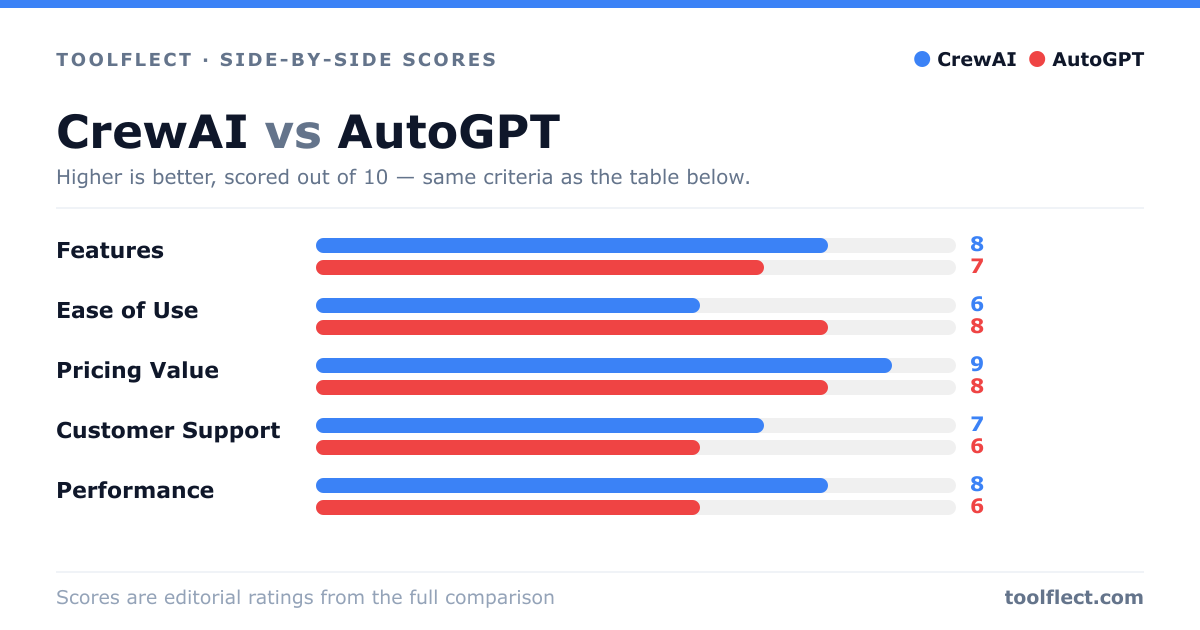
| Criterion | CrewAI | AutoGPT |
|---|---|---|
| Features | 8/10 – Role-based agents, task delegation, integration with LangChain | 7/10 – Autonomous loops, internet access, file operations |
| Ease of Use | 6/10 – Requires understanding of roles and processes | 8/10 – Simple setup, minimal configuration |
| Pricing Value | 9/10 – Open-source, free to use | 8/10 – Open-source, but may incur API costs |
| Customer Support | 7/10 – Community forums, GitHub issues | 6/10 – Community-driven, slower response |
| Performance | 8/10 – Efficient for structured tasks | 6/10 – Can be slow and resource-heavy |