H2O.ai vs DataRobot: Which Automated ML Platform Wins?
Overview
H2O.ai and DataRobot are two leading automated machine learning (AutoML) platforms that empower data scientists and business analysts to build and deploy machine learning models at scale. H2O.ai originated from the open-source H2O-3 project, offering a flexible hybrid approach with on-premises, cloud, and open-source editions. DataRobot, on the other hand, is a purpose-built enterprise AI platform focusing on end-to-end automation, from data preparation to model deployment and monitoring. While both aim to accelerate AI adoption, they differ significantly in deployment models, pricing, and target audiences.
Key Features Comparison
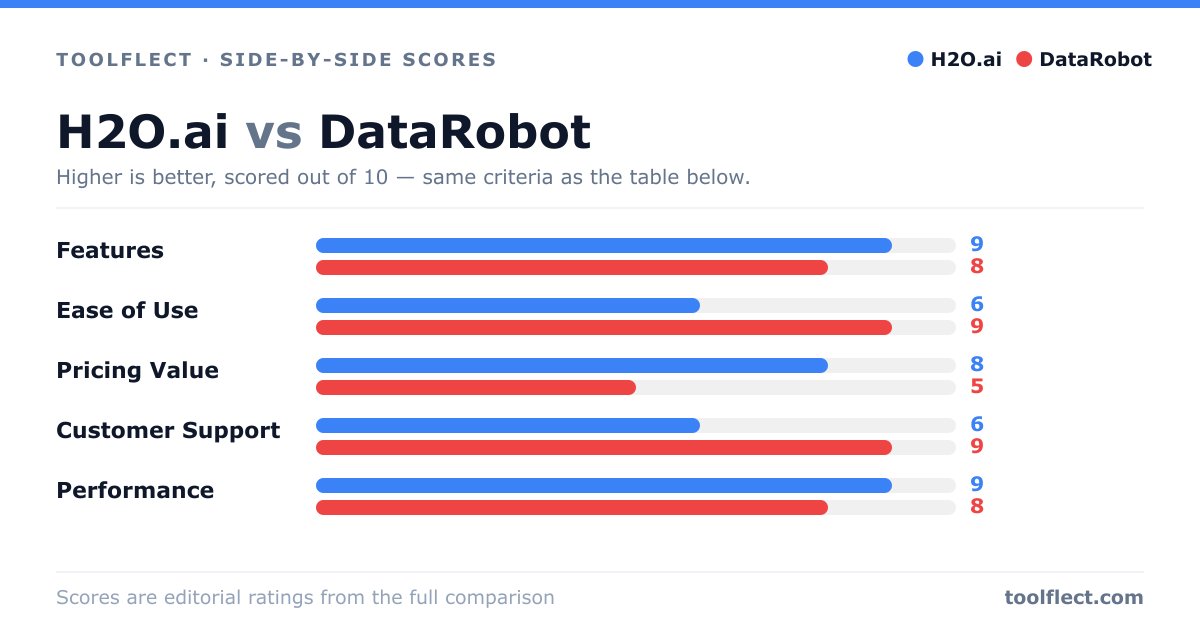
H2O.ai provides a suite of tools including Driverless AI, its flagship AutoML solution, which emphasizes automatic feature engineering, model tuning, and interpretability. The platform integrates with popular open-source frameworks and supports both on-premises (including air-gapped) and cloud deployments. Key features include automatic visualization, time-series forecasting, NLP, and a flexible Python/R API, alongside the AI AppStore for building custom AI applications. In contrast, DataRobot offers a fully managed SaaS platform or VPC deployment, featuring a unified interface for data preparation, model building, validation, and MLOps. Its distinctive capabilities include a wide range of algorithms, automated model documentation, bias detection, explainability, and a strong emphasis on MLOps and model governance. DataRobot also offers a broad ecosystem of connectors and pre-built templates for specific industries.
Pros & Cons
H2O.ai:
- Pros: Strong open-source community; flexible deployment (on-prem/cloud); cost-effective for small teams; low-level API control; no vendor lock-in. Cons: Steeper learning curve for non-experts; requires more manual intervention; limited built-in MLOps compared to DataRobot; support varies by edition.
DataRobot:
- Pros: Very easy to use with automated workflows; excellent MLOps and governance; extensive documentation and training; strong customer support; works well for large enterprises. Cons: High cost; less flexible for custom on-prem deployments; proprietary framework; can be overkill for small projects.
Pricing Comparison
H2O.ai offers three tiers: a free open-source version (H2O-3), a self-managed enterprise edition with annual subscription (based on node count), and a full Driverless AI enterprise license. Pricing for Driverless AI typically starts around $50,000 per year, making it more accessible for mid-sized companies. DataRobot operates on a subscription model per user with custom enterprise quotes, often starting in the six-figure range, and additional costs for compute and storage. DataRobot also offers a free trial and a limited community edition, but the production-ready features require a significant financial commitment. Overall, H2O.ai is more budget-friendly, especially for organizations with existing on-prem infrastructure, while DataRobot’s premium pricing reflects its managed service and strategic focus.
Best Use Cases
H2O.ai is ideal for companies that value open-source collaboration, have strict data privacy requirements (e.g., on-prem), or want to embed custom AI into existing applications. It suits data science teams that need control over the modeling process and are comfortable with coding. DataRobot is best for enterprises that need rapid model deployment without deep data science expertise, and that prioritize MLOps, regulatory compliance, and model explainability. It’s particularly strong in regulated industries like banking, healthcare, and insurance, where auditability is critical.
Verdict
Both H2O.ai and DataRobot are powerful AutoML platforms, but they cater to different needs. H2O.ai wins on flexibility, open-source ecosystem, and cost-efficiency, making it a great choice for cost-conscious teams and those with on-prem requirements. DataRobot excels in user-friendliness, enterprise-grade MLOps, and customer support, justifying its premium price for large organizations seeking a turnkey solution. The right choice depends on your team’s technical maturity, budget, and deployment strategy. If you value openness and customizability, choose H2O.ai; if you want a one-stop, fully managed platform, DataRobot is the stronger contender.
Visual Comparison