Replicate vs Together AI: Which AI Tool Wins?
Overview
Replicate and Together AI are both prominent platforms in the AI development space, but they serve different primary purposes. Replicate is a cloud-based service that simplifies running open-source machine learning models through a unified API, with a vast library of community-uploaded models ranging from image generation to text-to-speech. Together AI, on the other hand, focuses on providing high-performance infrastructure for training, fine-tuning, and serving large language models and other AI models, with an emphasis on enterprise-grade speed and scalability. This article provides a detailed, unbiased comparison to help you decide which platform aligns best with your development needs.
Key Features Comparison
Replicate: Replicate offers a user-friendly REST API that allows developers to run thousands of pre-trained models without managing underlying infrastructure. Key features include:
- Simple API endpoints for inference with support for popular models like Stable Diffusion, Whisper, and Llama.
- A web playground for testing models interactively.
- Pay-per-use pricing based on compute time, making it accessible for small projects.
- Support for custom models via Cog, Replicate’s containerization tool.
Together AI: Together AI provides a comprehensive platform for both training and inference, with a focus on performance. Key features include:
- Managed GPU clusters optimized for large-scale model training and fine-tuning.
- Ultra-fast inference engine with support for leading open-source models like Llama 3, Mistral, and DeepSeek.
- Custom model training with distributed training capabilities.
- Dedicated private endpoints and enterprise security features.
Pros & Cons
Replicate Pros:
- Extremely easy to use, even for beginners.
- Huge selection of models available out of the box.
- Transparent and low-cost pricing for individual developers.
- No need to manage infrastructure or deploy models.
Replicate Cons:
- Less control over training and fine-tuning processes.
- Performance may vary depending on model and load; limited optimization options.
- Costs can escalate with high-volume usage.
Together AI Pros:
- Superior performance and low latency for inference.
- Full suite for training and fine-tuning custom models.
- Highly scalable infrastructure suitable for production workloads.
- Strong customer support for enterprise clients.
Together AI Cons:
- Steeper learning curve, especially for using training features.
- Pricing is less predictable and can be expensive for small-scale use.
- Model availability is more focused on language models; fewer diverse model types compared to Replicate.
Pricing Comparison
Replicate uses a simple per-second billing model. Costs are based on the hardware selected for a model (e.g., T4, A100) and the time taken for computation. This makes it easy to estimate costs for small to medium workloads. For example, running a typical image generation model might cost a few cents per generation. Replicate also offers a free tier with limited credits to get started.
Together AI’s pricing is more complex, involving plans for dedicated GPU instances, reserved capacity, and per-hour rates for training and inference. While they offer competitive pricing for high-performance GPUs (like H100), the minimum commitment and enterprise contracts often make it more suitable for businesses with substantial budgets. They also have a pay-as-you-go option for inference, but costs can be higher than Replicate per request if you factor in performance.
Best Use Cases
Replicate: Replicate is ideal for developers who need quick access to a wide variety of AI models for prototyping, small-scale applications, or creative projects. It is particularly well-suited for:
- Hobbyists and startups building MVPs.
- Image generation and editing apps.
- Audio transcription or translation tasks.
- Experimentation with different models without heavy investment.
Together AI: Together AI is designed for teams and organizations that require high-performance, production-grade AI infrastructure. Best use cases include:
- Fine-tuning custom LLMs on proprietary datasets.
- Deploying large language models at scale with strict latency requirements.
- Building enterprise AI products with dedicated support and security.
- Research projects involving model training.
Verdict
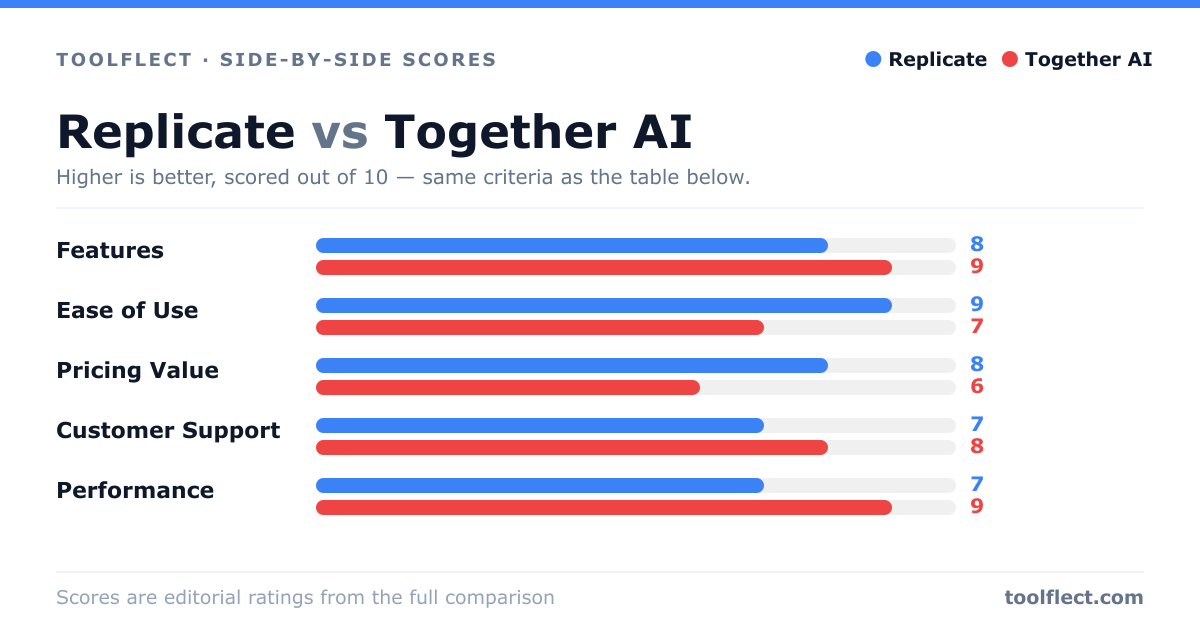
Both Replicate and Together AI are powerful platforms, but they serve different audiences. If you are a developer seeking ease of use, a broad model selection, and low upfront costs, Replicate is the clear winner. On the other hand, if you need top-tier performance, advanced training capabilities, and are willing to invest in a more robust infrastructure, Together AI is the better choice. Ultimately, the decision depends on your specific project requirements, technical expertise, and budget.
Visual Comparison