
ChatGPT vs Claude: Which AI Chatbot Reigns Supreme?
Overview
ChatGPT, developed by OpenAI, and Claude, created by Anthropic, are two leading AI chatbots that have garnered significant attention. Both leverage large language models to generate human-like text, but they differ in philosophy, capabilities, and target audiences. ChatGPT is known for its versatility and broad knowledge base, while Claude emphasizes safety, ethics, and nuanced conversation. This article provides an unbiased comparison to help you decide which tool fits your needs.
Key Features Comparison
- Model Variants: ChatGPT offers GPT-3.5, GPT-4, and GPT-4o; Claude offers Claude 3 Haiku, Sonnet, and Opus.
- Context Window: ChatGPT supports up to 128k tokens (GPT-4 Turbo); Claude supports up to 200k tokens (Claude 3).
- Multimodality: ChatGPT can process images in GPT-4 and GPT-4o; Claude can also analyze images in all Claude 3 models.
- Internet Browsing: ChatGPT Plus and Teams include browsing; Claude Pro does not have built-in browsing (requires API).
- File Upload: Both support file uploads (PDF, text, images) for analysis.
- Custom Instructions: ChatGPT allows custom instructions; Claude does not have a built-in equivalent but system prompts can be used via API.
- API Availability: Both offer APIs for developers.
Pros & Cons
ChatGPT
- Pros:
- Wide range of capabilities including code generation, translation, and creative writing.
- Large user base and extensive community support.
- Free tier available with access to GPT-3.5; GPT-4 available via subscription.
- Integrates with various platforms and APIs.
- Cons:
- Can sometimes produce incorrect or biased information.
- May require careful prompting to get desired results.
- Free tier has usage limits.
- Occasionally verbose or overconfident in responses.
Claude
- Pros:
- Strong focus on safety and reducing harmful outputs.
- Excellent at nuanced and long-form text understanding.
- Generous free tier with high usage limits.
- Good at following complex instructions.
- Cons:
- Less well-known compared to ChatGPT, smaller community.
- Fewer third-party integrations.
- May be overly cautious in some responses.
- Limited availability in some regions.
ChatGPT
- Pros: Extensive knowledge base, versatile across many tasks, strong writing and coding assistance, large user community and plugins.
- Cons: Can be verbose and sometimes inaccurate, lacks real-time web browsing in free tier, may require subscription for advanced features.
Claude
- Pros: Excellent at nuanced reasoning and long-form content, strong safety and ethical guidelines, good at following instructions, free tier with generous limits.
- Cons: Smaller ecosystem and fewer integrations, less known for coding tasks, may be slower in response time.
ChatGPT
- Pros: Extensive knowledge base, versatile for various tasks, strong language generation, and integration with many third-party apps.
- Cons: Can be verbose, sometimes generates incorrect information, lacks real-time web browsing in free tier, and may have biases.
Claude
- Pros: Excellent at nuanced conversations, strong ethical safeguards, good at summarizing long documents, and has a user-friendly interface.
- Cons: Less known, limited integration options, may be overly cautious in responses, and has a smaller user community.
ChatGPT
Pros:
- Wide range of applications (coding, writing, research).
- Extensive third-party integrations via plugins (GPTs).
- Higher maximum token output (4096 tokens in many models).
- Multimodal capabilities (text, image, and soon voice in GPT-4o).
Cons:
- Occasionally generates incorrect or biased information.
- Free tier has usage limits.
- Can be verbose and overly cautious.
Claude
Pros:
- Larger context window (up to 200k tokens).
- Emphasis on safety and reduced harmful outputs.
- Better at long-form reasoning and summarization.
- More concise and direct responses (especially Claude 3 Sonnet/Opus).
Cons:
- Fewer integrations and plugins.
- No internet browsing in web interface.
- Free tier also has limits; high usage can be expensive.
- Less suitable for creative writing compared to ChatGPT.
Pricing Comparison
ChatGPT: Free tier (GPT-3.5, limited GPT-4o access), ChatGPT Plus ($20/month), Teams ($25/user/month), and Enterprise (custom pricing). API pricing varies by model.
Claude: Free tier (Claude 3 Haiku), Claude Pro ($20/month for Sonnet and Opus), Team plan ($25/user/month), and Enterprise (custom). API pricing also varies; Claude 3 Opus is more expensive than GPT-4 Turbo.
Overall, ChatGPT offers more affordable entry points with the free tier and lower-cost API options, while Claude Pro provides access to top models at a similar monthly fee but with fewer extra features.
Best Use Cases
- ChatGPT: Content creation, brainstorming, coding assistance, customer support chatbots, and tasks requiring integration with other tools.
- Claude: Long-document analysis and summarization, sensitive conversations where safety is critical, research assistance, and nuanced debate or reasoning.
Verdict
Both ChatGPT and Claude are powerful AI assistants, but they excel in different areas. ChatGPT is the more versatile and feature-rich platform, especially for creative and integration-heavy workflows. Claude stands out for its safety, large context window, and ability to handle complex, length-constrained tasks. Your choice should depend on your primary use case: if you need a general-purpose assistant with broad capabilities, go with ChatGPT; if you prioritize safety and long-context processing, Claude is the better option.
Visual Comparison
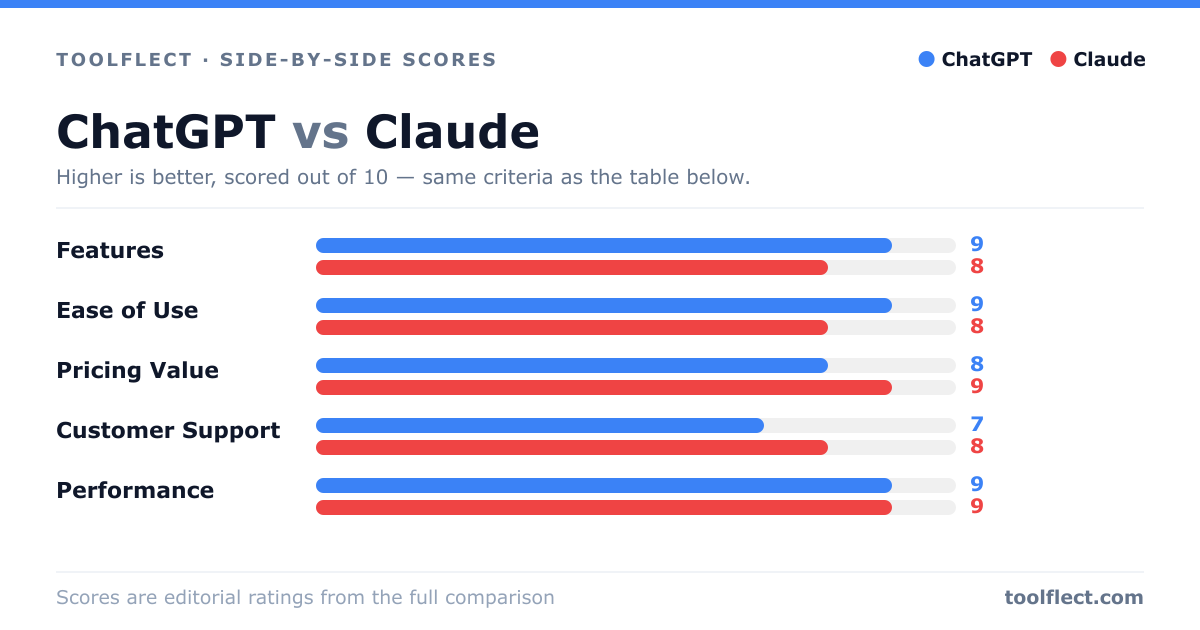
| Criterion | ChatGPT | Claude |
|---|---|---|
| Features | 9/10 – Extensive capabilities including plugins, browsing, and image generation. | 8/10 – Strong text processing, but fewer plugins and no image generation. |
| Ease of Use | 9/10 – Intuitive interface, widely used, many tutorials. | 8/10 – Clean interface, but less familiar to new users. |
| Pricing Value | 8/10 – Free tier available; paid plans offer good value. | 9/10 – Generous free tier, competitive pricing. |
| Customer Support | 7/10 – Support via help center and community forums. | 8/10 – Responsive support, but limited channels. |
| Performance | 9/10 – Fast and accurate, but can be verbose. | 9/10 – High accuracy, especially in long-form tasks. |
FAQ
Which has a larger context window, ChatGPT or Claude?
Claude. Claude 3 models accept up to 200k tokens of context, while ChatGPT reaches 128k tokens with GPT-4 Turbo. A larger window matters most when you need to paste long documents, contracts or a codebase into a single prompt.
How much do ChatGPT Plus and Claude Pro cost?
Both cost 20 USD per month. ChatGPT also offers a free tier on GPT-3.5 with limited GPT-4o access, Teams at 25 USD per user per month, and custom Enterprise pricing. Claude offers a free tier on Claude 3 Haiku, Claude Pro at 20 USD per month for Sonnet and Opus, and a Team plan at 25 USD per user per month.
Do ChatGPT and Claude both accept images?
Yes. ChatGPT processes images in GPT-4 and GPT-4o, and every Claude 3 model can analyze images as well. Both tools also accept file uploads such as PDFs and text files for analysis.
Does Claude have internet browsing like ChatGPT?
No. ChatGPT Plus and Teams include built-in browsing, while Claude Pro has no native browsing and needs the API to reach the web. That is the clearest functional gap between the two for research-heavy tasks.
Which is better for long documents and summarizing?
Claude. Its 200k context window and emphasis on long-form reasoning make it the stronger choice for summarizing lengthy reports, and it tends to answer more concisely. ChatGPT remains the more versatile all-rounder for coding, brainstorming and integration-heavy workflows.
Is there a free version of each tool?
Yes, both have free tiers. ChatGPT’s free tier runs GPT-3.5 with limited GPT-4o access and applies usage limits. Claude’s free tier uses Claude 3 Haiku and is generally described as generous. You need a paid plan to reach each tool’s top models.