Google Gemini vs Mistral: Which AI Chatbot Wins?
Overview
Google Gemini and Mistral are two of the most prominent AI chatbot platforms in 2025, each offering unique strengths. Gemini, developed by Google, is a multimodal model integrated deeply with Google’s ecosystem, excelling in understanding images, audio, and text. Mistral, on the other hand, is an open-weight AI model known for its efficiency, transparency, and developer-friendly approach. This comparison examines their key differences to help you choose the right tool.
Key Features Comparison
- Multimodality: Gemini natively processes text, images, audio, and video; Mistral primarily focuses on text but supports some image inputs via integrations.
- Context Window: Gemini offers up to 1 million tokens; Mistral has up to 128k tokens (32k standard).
- Open Source: Mistral is available under an open license (Apache 2.0), while Gemini is proprietary.
- Integration: Gemini integrates with Google Workspace (Docs, Gmail, etc.); Mistral offers APIs and can be self-hosted.
- Language Support: Both support multiple languages, but Gemini has broader multilingual coverage.
- Customization: Mistral allows fine-tuning and local deployment; Gemini offers limited customization via API parameters.
Pros & Cons
Google Gemini
- Pros: Superior multimodal capabilities; huge context window; seamless integration with Google services; strong factual accuracy.
- Cons: Proprietary and expensive for heavy use; limited offline functionality; dependent on Google infrastructure.
Mistral
- Pros: Open-source and free to use; high efficiency on consumer hardware; strong privacy (self-hosting); active community.
- Cons: Smaller context window; weaker non-text capabilities; less refined instruction following; requires technical setup.
Pricing Comparison
- Google Gemini: Free tier (limited queries) and paid plans via Google AI Studio or Vertex AI (pay-per-use). API costs vary, typically $0.001–$0.002 per 1k tokens for input/output. Enterprise plans available.
- Mistral: Free and open-source models can be run locally at no cost. Commercial API through Mistral AI: pay-per-use (around $0.0001–$0.0004 per 1k tokens). Self-hosting eliminates token costs.
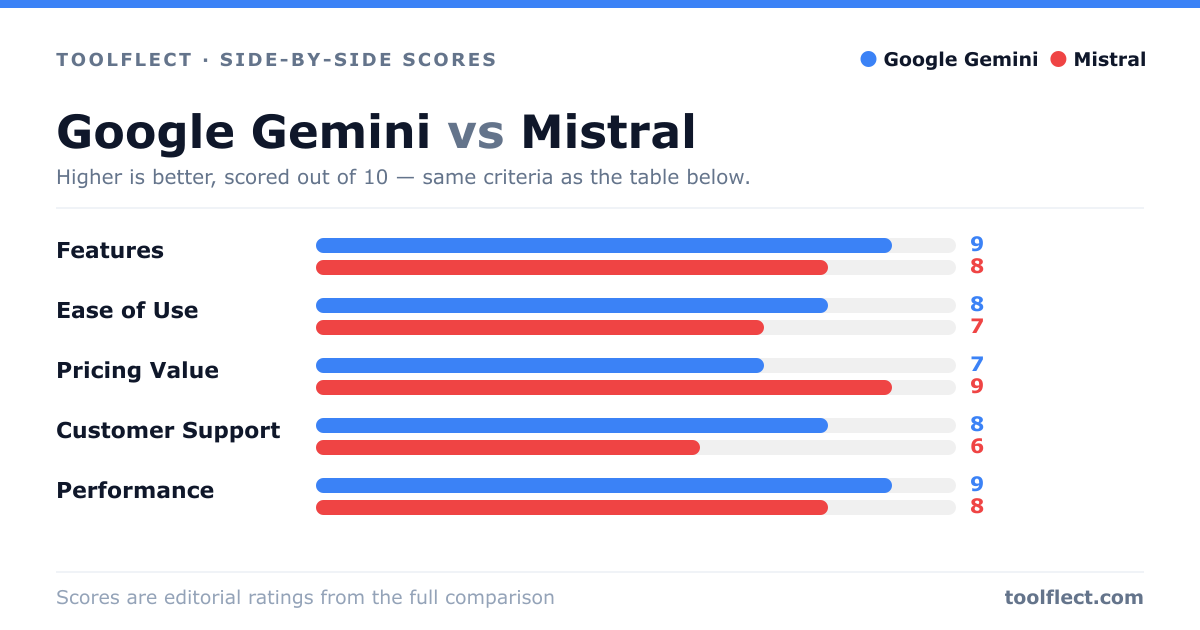
Overall, Mistral offers lower cost for scaling, while Gemini provides more features at a higher price point.
Best Use Cases
- Google Gemini: Content creation requiring multimodal analysis; enterprise workflows integrated with Google Workspace; research with long documents; creative tasks (image/video understanding).
- Mistral: Privacy-sensitive applications; startups needing affordable AI; custom model fine-tuning for niche domains; offline or edge deployments; developer tools and automation.
Verdict
Choose Google Gemini if you need a powerful, all-in-one assistant with broad modality and seamless Google integration, and you’re willing to pay for premium capabilities. Choose Mistral if you prioritize cost, transparency, customization, and data privacy, and have the technical expertise to leverage its open architecture.
Visual Comparison