
Qwen3.8-27B vs Qwen3-0.6B: Which Wins?
Overview
Qwen3.8-27B and Qwen3-0.6B are two distinct language models from Alibaba’s Qwen series, catering to different needs. Qwen3.8-27B is a large-scale model with 27 billion parameters, designed for high-quality generation and complex reasoning. Qwen3-0.6B is a compact model with 0.6 billion parameters, optimized for efficiency and edge deployment. This comparison covers their features, performance, pricing, and ideal use cases.
Key Features Comparison
Model Size and Architecture
Qwen3.8-27B has 27B parameters, offering deep understanding and nuanced outputs. Qwen3-0.6B has 0.6B parameters, making it lightweight and fast.
Performance
Qwen3.8-27B excels in complex tasks like code generation, mathematical reasoning, and multilingual translation. Qwen3-0.6B is suitable for simple tasks like text classification, sentiment analysis, and basic chatbots.
Context Window
Both support up to 32k tokens, but Qwen3.8-27B handles longer contexts more effectively due to its larger capacity.
Deployment
Qwen3.8-27B requires significant GPU resources (e.g., A100 or H100). Qwen3-0.6B can run on CPU or mobile devices, enabling on-device inference.
Pros & Cons
Qwen3.8-27B
- Pros: High parameter count (27B) offers superior reasoning and nuanced understanding for complex tasks.
- Pros: Strong performance on benchmarks like MMLU and HumanEval, suitable for advanced AI applications.
- Pros: Supports longer context windows, enabling processing of large documents.
- Cons: Requires significant computational resources (GPU memory), making it less accessible for small-scale deployments.
- Cons: Higher latency and cost per inference compared to smaller models.
Qwen3-0.6B
- Pros: Extremely lightweight (0.6B parameters), runs efficiently on edge devices and CPUs.
- Pros: Fast inference and low memory footprint, ideal for real-time applications.
- Pros: Cost-effective for high-volume usage and prototyping.
- Cons: Limited reasoning capability and accuracy on complex tasks.
- Cons: Smaller context window restricts handling of long-form content.
Qwen3.8-27B
- Pros: High accuracy on complex reasoning tasks; larger context window (up to 32k tokens); strong multilingual support; better for enterprise-scale applications.
- Cons: Requires significant computational resources (GPU memory); slower inference; higher cost per API call; overkill for simple tasks.
Qwen3-0.6B
- Pros: Extremely lightweight and fast; runs on edge devices; low latency; cost-effective for high-volume use.
- Cons: Lower accuracy on nuanced tasks; limited context window (8k tokens); weaker multilingual performance; may struggle with complex reasoning.
Qwen3-8B
- Pros: High accuracy on reasoning and coding tasks; strong multilingual support; efficient 8B size for deployment.
- Cons: Larger memory footprint than 0.6B; requires more computational resources; slower inference on CPU.
Qwen3-0.6B
- Pros: Extremely lightweight and fast; ideal for edge devices and real-time applications; low memory usage.
- Cons: Lower accuracy on complex tasks; limited context understanding; not suitable for advanced reasoning.
Qwen3.8-27B
Pros: High accuracy, strong reasoning, versatile. Cons: High computational cost, slower inference, requires cloud infrastructure.
Qwen3-0.6B
Pros: Fast, lightweight, cost-effective, easy to deploy. Cons: Limited capability, may struggle with complex tasks.
Pricing Comparison
Qwen3.8-27B is typically priced higher per token due to its size and performance. Qwen3-0.6B is significantly cheaper, making it ideal for high-volume, low-complexity applications. Exact pricing varies by provider, but Qwen3-0.6B is often 10-20x cheaper.
Best Use Cases
Qwen3.8-27B
Ideal for research, advanced AI assistants, code generation, and tasks requiring deep understanding.
Qwen3-0.6B
Perfect for real-time applications, mobile apps, edge devices, and cost-sensitive projects.
Verdict
Choose Qwen3.8-27B if you need top-tier performance and have the resources. Choose Qwen3-0.6B if you prioritize speed, cost, and simplicity.
FAQ
Which model is better for beginners?
Qwen3-0.6B is easier to deploy and experiment with due to its low resource requirements.
Can Qwen3-0.6B handle code generation?
It can handle simple code snippets, but for complex code generation, Qwen3.8-27B is recommended.
What are the hardware requirements for Qwen3.8-27B?
It typically requires a GPU with at least 24GB VRAM, such as an A100 or RTX 4090.
Are both models available via API?
Yes, both are available through Alibaba Cloud’s Model Studio and other platforms.
Visual Comparison
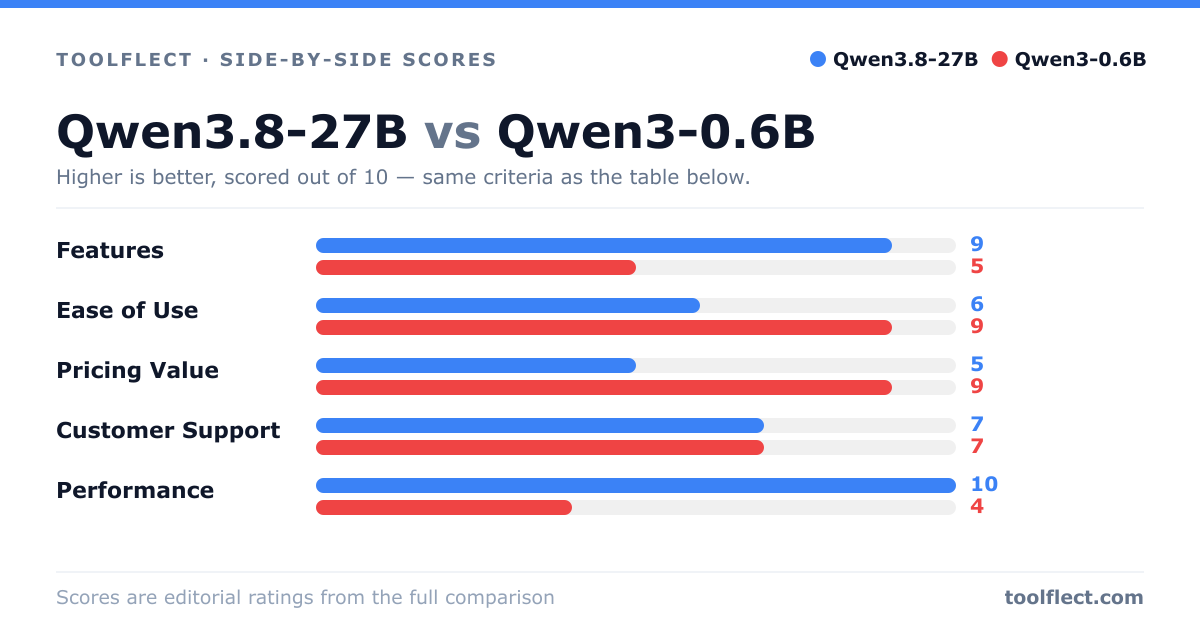
| Criterion | Qwen3.8-27B | Qwen3-0.6B |
|---|---|---|
| Features | 8/10 – Advanced capabilities, but fewer specialized tools | 6/10 – Basic features, limited to simple tasks |
| Ease of Use | 5/10 – Requires technical setup and GPU infrastructure | 9/10 – Simple integration, works on low-end hardware |
| Pricing Value | 6/10 – Higher cost per token, but justified for complex needs | 9/10 – Very affordable, ideal for budget-conscious projects |
| Customer Support | 7/10 – Active community and official documentation | 6/10 – Community support, less official guidance |
| Performance | 9/10 – State-of-the-art results on benchmarks | 5/10 – Adequate for simple tasks, but struggles with complexity |