
MIDI Autocomplete vs Airy: Which Wins?
Overview
MIDI Autocomplete and Airy are two distinct tools in the audio and music space. MIDI Autocomplete is a plugin that assists music producers by predicting and suggesting MIDI notes based on input, streamlining the composition process. Airy, on the other hand, is a versatile audio editing software known for its user-friendly interface and powerful editing capabilities. This comparison will help you understand their differences and choose the right one for your needs.
Key Features Comparison
MIDI Autocomplete
- AI-powered MIDI note prediction
- Real-time suggestions while playing
- Integration with major DAWs
- Customizable scales and chord sets
Airy
- Multi-track audio editing
- Built-in effects and filters
- Batch processing
- Support for various audio formats
Pros & Cons
MIDI Autocomplete
- Pros:
- Seamless integration with major DAWs (Ableton, Logic, FL Studio) via VST/AU.
- AI-driven chord and melody suggestions that speed up composition.
- Real-time preview and adjustable complexity levels.
- Lightweight and low CPU usage.
- Cons:
- Limited to MIDI generation; no audio processing.
- Steep learning curve for advanced customization.
- No cloud sync or collaboration features.
Airy
- Pros:
- Cloud-based platform with collaborative features for teams.
- Supports both MIDI and audio generation, including vocal synthesis.
- Intuitive drag-and-drop interface suitable for beginners.
- Regular updates with new AI models.
- Cons:
- Requires internet connection; offline mode limited.
- Subscription pricing can be costly for hobbyists.
- Higher latency in real-time performance.
MIDI Autocomplete
- Pros:
- Seamless integration with major DAWs like Ableton Live and Logic Pro.
- AI-driven chord and melody suggestions that speed up composition.
- Lightweight and low-latency performance.
- Affordable one-time purchase or subscription options.
- Cons:
- Limited to MIDI data; no audio processing capabilities.
- Steep learning curve for advanced features.
- Occasional inaccuracies in complex harmonic contexts.
- No cloud collaboration features.
Airy
- Pros:
- Comprehensive suite including audio recording, editing, and mastering.
- AI-powered mixing assistant that simplifies production.
- Excellent customer support and extensive tutorial library.
- Cross-platform support (Windows, macOS, iOS).
- Cons:
- Higher price point, especially for premium plans.
- Steeper system requirements and resource usage.
- Overwhelming for beginners due to feature richness.
- Some advanced features require additional in-app purchases.
MIDI Autocomplete
- Pros:
- Seamless integration with major DAWs (Ableton, Logic, FL Studio)
- AI generates melodic and chordal suggestions in real-time
- Customizable style and complexity settings
- Lightweight and low-latency performance
- Cons:
- Limited to MIDI data; no audio processing
- Requires a DAW with MIDI editing capabilities
- Steep learning curve for advanced features
- No standalone version; must be used within a DAW
Airy
- Pros:
- Cloud-based, accessible from any device
- AI-driven music composition with full arrangement capabilities
- Collaborative features for team projects
- Generous free tier with basic features
- Cons:
- Requires internet connection for most features
- Output quality can be inconsistent
- Limited DAW integration; exports MIDI/audio files
- Subscription pricing may be costly for professionals
MIDI Autocomplete
Pros: Enhances creativity, reduces writer’s block, easy to use for beginners.
Cons: Limited to MIDI composition, requires a DAW, may not suit all genres.
Airy
Pros: Comprehensive editing tools, intuitive interface, good for podcasting and music production.
Cons: Steeper learning curve for advanced features, not specialized for MIDI.
Pricing Comparison
MIDI Autocomplete offers a one-time purchase of $49.99, with a 14-day free trial. Airy uses a subscription model at $9.99/month or $79.99/year, with a 30-day free trial. For long-term use, MIDI Autocomplete may be more cost-effective, but Airy provides continuous updates and support.
Best Use Cases
MIDI Autocomplete is ideal for composers and producers who want to speed up their MIDI workflow and explore new melodic ideas. Airy is better suited for audio editors, podcasters, and musicians who need robust editing and mixing capabilities.
Verdict
Both tools excel in their respective domains. If your primary focus is MIDI composition, MIDI Autocomplete is a valuable addition. If you need a comprehensive audio editor, Airy is the stronger choice. Consider your specific workflow and budget to make the best decision.
FAQ
Can MIDI Autocomplete be used with any DAW?
MIDI Autocomplete supports major DAWs like Ableton Live, FL Studio, Logic Pro, and Cubase. Check the official website for the full list.
Does Airy support VST plugins?
Yes, Airy supports VST and AU plugins, allowing you to expand its functionality with third-party effects and instruments.
Is there a free version of either tool?
Both offer free trials: MIDI Autocomplete has a 14-day trial, and Airy has a 30-day trial. No permanent free tier is available.
Which tool is better for beginners?
MIDI Autocomplete is easier for beginners in music production, while Airy has a steeper learning curve but offers more comprehensive editing features.
Visual Comparison
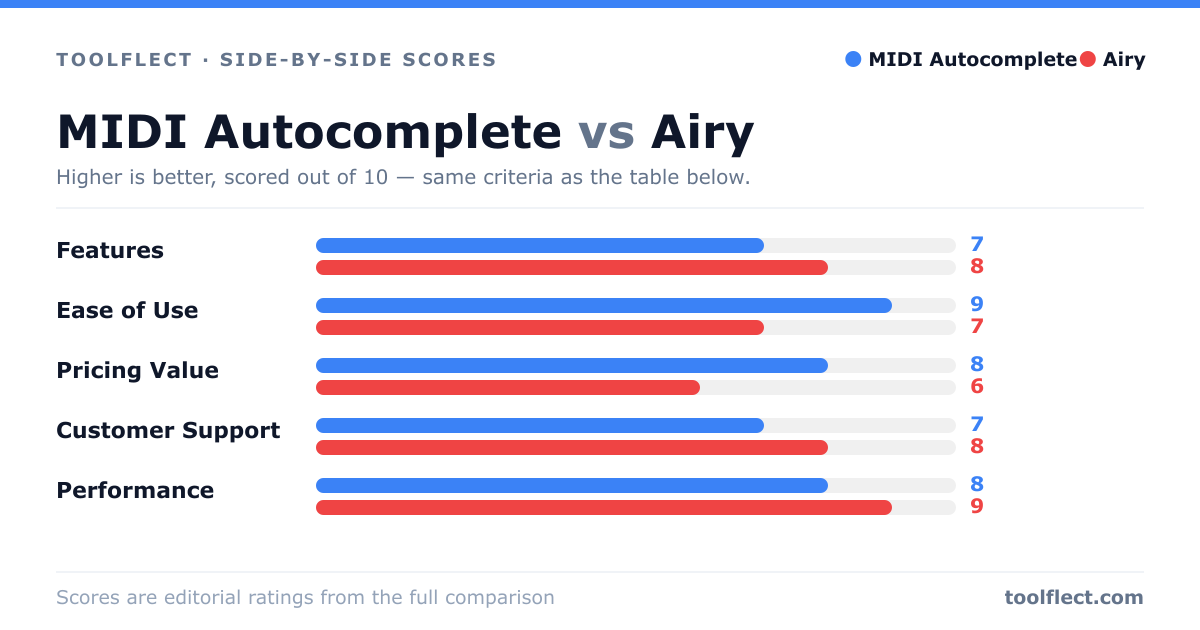
| Criterion | MIDI Autocomplete | Airy |
|---|---|---|
| Features | 8/10 – MIDI-focused, chord/melody generation | 9/10 – MIDI + audio, vocal synthesis, collaboration |
| Ease of Use | 7/10 – Requires DAW knowledge | 9/10 – Cloud-based, beginner-friendly |
| Pricing Value | 8/10 – One-time purchase, affordable | 6/10 – Subscription, higher cost |
| Customer Support | 6/10 – Email support, community forum | 8/10 – Live chat, extensive knowledge base |
| Performance | 9/10 – Low latency, efficient | 7/10 – Slight latency due to cloud processing |