
Writesonic vs Rytr: Which AI Writing Tool Wins in 2026?
Overview
Writesonic and Rytr are two popular AI-powered writing assistants designed to help content creators, marketers, and businesses generate high-quality copy quickly. Both leverage advanced language models to produce blog posts, ads, emails, and more. However, they differ in features, pricing, and target audiences. This comparison will help you decide which tool aligns best with your requirements.
Key Features Comparison
- Content Generation: Writesonic offers a wide range of templates (80+) including long-form articles, landing pages, and product descriptions. Rytr provides 40+ use cases, focusing on short-form content like emails, social media posts, and ad copy.
- AI Models: Writesonic uses GPT-4 and other advanced models, while Rytr uses its proprietary model based on GPT-3.5. Writesonic generally produces more nuanced and longer content.
- Language Support: Both support multiple languages, but Writesonic supports 30+ languages, Rytr supports 30+ as well.
- Plagiarism Checker: Writesonic includes a built-in plagiarism checker in higher plans; Rytr does not offer this feature.
- SEO Tools: Writesonic integrates with Surfer SEO for optimization; Rytr has basic SEO features like keyword suggestions.
- Collaboration: Writesonic offers team collaboration features in higher tiers; Rytr has limited collaboration options.
- Browser Extension: Rytr has a Chrome extension for quick writing; Writesonic does not offer a dedicated extension.
Pros & Cons
Writesonic
- Pros: Advanced AI models (GPT-4, Claude) for high-quality content; extensive templates and tools (e.g., SEO, paraphrasing); integrates with Surfer SEO for optimization; offers a generous free trial.
- Cons: Can be expensive for heavy usage; learning curve for advanced features; occasional inaccuracies in long-form content; customer support response times can vary.
Rytr
- Pros: Affordable pricing with a free plan; simple and intuitive interface; supports multiple languages; good for short-form content like emails and social posts.
- Cons: Limited advanced features compared to Writesonic; output quality may be lower for complex content; fewer integrations; no built-in SEO tools.
Writesonic
- Pros: Advanced AI models (GPT-4, Claude) for high-quality content; extensive template library; includes SEO tools and integrations; offers a free trial.
- Cons: Can be expensive for high-volume use; learning curve for advanced features; some outputs may require editing.
Rytr
- Pros: Affordable pricing with a generous free plan; simple and intuitive interface; supports multiple languages; good for short-form content.
- Cons: Limited advanced features; output quality may be inconsistent; fewer integrations compared to Writesonic.
Writesonic
- Pros: Advanced AI models (GPT-4, Claude) for high-quality content; extensive templates and tools (e.g., SEO, paraphrasing); integrates with Surfer SEO for optimization.
- Cons: Can be expensive for heavy users; learning curve due to many features; occasional inaccuracies in long-form content.
Rytr
- Pros: Affordable pricing with generous free plan; simple and intuitive interface; supports multiple languages and use cases.
- Cons: Output quality may be lower for complex content; limited advanced features; no built-in SEO tools.
Writesonic
- Pros: Superior content quality, long-form capabilities, SEO integrations, plagiarism checker, more templates.
- Cons: Steeper learning curve, higher pricing, no browser extension.
Rytr
- Pros: Affordable, user-friendly interface, browser extension, good for short-form content.
- Cons: Limited long-form quality, fewer templates, no plagiarism checker.
Pricing Comparison
Writesonic offers a free plan with limited credits, then paid plans start at $20/month (annual) for 100k words. Rytr has a free plan with 10k characters/month, and paid plans start at $9/month (annual) for 50k characters. For heavy usage, Writesonic can become more expensive, but it offers more advanced features.
Best Use Cases
- Writesonic: Best for content agencies, SEO-focused marketers, and businesses needing high-quality long-form articles, landing pages, and ad copy.
- Rytr: Ideal for freelancers, small businesses, and individuals who need quick, affordable short-form content like emails, social media posts, and product descriptions.
Verdict
Choose Writesonic if you prioritize content quality, long-form writing, and SEO tools, and are willing to invest more. Choose Rytr if you need a budget-friendly tool for short-form content and value simplicity and convenience. Both are excellent, but your specific needs will determine the winner.
FAQ
Which tool is better for long-form content?
Writesonic is better for long-form content due to its advanced AI models and dedicated long-form editor.
Can I try both tools for free?
Yes, both offer free plans with limited credits, allowing you to test their features before committing.
Do both tools support multiple languages?
Yes, both support over 30 languages, making them suitable for global content creation.
Which tool is more affordable?
Rytr is more affordable, with plans starting at $9/month, while Writesonic starts at $20/month.
Visual Comparison
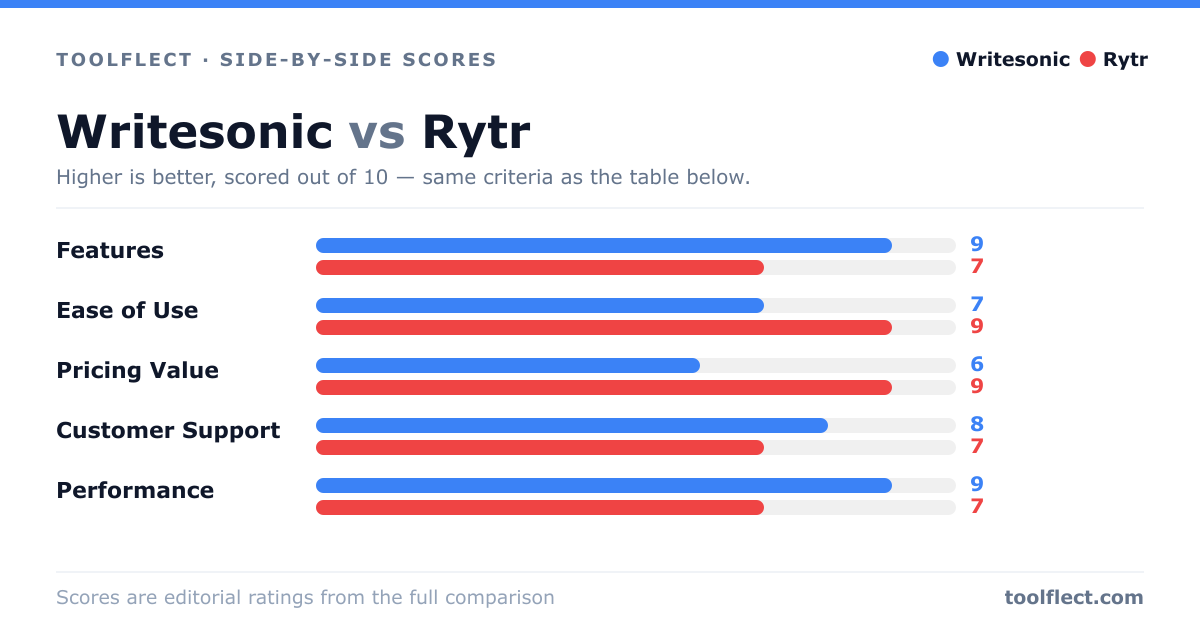
| Criterion | Writesonic | Rytr |
|---|---|---|
| Features | 9/10 – Extensive templates, AI models, SEO tools | 6/10 – Basic templates, limited advanced features |
| Ease of Use | 7/10 – Powerful but slightly complex | 9/10 – Very user-friendly, minimal learning curve |
| Pricing Value | 7/10 – Higher cost but feature-rich | 9/10 – Affordable with free plan, great value |
| Customer Support | 7/10 – Responsive but sometimes slow | 8/10 – Helpful support, quick responses |
| Performance | 9/10 – High-quality output for most tasks | 7/10 – Good for short-form, less consistent for long-form |