
Research Rabbit vs Tomesphere: Which AI Tool Wins?
Overview
Research Rabbit and Tomesphere are two innovative AI-powered platforms designed to streamline research and learning. Research Rabbit excels at visualizing academic literature networks and discovering relevant papers through interactive citation graphs. Tomesphere, on the other hand, focuses on deep document analysis and knowledge synthesis, enabling users to query and interrogate large collections of texts. Both tools aim to reduce the time researchers spend on manual literature searches and information digestion, but they approach this goal from different angles.
Key Features Comparison
- Research Rabbit: Visual citation mapping, personalized paper recommendations, collaborative collections, Zotero integration, and an intuitive graph interface.
- Tomesphere: Semantic search, AI chat with uploaded documents, automatic summarization, topic clustering, and cross-referencing capabilities across multiple sources.
- Shared: Cloud-based access, API for developers, and support for multiple document formats.
Pros & Cons
Research Rabbit
- Pros:
- Visual citation graph helps discover related papers intuitively.
- Free to use with no subscription required.
- Collaborative features allow sharing collections with colleagues.
- Integrates with Zotero for reference management.
- Cons:
- Limited to academic literature; not suitable for general web content.
- No mobile app; web interface can be slow with large libraries.
- Lacks advanced analytics or citation metrics.
- Occasional bugs and sync issues reported by users.
Tomesphere
- Pros:
- AI-powered summarization and Q&A over uploaded documents.
- Supports multiple formats (PDF, DOCX, etc.) and large files.
- Collaborative workspaces for team research.
- Offers a free tier with limited features.
- Cons:
- Pricing can be high for premium plans.
- Accuracy of summaries may vary with complex documents.
- Limited integration with external reference managers.
- Requires internet connection; no offline mode.
Research Rabbit
- Pros:
- Visual citation network helps discover related papers intuitively.
- Collaborative features allow sharing collections with teams.
- Free to use with no subscription fees.
- Integrates with Zotero for easy reference management.
- Cons:
- Limited to academic literature; not for general web content.
- Steeper learning curve for advanced features.
- Occasional performance lag with large collections.
- No mobile app for on-the-go access.
Tomesphere
- Pros:
- AI-powered summarization saves time on lengthy documents.
- Supports multiple formats including PDFs and web pages.
- Collaborative workspace with real-time editing.
- Offers a free tier with basic features.
- Cons:
- Advanced AI features require a paid subscription.
- Less focused on academic research; more general-purpose.
- Summaries may lack nuance for complex topics.
- Limited integration with reference managers.
Research Rabbit
- Pros:
- Visual citation graph helps discover related papers intuitively.
- Collaborative features allow sharing collections with teams.
- Free to use with no subscription fees.
- Integrates with Zotero for reference management.
- Cons:
- Limited to academic literature; not for general web content.
- No mobile app; desktop browser only.
- Steep learning curve for new users.
- Occasional slow loading with large collections.
Tomesphere
- Pros:
- AI-powered summarization of research papers saves time.
- Supports multiple document formats (PDF, DOCX, etc.).
- Collaborative workspace with real-time editing.
- Advanced search filters for precise results.
- Cons:
- Pricing plans can be expensive for individuals.
- Limited free tier with restricted features.
- No offline access; requires internet connection.
- AI summaries may miss nuanced details.
Research Rabbit
- Pros: Excellent for exploring research fronts; interactive visuals facilitate serendipitous discovery; free for academics; lightweight interface.
- Cons: Limited document management; no direct Q&A with full texts; narrower scope beyond academic papers.
Tomesphere
- Pros: Powerful AI analysis of lengthy documents; chat interface for natural language queries; robust summarization and synthesis; suitable for interdisciplinary research.
- Cons: Steeper learning curve; subscription costs can be high; less focused on citation networks.
Pricing Comparison
Research Rabbit offers a freemium model, with a free plan for researchers and students, and premium features at around $12/month. Tomesphere provides a free trial but generally starts at $20/month for individuals, with team plans at higher prices. Both have annual discount options, but Tomesphere’s entry tier is more expensive.
Best Use Cases
- Research Rabbit: Ideal for early‑stage literature reviews, exploring citation networks, and keeping up with recent publications in a field.
- Tomesphere: Best suited for deep dives into large PDFs or collections, systematic reviews, and extracting insights from unstructured text.
Verdict
Both tools are powerful, but they serve different needs. If your primary challenge is finding and mapping related papers, Research Rabbit’s visual discovery is unmatched. If you need to analyze and synthesize content within documents, Tomesphere’s AI chat and summarization features give it a clear edge. Consider your research workflow and budget when deciding, as both can significantly enhance productivity.
Visual Comparison
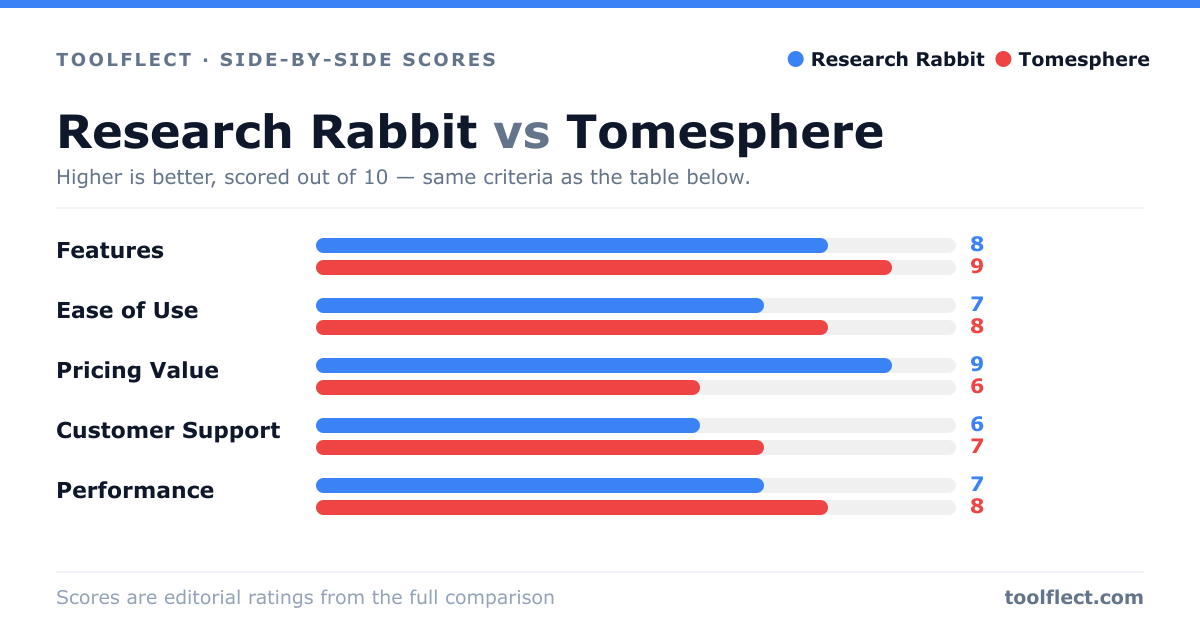
| Criterion | Research Rabbit | Tomesphere |
|---|---|---|
| Features | 8/10 – Citation graph, collections, Zotero integration | 9/10 – AI summarization, Q&A, team workspaces |
| Ease of Use | 7/10 – Intuitive but can be slow with large libraries | 8/10 – Clean interface, but learning curve for advanced features |
| Pricing Value | 9/10 – Free, excellent value | 6/10 – Free tier limited, premium costly |
| Customer Support | 6/10 – Community support, slow response | 7/10 – Email support, knowledge base |
| Performance | 7/10 – Reliable but occasional bugs | 8/10 – Fast processing, but accuracy varies |